

The Human Experience · Episode
Episode 126 – Massimo Pigliucci – Stoicism, Virtue & thriving in a world out of control
A conversation with Massimo Pigliucci
Massimo Pigliucci is a scientist, skeptic, and philosopher, who in recent years has written a number of books on Stoicism. He earned a PhD in Philosophy from the University of Tennessee, and is the K.D. Irani Professor of Philosophy at The City College of New York.
Stay with the full conversation.
Episode field notes
Show notes
Massimo Pigliucci is a scientist, skeptic, and philosopher, who in recent years has written a number of books on Stoicism. He earned a Ph.D. in Philosophy from the University of Tennessee and is the K.D. Irani Professor of Philosophy at The City College of New York. He also has a background in biology, with a PhD in Evolutionary Biology from the University of Connecticut.
He has had articles published in a number of publications, such as Philosophy Now and The New York Times. He has also given a TEDx talk titled Stoicism as a philosophy for an ordinary life.

In this episode we spoke to Massimo on how to live a better life through the application of stoic philosophies.
You will love this episode!
Find Massimo and buy his book Visit amazon.com.
We rely on listener support to keep this show AD FREE – If you value even one of our shows, help us sustain and scale the show up; Become a member for 5$/mo (a cup of coffee) or Donate.
Read the conversation
Transcript
Welcome to the human experience podcast the only podcast designed to fuse your left and right brain hemispheres and feed it the most entertaining and mentally engaging topics on the planet as we approach our ascent please make sure your frontal temporal and occipital lobes are in their full upright position as you take your seat of consciousness relax your senses and allow us to take you on a chip we are the intimate strangers thank you
for listening [Music] friends thank you so much for being here we had a couple stream issues after a short break of not doing any podcast we are finally back and live-streaming we’ve changed the format and yes it’s and it’s just me behind the wheel so if you feel some bumps that’s that’s why it’s just our first show back but sit back relax grab a drink enjoy this conversation with my guest my guest this week is Massimo Pigliucci he is a
scientist skeptic and philosopher who in recent years has written a number of books on stoicism he earned a PhD in philosophy from the University of Tennessee and is the Cady Irani professor of philosophy at the city of College of New York he also has a background in biology with a PhD in evolutionary biology from the University of Connecticut Massimo what a list of credentials you have my good sir welcome to hxp yes
indeed and we were we were talking a little bit about this about the show and I mean we were running into some issues it’s a perfect way to bring in what stoic philosophy is and what stoicism encompasses can you tell us a little bit about so what is stoicism well we experienced a classic situation where I think one of the fundamental concepts of stoicism is something called the dichotomy or control which essentially tells you or reminds you of the fact
that some things under your control and other things are not in your control and that you as a consequence it’s logical to focus on the things that are under your control and then take the rest as it comes if you can influence it for the better good and if not that’s that’s okay you have to make peace of it with it so for instance you know we just had as you know some technical difficulties first with my setup then yours hmm well
there are things we can do about of course you know right sorry I try to fix the bit on my part eventually we succeeded you try to fix the bed on your part and you eventually Disick’s it but while you were working on your bars it was absolutely nothing I could do other than just wait now some people might get upset or nervous or you know start filling around or something mike is like well if it’s gonna happen it’s gonna
happen if it’s not gonna happen it’s going to happen another day for sure it’s not a tragedy right now at the end of the world if we can make this happen today great if not we will find something else so this is a classic example of you know many many times in life you know almost on a daily basis we’ve run across things that you know small or or big that are going to frustrate us or that make us angry or that make us you know disappointed and
things like that but if you train yourself to always everything you do think in terms of the background control you always ask yourself the first question you ask yourself is well is this under my control if the answer is yes then okay well what can I do about it mm-hmm no it’s like well then sit back and relax because there’s nothing else you can do mm-hmm yeah for sure I mean there’s and this is why I think I connect with what stoicism teaches so
much is because you know most most of the things external to us are completely out of our control like we’re not we’re not able to manage the emotions and feelings of other people we can’t imagine I mean and life life tends to throw you know curveballs at us and we just we sort of just have to adapt to those things and I think this is where the the strongest part of stoicism is is it it kind of teaches you how to do that
that’s right the thing that’s important when were to keep in mind is this isn’t a question of you know saara quietest philosophy it’s not oh well there’s nothing I can do about it therefore I’m just not going to do anything it’s if it were just that then it would be a losing proposition because that means that you would just disengage from everything that you’re not guaranteed to succeed to succeed the the approach is there from
approach is to try to keep in mind where your locus of action is where is it that you’re going to be more effective in tackling a particular problem and focus your energy there the other side of that approach of the economic is that what you cannot control you should develop an attitude of equanimity officers accepting with serenity what’s going what’s going to happen this is actually very similar to concepts that are found in other traditions including
in 8th century Buddhism and medieval Judaism and also in Christianity simulations may have heard of the serenity prayer which is a standard prayer it’s a 23rd century Christian prayer that is used at the beginning of a a meetings or similar 12-step organizations and of course I never remember on the spot how exactly the prior goes but essentially it is asking God to allow you to make the distinction between what is under your control and
what is not in your control having the patience and fortitude to withstand you know to accept once and on your controlling the courage to actually change what it is under your control it’s essentially the same same concept as in stoicism and it’s not by chance because as it turns out the most famous rendition of this dichotomy of control is found at the beginning of epictetus enchiridion the enchiridion is kind of a short
manual for how to live your life which was written in the second century and after the end of the Roman Empire when Christianity basically took over throughout the Middle Ages the enchiridion was actually used by Christian monks as a training man the only difference with your original is that every time that the very big pillars was talking about Socrates as an example the good Christian monks replaced the word Socrates with the word
Jesus but other than that it’s the same thing so it’s no surprise that we actually find the same concept in a number of different traditions including the Christian one which has been highly influenced by by stories when I you know when I think of someone who is stoic in mainstream culture I think of Spock from Star Trek that’s how I think of when I think of someone who is sort is it so is it I mean just to clarify this is it is it
suppressing your emotions that’s not what stoicism is is it no it isn’t and in fact because action of most practicing stoic cies is to tell you that note isn’t like spock at all but it’s actually not quite that easy because despite the fact that spark is supposed to be suppressing emotions if you actually pay attention to the original series and to enter the various movies based on the original series you will see this that spark does have a
motion they had positive of their positive emotions however he loves his friends for instance love is an emotion he says several times several times that is a close friend of Captain Kirk and dr. McCoy he clearly cares about knowledge and science he also very clearly cares about justice and ethics right and in one of the movies he actually sacrifices himself saying that you know the the benefit of the many out to outweigh the benefits of
the one well all of those actually positive emotions so despite sparks own for the stations that it doesn’t have emotions and then he wants to control emotions that’s not quite what he’s doing what he’s doing is to controlling the negative emotions and disruptive emotions things like anger hatred fear those are the emotions that are really not good for you and that pretty much is the stoic attitude stoicism is not about
surprising emotions but rather in a sense to sort of reorient our emotional spectrum away from negative disruptive emotions such as hatred fear and and you know and and anger especially and towards the express cultivation of positive emotions such as love joy sense of justice so so in a sense there is something true about the stereotype accept but of course like every stereotype it only gets things half right or a border right not enough of
the treasure the other part of the stereotype that is typical when people use the word stoic in the sort of the common meaning as opposed to the philosophical one is that stories are often envisioned as going through life of a stiff upper lip well and so therefore being you know particular particular fun to hang around with that’s also not true of course Stoics do alter things that everybody else does in fact Seneca one of the major Roman Stoics explicitly
says that sometimes you just have to let it go go dancing go for a walk enjoying wine evening to intoxication that doesn’t sound like somebody who’s not having fun really but the right the right part the correct part of the stereotype is that in fact endurance is in fantastic value the notion is that we should endure what we cannot control what we’re going back now to the dichotomy of control then we started with sure if something is none of the
inventory if you cannot do anything about it then you only have two choices really either you endure it and try to sort of get over these particular hump in your life or you can start and get upset what makes it work which simply makes it work yeah that’s right it doesn’t actually prove things in fact it makes it more so makes you feel force and probably because that kind of strong emotional reaction clouds your judgment
it actually makes things also of course in a practical sense yeah I mean if I think of any time where I’ve been in a situation where things are out of my control whenever I make the choice to sort of react or bite into those emotions it just makes it tremendously worse I mean and whether it’s you know fight with a friend or something that’s going on like I was traveling last week and it was it was like mini disaster after me you know
like just putting out these various fires and if you find yourself in this state of panic when that’s happening it merely makes the situation that much that much worse so there’s so much there’s so much to be said about the power of stoicism and having that as you said this a sort of meter on your your emotions and being aware of them and and honing out you know the the negative versus the positive and being selective
about that yeah how do you do that because you know the theory is it’s pretty clear I mean you can I can explain story theory in the basic story theory in a few minutes and if you really want to get into the details we need a few hours but no more than that so it’s not that difficult it’s the practice of course that is that it’s difficult but but let me tell you a couple of things about this first of all it’s not surprising that
the practice is difficult I mean imagine a complete different kind of situations which are where the Stoics did use as an analogy of them to explain their flaws they say you know imagine your little gym and you know you call up a somebody a trainer and the trainer explains to you the theory of you know how to do your exercises it’s not rocket science you you can listen the trainer and understand what he’s saying and a
few minutes you get the gist of it but that doesn’t mean that you in a few minutes you’re gonna grow muscles and and and eliminate fat right that’s gonna take hours and hours and days and days and then monks and moms and eventually years and years of practice it’s the same with a philosophy of life what it’s always more Christianity or Buddhism or anything else the theory is not that difficult the practice become it takes
you no time you get better only only with time now there are certain some basic techniques some basic ways of doing this and one of them has been proposed by a modern stoic actually Bill or vine who is publishing about the publish actually a new book called the stoic challenge which is gonna come up and come out in in September and bill says ok so every time you go through a situation like the one you were talking about at the airport things that you’re
on vacation will try this little mental trick hmm imagine that you think okay so this this is the Stoics God are sending me a test they’re testing me they want to know how I’m doing under these conditions and so forth the duration of the test which is of course the duration of whatever problem you have to actually tackle you’re gonna keep mental scores with yourself about so how am i doing am i reacting with anger in my intro
reasonably am I making progress am I getting frustrated and so on and then at the end when the challenge is over you sort of sit down maybe even write it down and say so how do you guys do on this and the trick is of course it’s a mind trick right but my tricks are crucial I mean this this is how we actually live our lives among our lives of mental lives or in our actual the real life our is a number of mind tricks the way you
think about things completely changes the way you actually experience them and the way you react to them so every time you have a channel something happens it doesn’t go your way just say stop for a second and say to yourself either you know loudly if nobody’s around to listen to you or you know mentally it’s like ah here’s that here comes a challenge from this body cards and you don’t have to believe in story cards obviously bill everybody doesn’t believe
in Stan story gods and why it’s just a mental device and say okay here’s a challenge let me see how I do let me keep tabs on how I’m doing and then I’m gonna write a report to myself that’s the important parts of writing down things essentially doing what stories referred to as a philosophical diary it’s important because for one thing it allows you after the fact to analyze more commonly your own reactions and think about what went right and what
went wrong but also since you know you can do that you’re gonna actually self examine basically in writing then Seneca suggests you’re gonna be more careful about what you do because you’re not gonna lie to yourself if you have you know you’re gonna have to write things down you’re not gonna pretend that you did something different you know what you did and you’re gonna write it down so you’re gonna hold yourself accountable
essentially for your actions both okay so I mean there’s a lot to unpack there and I’m doing my best to say so I mean first of all you consider yourself a skeptic I mean you you listed yourself as a skeptic does that mean does that mean that you do this more more objectively I would say do this did the Stoics have a belief in God well in a sense yes but it needs to be really seriously qualified so the Stoics were from a modern perspective what we would
call pantheists that is they believed that God is in the universe in fact they believe that God is the universe God for the story is made of matter its physical and it is exactly the same thing as the universe I mean that they are pretty explicit about this if Bianca diogenes laërtius for instance which is one of the commentators on the early Stoics he says it’s basically the story called God the same as true the same as nature it’s the same same thing
so in a sense yes they did believe in God but it’s a it’s a God that it’s actually essentially embedded in the laws of the universe now one difference in in the way in which we moderns might think of the universe and the way the story started this is the destroys just like pretty much everybody in antiquity thought that the universe was a little kanessa mm-hm and therefore the universe was was doing whatever it is that it’s good for
itself okay so which are everything that happens in universe it’s good for the universe and we are bits and pieces of the universe so indirectly in a sense kind of us but not in the sense that the universe actually cares about us not that there is a God out there that decides you know what what’s gonna happen and what’s not gonna happen it’s just that the organism that the cosmic organism is doing things we are bits and
pieces of that cosmic organism and so just going on from the right if you will come up with an analogy to sort of explain what the a little bit better maybe before the concept is so sure I have like every like every human being we have you know hundreds actually billions of neurons in our brains right each one of those cells is part of me and I am the organism so I do whatever it is but it’s good for me so in this case I’m talking to you and then I have
dinner then I’m gonna go for a walk or something like that well my neurons don’t know what’s going but whatever I do is in a sense good for the neurons meaning that friends are part of me so they just they go along with the right did they do their part if I did not have neurons I couldn’t be talking to you I couldn’t be making decisions I couldn’t do anything okay so the relationship between my neurons and myself is pretty much the
relationship than the ancient stoic start there is between us and the universe where we are the neurons we are the cells so the individual cells can die in your sense can you know bad things can happen to any individual that can become they can die out that can become cancers or whatever it is but what happens when the needle sells is part of a way in which the organism has a whole reacts so that’s the way the ancients thought about it
most modern stories don’t believe that the universe is a living organism because you know modern physics tells us that things don’t work that way and so a modern stoic is more likely to accept what it’s called Einstein’s gods sometimes Stalin was famously asked you know do you believe in God and his reply was sure I believe in the laws of nature so God here is conceived as the fact that the universe has a rational structure if it did not have a rational
structure we couldn’t understand it with there would be no science possible so the universe does have still with me melsmel okay guys it looks like we might have hit a little bit of that bump that I warned you guys about earlier we’re gonna find out what happened to Massimo’s microphone so sorry masamori back okay we lost we lost massimo hang tight here guys just gonna bring our producer in – massimo you still with me
yes ok ok you dropped out for a little bit and and now you’re back ok alright so so the last thing I heard you dropped out around when you were talking about the nature of the universe and our interconnected nature – to Nate to nature the human connected to nature so yeah I think so but what do you pick up from there please ok so the analogy that I was making was that just as for the ancient Stoics God is the universe and
we have bits and pieces of it and we do our within that universe so in the same way that say my new Gran’s my little neurons don’t know that I’m a part that they are part of a living organism and I am the living organism I go around doing what it is that I need to do and the neurons just both go along for the ride and also make it possible to do things right so the way to look at at how the ancient Stoics thought about the relationship
between themselves and the universe is pretty much like the relationship between my neurons and myself we are part of these cosmic living organism now Lauren Stoics don’t believe most money storix there are exceptions don’t believe that the university is a living organism because you know we’ve just followed what whatever the physicists tell us and the physicist don’t think of the universe as a living organism mm-hmm
so in that sense a modern stoic is more likely to believe in what is sometimes referred to as Einsteins god einstein was famously asked at one point if he if he believed in God and his answer was sure I believe in the laws of nature and the meaning right sorry so many meaning that well I believe that the universe is organized in a logical manner because if it were not organized in a logical manner in a rational man wouldn’t understand it there would be no
science possible but where that rationalization comes from we don’t know physicists haven’t given any answers yeah so it’s just a fact of life itself it’s a wrong fact the universe is organized according to laws and principles and we act following those laws and principles so you do you think that this accordance to living in connection to nature I mean what position that does that put us in do you think it it it puts us in a place to
grow as people more if we’re connected to nature I think so but we need to be clear about what that phrase actually means in the story context so one thing it doesn’t mean is that we should go running naked into the forest and hacking trees that’s not what living according to nature means although of course there’s nothing wrong with that if you want to do it but the phrase itself just means that we should be taking seriously both the nature of
the universe and the nature of humanity of human beings okay still there yeah I’m here I’m here okay good because now I’m getting annoyed okay I know I got a little silent because I thought you’re gonna keep going the nature of the universe in the nature of humanity the universe means that we better live our lives following your understanding exactly how the laws of physics work if you try to do something that goes against the laws
of physics you’re gonna get yourself into trouble now you might say well who’s gonna be so silly to do something against the laws of physics and Mayans will be planning people for instance anybody who uses automatic medicine is doing something against the laws of physics he’s thinking that that I do red sugar essentially and water will cure disease that’s nonsense and a stoic would say now don’t do it because that means you
don’t understand the nature of the universe or I don’t know if you remember several years ago there was this very unfortunately highly successful book and DVD that came out was called the secret right yeah so the secret is based on an incorrect understanding of the universe essentially all right so so the circuit says that if you really want something if you really truly want something like you know a new job or a new relationship
or whatever it is then the universe will somehow Bend and and recognize that now it doesn’t work like that if an Epictetus 2,000 years ago you know almost 2,000 years ago explicitly wrote that it doesn’t work that why one of his students was complaining because he had a broken leg and a meat-eater says well what do you want that the universe just changes things around so that you’re breaking like it’s not broken yeah deal with it you got a broken leg
horse things can happen so so one level of the phrase living according to nature means just live your life according to best understanding of how the world actually works and not according to how you would want the world to work so it’s essentially it’s a it’s a way of saying don’t engaging in you know wishful thinking but the other the second part I think is even more important the one about human nature so the Stoics thought that there are two
fundamental aspects to human nature one is that we are eminently social organisms we can if we need to we can survive in isolation but we only thrive in social groups mean so we’re eminently social and the second component is that we are also capable of reason we’re the only animal or at least again knowing which reason has really achieved certain levels that are not found anywhere else in nature right from these two things
they concluded that therefore a good life for human being is a life in which you apply reason to improve social living okay so the meaning of life according to Stoics is precisely that and Marcus Aurelius says it explicitly in the meditation it says you know do whatever social reason demands and only whatever social reason demands because that’s the whole point the point of letting a human life is to be helpful to others make things better for everybody
which means of course making things better for yourself so someone let’s let’s just take a little bit of a pause you’re feeding us so much information which I love so much but I want to just I just want to backtrack a little bit and I want to cover you mentioned Marcus Aurelius I find his life fascinating I think I think it’s so interesting the story behind everything he was doing the position that he was in but I’ll let you
tell the story can you tell us more about Marcus Aurelius his and his life as an emperor and what he was doing when he wrote meditations we don’t know exactly which years but close to the end of his life and in fact he was on the frontier you’re fighting an eight-year long war against the Marcomanni and other German tribes these tribes had essentially tried to invade Roman territory in some negotiation the interesting bit actually
about this is that along a this was a defensive war that Marcus was was doing but if that it was a war that resulted on the fact that the America money actually wanted to be part of the room and sort of ecosystem they wanted to be able to trade as equal partners with the Romans and so there was some disagreement essentially on economics if you will and as often is the case when disagreements of economics cannot be resolved diplomatically then people
start you know taking a box so a Marcus family itself II did not want to wage war but he found itself in on the frontier in the end of his life and this is where he brought the meditations we know this for a number of reasons and for one thing because of his correspondence with some of his friends and associates but also because two chapters two volumes of the implementations actually explicitly say that they were bring in you know in the
fields and they give the location so we know where he was now Marcus had arrived there it was very interesting way so first of all it was one of the so-called five good emblems there was a period this was the peak of the Roman Empire the Roman Empire was its most peaceful as well as its most extensive during the reigns of these five emperors which included Adrian and inspires internal spires was Marcus adoptive father
okay so Adrianna fat had suggested to Antoninus to uh transpires that he should adopt Marcus because Adrian saw in Marcus the young Marcus somebody who had jobs he had what it took to become an emperor so Marcus was basically raised in under inspires household and you know Palace he was given instructions you know indication accordingly any study philosophy since he was very young he started with a number of philosophers
not just 2x looking at different philosophical approaches he also studied rhetoric he started number of a number of things but apparently since he was very young he stoicism is the thing that clicked with his historic teachers we’re the ones that made the most impression and he sorta try to start practicing stoicism to the point that his mother cup with worries because as a boy he started sleeping on the floor in order to in cinema in a mass poverty in
order yeah it’s right so to remind himself that he could cope with adversity and his mother said none of this nonsense now eventually after an appearance buyers died Marcus became Emperor in fact he became co-emperor he decided to share the Empire of Marcus Paris was not exactly the best you know Co Emperor but he did his job Ethiopia did okay and then at some point first died and Marcus became the sole Emperor in charge of everything this was
a trial you know a pretty difficult time as I said the five Emperor’s did oversee a time of peace and prosperity for the Roman Empire but when it came to Marcus she was pretty unlucky he had to face one war on the eastern frontier against the Parthians of what you know one of Rome’s regular standby enemies the second war later on as I mentioned on German frontier he also faced an internal rebellion these trusted lieutenants at some point declared
himself Emperor so they had to be dealt with and more importantly you have to deal with a plague that was brought back to run by the legions coming back from the east plague was the worst recorded in ancient history it probably killed between three and five million people hmm that’s a lot to deal with during during someone its wings and so what you see in the meditations is essentially Marcus coming to terms with all this stuff you know
how do you how do I do thanks how do I cope with the stress and the fact that some of my own people are betraying me upon his wife was not faithful either so that was another problem hunan that the meditation session essentially a personal diary where Marcus is made up of twelve books so but in fact it’s like it’s one book with 12 chapters really and in in each book you see my purse going over and over on the same themes in fact one of the
criticism that people have of the meditations is that it is repetitive and if then it’s preachy but that’s to be understood you know it’s of course it was repetitive it’s somebody’s diary first on diary presumably you you run into the same problems over and over so you write about the same problems over and as far as prejudice is concerned while he was fishing to himself it was it was telling himself he never meant to
my published like this was not as it was not his intention to publish this journal that he was writing for himself and right I mean you know he had you know he had anything at his disposal that he wanted he was Emperor you know so he had all the money that he wanted I mean people were bothering him for something every day so I mean what was something that Marcus said that sort of hit home with you like I think in a paraphrase I think he said something
like you know people will ask you for money today they will annoy you they will bother you and so I thought it was really amazing that this the posthumanist this this person has become you know such a almost a literary genius like you know like it’s putting out this this philosophy without the intention of doing that which is which gives it this whole other color and dimension that I find fascinating about his life you’re
thinking of my favorite quotes from from the meditations where he says you know start out remember you should start out every morning expecting that people are going to be nasty and treacherous and you know vile and so on and sports this was his normal sort of experience of the world he says I you know Don expect otherwise I mean to expect otherwise it’s like you know expecting a thing to be in flower in the winter to use actually metaphor
that comes out of evicting us it’s like that would be silly it would be irrational this is one of those things again then that goes back to the control with which we started in this conversation right so you don’t expect the people all of a sudden change and become great and good in everything you just deal with what they would take what the actual we are not with the way in which you want them to be but then he goes on in
the same the very same paragraph he says but you know remember you have also made mistakes you also be annoyed and you’ve also been you know creating problems from others and tell me that you know everybody does that that’s what they would they do because they think that they’re right I mean you know you rarely encounter somebody decided you’re bent on doing the wrong thing knowing that it’s the wrong thing people are in good
faith usually they they think that they’re doing what the right thing is they made me be stakin and they may be annoying as a result or creating problems as a result but you know you need to understand where they’re coming from and then funny says spelling the same paragraph in the same section he says regardless of all of this this should not touch you because what you can do is always through treating yourself and think about what is the
right thing to do and do it regardless of what other people think or regardless of what other people do it is up to you to do the right thing again this is another application of the economy control he’s saying look you don’t control what other people do but you do control how you react to that you do control what you do you do control your own judgments your own decisions to act or not so focus on does and you’ll be
fine so it’s it’s a very wise way of sort of approaching pushing problems many nations also starts out in dark first chapter in the meditation it’s called the first book as a surprise it’s a chapter the first chapter in the meditations really isn’t a long exercise in gratitude he starts out by saying I’m thankful to my father for my mother for that my grandfather for this my friends for this my teachers and so on and so
forth it’s a great example of literally as you were saying a minute ago the most powerful men in the Western world at the time that begins his own diary by reminding himself that he’s got that point of power and and in you know of prestige and everything because of countless people who would be good to him and who have influenced them for the better and it’s a great it’s a great and you know exist exercise in humility century in
being grateful to people which we all could use a little bit more of yeah for sure and it you know I love I love the idea of his life and and at the limits he was tested I would say he was probably one of I mean the greatest ruler that we’ve seen in you know in recent times and in ancient history times it doesn’t seem like there’s a ruler that I’ve heard of that is so balanced and thinking so clearly about how to rule how to govern how to deal
with you know everyday sort of problems and issues and really addressing you know really addressing that you’re you’re going to deal with like it’s going to come up whether it’s for other people or whether you know maybe the livestock you know there’s a plague in the livestock all dies or you know something happens but it’s going to test you it’s going to test that inner resolve that you have and I think if we circle brought back and we we add this
into our lives today you know we have technology we’re connected all the time to our devices where we’re online so it presents a new way of sort of giving problems you know because I can read you know massa I can go to Massimo’s Facebook page and pull up like Massimo you were having dinner we were supposed to go to dinner what happens right so it’s really interesting to connect such an ancient philosophy to modern day
living oh absolutely so so one thing that I think social media does for me you know I have to use social media for a number of reasons some of them are sort of personal because most of my family is in Italy and I live in New York so it’s a nice way to connect and you know stay in touch we my brother’s my sister or my nephew my niece etcetera and and some of it is professional right I used Twitter and Facebook as you know to broadcast my
professional writings to learn about other people’s writings and so on so I have to be essentially a yawn I have a choice I could decide not to do it but it’s a good thing for me to do that said almost every day when I get on Twitter or Facebook it’s a it’s an exercising stoic resilience because of course somebody is gonna tell me somebody’s gonna be nasty somebody’s gonna be doing this or that or the other and you want there’s like
what are these people thinking why are these people doing this but if you take it as a challenge remember I mentioned that the notion bill or vines notion of the gods destroyed gods are throwing your challenge if you think of in terms of challenge then you say okay well let me see how how can I cope better with people who are in fact unknowing or insulting or something like that and it really helps I mean I know me more
amazing it’s amazing my behavior online has improved dramatically for the last several years because every time I clean I’m mentally prepared okay here goes another stoic challenge let’s see how you can do it when you do a challenge to yourself you automatically pay attention you automatically trying to sort do better and you say AHA this guy I know what this guy’s trying to do is trying to get a dancer response out of me
I’m just not gonna do that starts were really big on insults as in not not doing insults but but on on handling it so I picked it ice princess that there’s two ways to deal with an insult the basic one which is easily accessible to everyone is to react to an insult as a rock what so I actually have some of my students do this as an exercise I said you know go in the bank here pick up a rock and then start insulting it how
does that feel and of course they do it and of course they said well I feel like an idiot he said exactly that’s the point if somebody insults you and you don’t respond they’re gonna feel like idiots because the point of an insult is to get a reaction out if you don’t get the reaction if the person who insults you doesn’t get a reaction he feels he’s like well what’s going on here what am I missing recycling yeah yeah and so and so that’s
an easy thing to do just like well somewhat easy so I actually require some training but but it’s yeah just walk away the more sophisticated reaction to an insult is also brought up by Epictetus and a video says so there’s a pain in the in the in these courses were one of me students as a I heard these guys he has all sorts of bad things to say about you he said this and that he insulted you and the victims response is oh well that’s because it
doesn’t know me well otherwise you could send much worse so in other words you used humor to defuse a situation I mentioned build or find my colleague friend earlier and he has this example where years ago it was Aneesha philosopher he’s a professional philosopher so years ago he was walking in the halls of his department and colleague stops him there’s our bill I was just thinking him finishing writing my book and I was just
thinking of mentioning your work you know builds natural immediate reaction was to think that’s not but before he could say that say anything the colleague goes on and says yeah the problem is that I haven’t decided yet whether what you wrote is misguided it’s wrong or downright evil so bill thought for a second remember Epictetus and needs any answered or why not both and then walked away and the colleague was stunned because like what are you
gonna say is that so somebody’s basically not only deflected the insult benefit sort of like a boomerang throw it back at you is I you could have run worse and I don’t care that’s your opinion that’s in your under your under your control under my control is to simply ignore you because you’re beneath my might notice I just don’t I don’t care sure I don’t I don’t give a damn about it so this is something that people can in fact practice on a regular
basis because there are all sorts of opportunities to do so on your on the job sometimes we’re friends sometimes with relatives I mean imagine you not your typical Thanksgiving dinner where your insane uncle is going on racist rants or something like that you there are countless opportunities and of course including the ones of mine to feel insulted and to react to the insult in fact we kind of live in a society at this point where outrage and insults are
just flying all over the place but trying a little stoic emergency next time around either in completely ignored the insult or deflected by by way of humor and see how it feels I really went since I started doing that I feel so much better myself and I know that I pissed off a lot of people no I know for sure that you know when you’re in that state of where you expect someone respond to respond to and you’re like almost goading them you’re
poking them you’re pushing them and you want you’re looking for that feedback and when you when someone expects you to be enraged and you give them no response at all it enrages them further which is beautiful it’s almost like deflecting an attack there’s a there’s a quote from epic Titus that I really really like it says who then is invincible the one who cannot be upset by anything outside their reasoned choice if you train
yourself well now let me make a point here it’s an important caveat because sometimes people misunderstand what what we’re talking about it’s a robot what do you mean I mean I I feel I cannot avoid getting upset somebody you know insults me or or I cannot avoid being angry or something well let’s talk about what exactly you can and you cannot avoid the the immediate reaction is unavoidable this is what these two is called a proto
emotion so you know the little anger that you feel was welding inside you when somebody started saying something that you think is insulting or stupid or something that’s that’s not that’s not avoidable that’s just a natural reaction or that little you know instantaneous theater that you feel if you hear a loud noise all of a sudden that you’re not expecting that kind of you know media automatic reaction those things you
cannot control you cannot and the Stoics never sent that you should try to control them they’re just natural reactions however both the stories and modern cognitive scientists thought that the mature emotion what they actually called it passion but the mature emotion is a combination of the proto emotion and of your cognition of the fact that you’re thinking about things in a certain way so you cannot avoid the project motion but you can
definitely work on the full leaf the fully fledged emotion because that one includes a cognitive that includes a judgment so for instance if you say you know well I cannot avoid feeling you know a little disturbed by somebody who’s insulting me that’s true you cannot you cannot avoid it but then you can stop yourself and say okay this guy just doesn’t know what he’s talking about it’s just opening his mouth and and and air comes out of it
and I’m not hearing it that’s up to you to modify your judgement instead of going oh yeah I have plenty of reasons to get upset if I’m gonna be really upset that I’m gonna be punching on the nose or something instead of doing that so in other words feed on your on your promotion until it develops a full fledge anger you can actually do exactly the opposite and say what am i upset about the guy is just talking so what great that doesn’t mean that
doesn’t make any difference in my life that’s some kind of fact right similar with you know the loud bang you know the noise well if it turns out the noise is in fact you know somebody’s shooting your father then you might want to take cover but morally in the night isn’t it’s just you know something I would sign happen something inside you your apartment fell down it’s like okay well that’s not a big deal no reason to
get upset so you come down immediately so a lot of the way in which we react to things is under our control not in the sense that we can avoid the proto motion but in the sense that we can actually reason for a thing in a sense it’s kind of the opposite of the famous commercial right instead of just do it historic so say it’s done yes stop it may very well be then you want to do I mean it’s not you know the notion that you always end up being that there
is no action to be taken sometimes there is an action to be taken for instance if let’s say a co-worker is being harassed by a boss well there is an action to be taken there because one of the fundamental stoic virtues is the virtue of justice and you should intervene if you see an injustice being done you should intervene and try to you know counter it as much as possible so sometimes your judgement is that yeah you should act but a lot of the times
you judge me is gonna be you know if you think about it it’s like no I don’t think so it’s not worth my energy somewhere getting upset about it for sure so someone let me I’m gonna have to really back in man here this take your your own you’re your own person you just develop a topic all by yourself it’s great I mean I love hearing this out there like me wrong but you’re like your own Segway artist it’s okay so you know
I want to I want to talk about virtues you know because the Stoics were very strong about living in honorable life and you know the different virtues that we should embody in in our actions and what we do in and who we are so so what are some of the cardinal virtues please right so the storix first of all stoicism is type of virtual ethics there are several different kinds of virtue ethics the most famous one is re startles then there is epicureanism this
is a number of them SOI system is one type in one version of virtue ethics and what they all end in common is as you were saying that we are supposed to act following certain virtues virtues are essentially propensities to act in one way or another they’re they’re part of our character the part of who we are the stories in particular recognized four cardinal virtues four fundamental approaches and these are practical
wisdom courage justice and temperance practical wisdom is the knowledge of what is good for you and what is not good for you and for displays we need that boiled down to a very simple thing we’re going back again to the duck on your control whatever is good for you is what it’s under you bro whatever is and you do right and whatever is bad you with what is under your control don’t do so in other words your good judgments are good for you your bad
judgments are bad for you and nothing else everything else is not in your control so you should simply ignore it so that’s practical wisdom which means anything you know in practice so to speak that everything you do you should ask yourself the basic question is this under my control or is it not so that’s practical wisdom courage is not just physical courage but the courage to stand up in the right thing so it’s really moral courage well what’s the
right thing what the right thing is what what concerns the dirt Bertram the virtue of justice justice tells you that you should be treating other people fairly you should be treating other people as you wanted to be treated and you should never treat other people as means to an end but as enging themselves in other words you should recognize them as human beings that are inherently worthy of respect they’re not your students they’re not something to play
with they are they are human beings just like you and the finally temperance essentially means that you need to react to situations in the proper measure neither too much nor too little so let me go back to my example of the boss that is arising a co-worker right what is practical wisdom telling me well that I can arrive at the judgment that that what boss is doing is in fact incorrect and I can do something about it I may
not be able to change the boss’s mind that may not be able to stop behavior but I can certainly try to intervene that is under my control so I should intervene right courage tells me that I should summon the courage to intervene it’s not just a theoretical thing I actually need to do it in practice and then they take courage because after all he’s my boss right so I could suffer consequences from trianing so I need I need courage
justice tells me that in fact arresting a coke a worker is not good things it’s in just because it is not trained person with respect and temperance tells me that I need to do it properly act properly I don’t want to just whisper something on the my breath because my boss is not gonna hear it that would be under-reacting but I also don’t want to go and punch him on the nose sure because that would be overreacted Shirin
so I need to act with temperance I need to just stand firm and say clearly and and what calm is like you know just kind of be able to really not acceptable so that’s those are the fundamental interest and the way the Stoics used them is as as moral compass so imagine that you know when we navigate around your city you need a map you have a when you when you navigate a ship you neither or an airplane you need a compass to
know where you’re going and interestingly of course compasses do have cardinal points three north south east and west and the same goes for the four cardinal virtues essentially the notion is that every time you are in the situation a difficult situation or situation where you have to make a decision you should ask yourself well is this under my control or not is there’s a courageous thing to do is adjust thing to do and I might reacting temperately
yeah it’s amazing I mean if I think if we brought this into you know instead of putting on the Kardashians or it’s some mainstream garbage if we talked more about virtue wisdom justice courage and temperance I mean I think maybe we would make leaps and bounds and I mean it’s to be said that’s such an ancient do you think this leads me to my next question do you think that there was I mean for the research for the show’s looking at
the links between Buddhism and stoicism and there seems to be an interesting parallel between those things like I think Buddhism originated about 2,500 years ago whereas stoic stoicism was about 2,300 years ago so Buddhism is a little bit older and and and Buddhism adds in a sort of spiritual like enlightenment the path the way you know they talk about suffering as well so I mean it seems like there are many links in into these two systems of thought
there are absolutely we don’t know we don’t think at least that those links are result of direct influence although there was a ancient Greek philosophy important philosopher Perrault was a skeptic original sense of the term and therefore non-historic who was who did go to India with Alexander the Great and we know that it was in Kentucky came in contact with Buddhist monks and Buddhism was right at the beginning at the time so
and interestingly we don’t actually have written down books from Buddhism at that time so it’s at least possible people have speculated that there are some reciprocal influences that Piro brought back to Greece some influences from Buddhism and that vice versa he influenced very very early Buddhism unfortunately don’t know well the only thing we know is that you went there and you did have contact you don’t really have much of a sense of how much
chilling in front was either why but you’re absolutely right that there are strong similarities between Buddhism and stories and in fact I typically think of you know I present stoicism as the Westerner it’s those are not the only two that are similar that I mentioned earlier similarities with certain aspects of Christianity you know the serenity prayer or even not believe of Judaism there are also strong similarities
between both Buddhism and and stories and other Eastern philosophies like such as Dao ways before instance but the ones between Buddhism and stories in a particularly strong the two philosophies differ dramatically in terms of metaphysics so let me step back for a second to give a little bit of background sure I think that every Asif II of life such as stories Epicureanism etc but also every religion Christianity to raise confusion whatever you want
they all of all those have two components at least two components and metaphysics which means an account of how the world works and in ethics which is an account of how you should work within the work the world how do you act within the so if you think about you every really you know take three Stanley for instance Christianity does have a mid physics as an account of world actually works was created by God it supports means the Providence etc and
then there is of course yes you know what is what are you supposed to do if you are a good Christian to be a good question the same exact thing goes for every other philosophy or religion of life that I know of including you therefore Buddhism now the difference between Buddhism and the big differences between Buddhism and stoicism are in the metaphysics the two metaphysics are very different the Stoics as we were saying earlier
were clearly materialists they thought that the universe itself God the soul everything is made of matter okay everything is made of stuff okay while on the other hand Buddhist metaphysics is or is it area kids or you know they do believe in reincarnation for instance or any things like karma it’s not like that there’s nothing like that even stoicism but despite was very different you know very different metaphysics their ethics
are very very similar you can you can have you know the Buddhists of course have the the phone Noble Truths and the Eightfold Path to wisdom and saurons fourth concept they have concepts such as non-attachment and it said there are proper action proper intention and so on and so forth well the Stoics is something very similar they have virtues that become their control they work they use different names but they work out to
about the same same approach in in practice so there are very strong similarities now you mentioned enlightenment which is kind of interesting concept because of course the in the Buddhist tradition enlightenment isn’t it also you know has a metaphysical sort of component to it certain things happen when you become enlightened but the stories do have a equivalent of the alignment and that’s called ataraxia other axia means
serenity or tranquility and basically the notion is that if you actually act like a stoic in life you will achieve ataraxia you will be serene and you will be serene because you will always do whatever it is under your control and you will always accept with serenity everything else that you cannot control you’ll say well sometimes you win sometimes you lose today I lost well that’s too bad but you know there’s going to be a next time and
that kind of attitude or things that happen to you brings serenity and brings what what as a state of mind that the Stoics referred to as ataraxia now the difference between ataxia and enlightenment is that in Buddhism and enlightenment isn’t sent in in a in a very strong sense at least from what I understand it’s a goal it’s it’s one of the things you want to do you want to achieve and like for destroyed so that access this iPod it’s a nice Thai
product but it’s a side product nonetheless the gophers for a story is not which he was an access not to achieves or anything it’s that the goal is to behave morally is to be a good human being essentially in fact interestingly the word virtue that we’ve been using before you know unfortunately in English it sounds a little weird largely because it has sort of very strong Christian connotations but virtue in the original Greek is a right a and
heritage just means excellence so what the stories are trying to say is that we should try to be excellent human beings the best human beings you can well what does that mean I mentioned earlier living according to nature well the best human beings are the human beings that live to the fullest potential of what a human being can do and that according to the Stoics is to live socially and reasonably so the more reasonable you
are sociable you are meaning you’re helping society not a heaven then then you the more excellent human being you so the goal in stories means to become an excellent mean the best human being you can as a consequence if you get there if you become what the story is call the sage which will be the equivalent of a list you know enlightenment sure then you also achieve attraction also chief complete surrounded your mind yeah what an
amazing concept this idea of you know tranquility within oneself while you know living I think that’s I think that’s the key here you know were the Stoics meditators did they’d meditate well so the word meditation has of course different conditions in the auditions and in fact even with him it has many different connotations some which are actually similar to the stoic one and some which are very different so most West
who have heard of Buddhism they tend to think about Zen meditation and things like that and so those are exercises you do in order to empty your minds of thought you know focus on now on a mantra you know let your thoughts go essentially that kind of meditation is not found in stores is moving but there are Buddhist meditations in other tradition in other Buddhist traditions that are much more similar to what the stories think of is a meditation I mean
after all the title the common title of Marcus Aurelius book is the meditations right exactly yeah but meditation here in that same historic sense means reflection so you want to reflect on certain things you write your your diary your philosophical diary so that you convert from your experience sanika actually gives specific instructions on how to do this and a potatoe starts as well Seneca says you should you should wait until the evening
before you go to bed don’t do in your bed because you’re gonna fall asleep but before you go to bed find a moment of quiet and a place of quiet in your house on your apartment and then write down the answer to the following questions ask yourself today what did you do wrong what did you do right and what you could do could you do better and the point is you want to know what you did wrong not because you want to indulge in regret
and flagellate yourself or something like that that that’s pointless because the past is outside of your control hmm but you don’t want to learn from your mistakes so running them down running down things like today I did this and I shouldn’t have done it that is a way to fix that memory in your psyche a way to pay attention to the fact that you did do something well the second thing is right so what what what is it right
because closing is also very soft forgiving in other forgiving kind of philosophy great there are things you take right in short so pat yourself on the back because it’s good you need to pay attention to the things you did right just as much as the things you did wrong because after all in the long run the whole point is to move away as much as possible from the things and move away is towards as much as possible the good thing so basically
what you you can think of your practice as a way to alter the balance diminish is much responsible the bad things or the new mistakes and increase as much as possible to things and then the third question is what could I do better well the reason for asking yourself that question is because often we encountered the same or very similar situations but you go to work every day you see the same people you run into similar
situations or you go and you have your family and you come back again no you can end up very similar situation are you with your friends and transport and so maybe today you did not react well on your job or with your friend or with your partner but you know the same thing or something very similar is gonna happen again tomorrow next week and so if you pay attention and you ask yourself what could I do better well how
how is it gonna be better the next time around I’m going to react better the next time around again that’s that because you write it down that’s forcing you to pay attention it’s essentially in a sense making a plan for the future and say okay well the next time is up here’s what what I’m gonna do and you do that you know if not everyday Seneca says actually everyday you know I don’t do it every day I do it several times of you
know whenever the the need arises I mean you may have entire days where you don’t actually do anything is particularly noteworthy is very right I mean it’s totally necessary to have these types of tools that we can use cognitively that we wear you know whether it’s writing down you know these things that you feel you’ve done wrong every day at the end of every day before you go to bed it it for me you know I’ve practiced this a
little bit you know inconsistent but you know it leaves me with a sense of being cleaned at the end of the day yeah and runt and and I it’s it it’s almost like a unloading sort of phase I mean this the Stoics had these sort of cognitive behavioral therapies that they practiced enough so I want leads me in perfect segue into the the pre-med etat Tati Oh malorum anything yes that’s right yeah yes okay and what do you think about thinking
about bad happening okay you mentioned the CBT cognitive behavioral therapy which is one of the most successful evidence-based the therapies that you can do today psychotic and interestingly CBT started out in a couple different forms one of which was called rational emotive behavior therapy am still yes actually and early on in the 1950s and 60s the people that got CBT started actually did it expressly by inspiring themselves to the Stoics and
particularly to and potatoes and marcus aurelius so there are a lot of similarities median stoicism of course stoicism is a philosophy of life so it’s not just in sound AB it’s not just the therapy you’re not supposed to use it only when you have a problem while on the other hand CBT tends to be more specific more targeted plpl if you have an issue like depression or something like that then you can go to a CBT practitioner to deal with it you can
think of ever of stories in sort of a CBT for life in general people have normal kinds of daily problems so so that’s the relationship basically between between the two they work in the ivied as a scientific evidence based and therefore stoic techniques work in a very similar way now let’s go back to the dance tomorrow just as an example so for me the past malorum or the exposure to adversity is in fact does find in analogy in CBT and civility
practitioners called it an exposure to a negative stimulus or absorb in stimulus that you want to avoid so let’s say for instance that you have a phobia one of my favorite is phobia or but some people for whatever reason have a phobia of their scare buttons okay which you would think yeah which you have a B on these buttons that’s right yes okay some people do have that there is it’s a it’s a conical condition and of course
there’s no actual reason to be afraid of buttons but you know people have some people have a phobia so the way CBT petition will go about it is first of all to let you imagine the button you know before you actually go in near it or you touch it handle it or anything you imagine it and you and started managing you know what’s the worst thing you can have when I handle it but is it gonna bite me now is it gonna poison me no is it gonna do
something really badly No so you you appear to it yourself mentally first mentally you know this is typically done in modern times this plan is an actual pathologist visualization exercise you close your your mind your eyes and then you start thinking your mind as if you were looking at a movie watching a movie or yourself doing that and then eventually you graduate CBT you actually got way to actually getting exposed to the stimulus directly
to actually see the button and handle the button and so on until eventually you be able to overcome your your fear now in the case of the preventative malorum there are examples of this kind of technique that are found in Marcus Aurelius and in Seneca and basically what they’re doing is they’re they are asking themselves question you so what’s the worst outcome possibly what’s the worst thing that can happen so if I go
let’s say let’s let’s use a practical example it say that tomorrow morning and have a job interview mm-hmm right well one way to go from if that’s you there’s different ways one can do it visualization I just said it CBT practitioners to it so you can just close your eyes and imagine yourself into the interview and so on another one is a diary you can write down you know so look the scenario so what’s gonna happen or you can talk to somebody about
the scenario there’s number of different ways but let’s say I need to go tomorrow for this interview and I’m you know sorry my turn worried about this thing well the first thing you can ask yourself is so what’s the worst thing you can Africa I don’t get a job fine I can survive there will be other jobs there’ll be other interviews you know or it’s the worst thing you can happen why I make a full myself well you know things happen at
sea as finally cessation you know I saw the end of the world we all embarrassed ourselves sure and you know you’re probably never gonna meet that person again anyway so you start by working yourself with the worst possible scenario and then you walk yourself back and say yeah but that’s the worst thing what’s the next horseman can’t oh you’re doing interview doing well and you’re not quite getting the job but you’re you
know in the final nice well that’s good what was the next thing that can happen well the next thing you have in action you do a really good interview and you’re doing really well and you actually get the job and so on so the notion is to be prepared for the worst on the grounds that that a the worst isn’t going to be something you cannot bear you will be able to deal with it especially if you’re prepared mentally with for dance and – the worst is
actually unlikely to happen right it’s inside it’s not a guarantee it’s not that you know that fail it’s possible in fact sometimes it’s likely the things they’re going to better than you than you think so it’s a way of reminding yourself that even the worst-case scenario is not quite as bad as you might think and also that you are capable of enjoying it you’re capable of withstanding it exactly if I mean if we put in front of us like the worst
possible thing that can happen and we it’s it’s almost a form of understanding better you know okay like rationalizing fears you know like so in some way by seeing this written down on a piece of paper in front of you you’re you’re realizing okay well there are ways that I can deal with this if in the unlikely chance that it does happen most most likely it’s this none of this stuff is gonna go on and going to occur the the
interview has gone perfectly so far – are you know small technical issues but it’s been a great conversation and I think we’ve covered some amazing topics that you know will really benefit people so then you know shifting shifting over once you realize okay like I’m I’ve listed down all of my fears in the worst case scenarios then you know perhaps writing down okay what are some of the best what are the best things that can come
of this scenario as well yeah yeah exactly now there is one exception all this which is a big one as far as the Stoics are concerned that’s death one thing you are not going to overcome death right and so the story is just like the Koreans actually write a lot about death and you fat seneca goes so far as saying that death is the ultimate test of character how you actually approach that is the ultimate test of character
now this is one where the worst case scenario one of these days is going to happen we’re all gonna die and therefore the focus there shouldn’t be on overcoming death that’s impossible I mean again see above what we’re discussing you know living life according to nature and understanding how the universe works what one thing there is to understand about how the universe works is the world mortals die so then the question isn’t really damped
itself the question is how you can handle it how are you prepared when it happens are you are you Affairs in order are you mentally prepare are you emotionally clear I did you prepare your relatives your loved ones you know did you talk to them and so on and so forth those are the things that you can do those are things under control you can write the will you can talk to your friends and family you can prepare mentally this is gonna happen it’s gonna
happen now after it happens the Stoics agree completely with the experience that’s it done there’s nothing else to do because there’s not going to be any U&E so there’s so being afraid of death as in what happens after you die it’s like there’s nothing to be afraid of there because there’s gonna be any you anymore remember the stories where materialists they thought that death is the end of the story you gather we absorbed in the
universe you become part of these of the what they call the logos the universal is this notion that we can essentially recycled as part of universe but we are not going to exist as independent consciousness anymore and therefore there’s nothing to be afraid of as it be curious sometimes actually despite the fact that it was member of a rival school he is often quoted by Seneca as a bigger is sad you know whatever death is you are
not whatever you are she is now it’s you’re simply not gonna be there you’re gonna be there before yeah but once it happened that’s it it’s not gonna be any more you so don’t worry about it in sin again Fenton in a very modern passage at some point writes to his friend Lucilla’s that that you know it’s silly to be afraid of what happens after death those those are the things that the poets are been scaring as well or the or
the priests have been scaring us with in order to control us but there’s there’s nothing to be afraid of because there’s nothing period there’s gonna be no sensations since there’s gonna be no body there’s gonna be no sensation at all no matter to you I mean how would you know if you don’t have a body you’re not awake you’re not aware of anything it’s it’s not gonna matter to you at all and if you do then so be it you know you
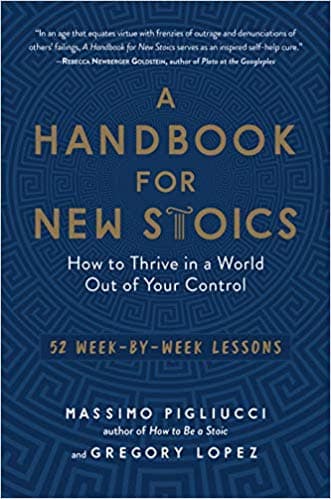
you decide what you want to do at that point but if if there’s nothing there anyway it’s it’s not you’re not going to have a space to react in so some awesome I you know we’ve been we’ve been going for a little while we’ve covered a lot of stuff I mean is there a way we can wrap this together with a nice little bow tie make it pretty well I mean I I really wanted to to mention your book that you that you wrote a handbook for
new Stoics it’s it’s actually on the screen for people to look at we will provide the Amazon link when does this book come out the book comes out on May 14th and so it’s just a couple weeks away yeah I mean hey or less I went I went through the book and it’s actually really well-written and really well structured you tell us a little bit about it you you there are weekly exercises that you sort of perform each week for with a different goal in mind
correct it’s a double fifty-two X’s money can go on for a year doing this thing although my co-author Frank Lopez and I actually provide a shortcut in the beginning and say if you don’t want to go through the whole thing here’s the most important exercises and then see how you feel about it and see if you want to proceed but basically the book is is written as a workbook as if we were in fact see media company behave of therapy what
you’re supposed to interact with it you don’t you don’t just read it the art actually the publisher the experiment did a very good job it from a graphic perspective to highlight the different parts of the book and living space for people to write down their notes and checking boxes and things like that but essentially every exercise every chapter is structured the same way it starts out with a hypothetical day-to-day situation
so somebody who gets upset for instance because she’s gone to the gym and somebody else is being misplacing stuff and so now that gets in the way of her doing your routine or something like that so it’s a normal it’s a day-to-day situation things that can happen to any any one of us then they immediately after that we introduce a quote from one of the major stories usually activist Seneca or Marcus Aurelius although there
are some others that are put in here and there and the quote has the red pertinence it’s directly relevant to the situation that and they started out the chapter after the quote we explained the theory we say okay so here’s why this particular quote is relevant to this particular kind of situation here’s how it’s an actual exercise where the reader is guided step-by-step throughout the week into actually practicing whatever
it is that we that the exercise is about so for instance if it is about not getting upset you’re gonna say well okay here are some techniques for not getting angry here are some techniques for overcoming the irritation and then people can write down every day how they’re doing if they’re good at their proving or not whether the exercise is working or not for them then setting aside on to the second exercise hmm okay yeah I mean I really love it because it
puts into a frame that you know these concepts be practical and you you really deliver that you really deliver a method to sort of learn the different because I feel sometimes the the Stoics were a little abstract you know it can be an abstraction to discuss emotions like what is fear really you know like fear mate means something different for me than it does to you you know we’re clearly afraid of different things so
with this you know you’re you’re putting people into situations with their with their own lives and it’s you know it is set up like a workbook I’m just paging through the book right now and you know it says on week 14 you just you evaluate your goals you know and it’s it’s full of really practical stuff just like that I mean I’m I’m not only just pitching it because you’re my guest I’m also pitching it because I really enjoyed it
thank you yeah I think it’s unique there are stories another one a few years ago called happy historic but most of the stoic this books about modern stories and then out there are interesting I mean that there’s a lots of good ones they tend to be the theoretical or discursive they talk about the history stoicism then there’s some reference to practice for sure but not in a such a systematic way you know him you know
holding your hand kind of way as the handbook for new stories which I covered with Greg focus so I we think that that’s a unique entry into the Canon so to speak so hopefully it’ll be useful to people to actually put this stuff into practice because it’s Remer remember stoicism is a practical philosophy it’s supposed to change your life if it doesn’t change faragut Tiras again himself words some of the students he says you know if you if you came here
just to theory you’re wasting your time if you don’t get out of this classroom and i can’t really practice actually become a better person actually in fact implement these things then you’re just wasting your time then it becomes just an exercise in to run academic exercise in the bad sense of the word and and story is supposed to really change your life and it does a few years ago and they told me that you know these this approach it really
has turned things around for them in some cases helping them out of really bad situation in other cases just generally making their lives better focused you pay more attention to what you’re doing you’re less prone to anger and and therefore new people like you more you better dealing with people and so on wouldnít be amazing it’s like the social media version of like road rage would decrease massively maybe all the haters we have would just chill out and
relax and you know have a drink and sit back and not take everything so personally and right you know it just it I think it genuinely can help I mean that’s why we covered this is because I really think stoicism can offer people even after so much time now today in the modern world where we are overrun with information connection and things that generally produce anxiety mental illness is something that people deal with you
know I think one in four people in America are suffer from some disability so you know I think I think the mental frame that we have on things so crucial so important Massimo thank you so much for your time and energy and just the material I loved the way that you you know wrapped it all together just I know there’s a lot of it a lot of material and a lot of these people’s lives like Seneca epic Titus and Marcus Aurelius
like they they lived very intriguing lives and so so to you know kind of bring it back around for us studying them I think I think you did a great job well thank you very much this was a lot of fun yeah I’m certain it will be so just one more time the book is called a handbook for new Stoics how to thrive in a world out of your control it’s a 52 week by week lessons guide written by my guest Massimo Pig Leo Chi and my saying of last name right
Bellucci okay I’m sorry I should have asked that we’re in a mess of organization at the beginning and Greg Lopez is the co-author and and then when is the date this is gonna be available May 14th for pre-order now great we will make that link available in this video and I’ll send you a link as soon as we wrap this up I’ll I’ll send you a link where you can put it out to your feeds as well Massimo thank you so much for for being
on the show as our first live format guest is really truly an honor to speak to you sir it was a pleasure thank you thank you so much guys you heard here that was our guest I mean wow what an amazing show to come back on and you know there’s there’s so much more in store and ahead we’ve got a whole litany of guests that are just absolutely going to blow your mind they are going to blow your mind that that’s how good it is so be sure
you stay in tune I’m gonna run the outro I’ve been working nonstop for the last few weeks just I was in the jungle for a little while and now I’m back in the States and we’re going full steam ahead with everything that’s happening at hxp so I hope you guys are ready for that here’s the outro guys thank you so much and we will see you you will hear from us next week [Music] [Music]
Ideas worth returning to
Quotes
Five substantial excerpts from the published transcript, lightly edited for clarity without changing their meaning.
“The early Stoics often treated God, nature, truth, and the universe as different names for the same reality. In that sense they believed in God, but not necessarily as a separate supernatural person. Their divinity was embedded in the rational order and laws of the universe itself.”
From the conversation“A modern Stoic may be drawn to what is sometimes called Einstein’s God: confidence in the intelligible order of nature rather than belief in a personal deity. Science is possible because the universe behaves with enough regularity and logic for human reason to investigate and understand parts of it.”
From the conversation“For the Stoics, a good human life applies reason to improve social living. Marcus Aurelius repeatedly urges himself to do what social reason demands. The point of life is to be useful to others and make things better for the community, which also improves the conditions in which one lives.”
From the conversation“Marcus Aurelius begins his Meditations by naming people who treated him well and influenced him for the better. It is an exercise in humility and gratitude. Even a person holding extraordinary power can begin by acknowledging that character is formed through debts to teachers, relatives, friends, and examples provided by others.”
From the conversation“The Stoic goal is to become the best human being you can. That means developing the capacities most characteristic of humanity: reason and social cooperation. The more reasonably and sociably you live—and the more you help society rather than harm it—the more fully you realize human excellence.”
From the conversation
About the guest
Massimo Pigliucci
Massimo Pigliucci is a scientist, skeptic, and philosopher, who in recent years has written a number of books on Stoicism. He earned a Ph.D. in Philosophy from the University of Tennessee and is the K.D. Irani Professor of Philosophy at The City College of New York. He also has a background in biology, with a PhD in Evolutionary Biology from the University of Connecticut.

Episode #186- Positively Angela – The 7 Hermetic Principles & Living a Better Life
December 20, 2022 · 1:26:56

Episode #185 – Brad Klausen & Chance Gardner – Esoteric Egypt, Pineal Gland Activation, Kundalini, and more
December 14, 2022 · 1:50:21

Episode 196: Waqas Ahmed — Polymathy, AI & the Future of Human Creativity
September 28, 2026 · 1:04:41

HXP SHORTS: #001 – Deconstructing Death: What Happens When We Die?
September 14, 2026 · 11:37
Episode 194 Dr. James Fadiman – You Are Not One Self: Microdosing, Multiplicity and the Mind
September 4, 2026 · 1:14:38
Independent conversations
Help make the next one possible.
Membership sustains ambitious, unhurried interviews and keeps the complete archive open to curious listeners everywhere.
Become a member