

The Human Experience · Episode
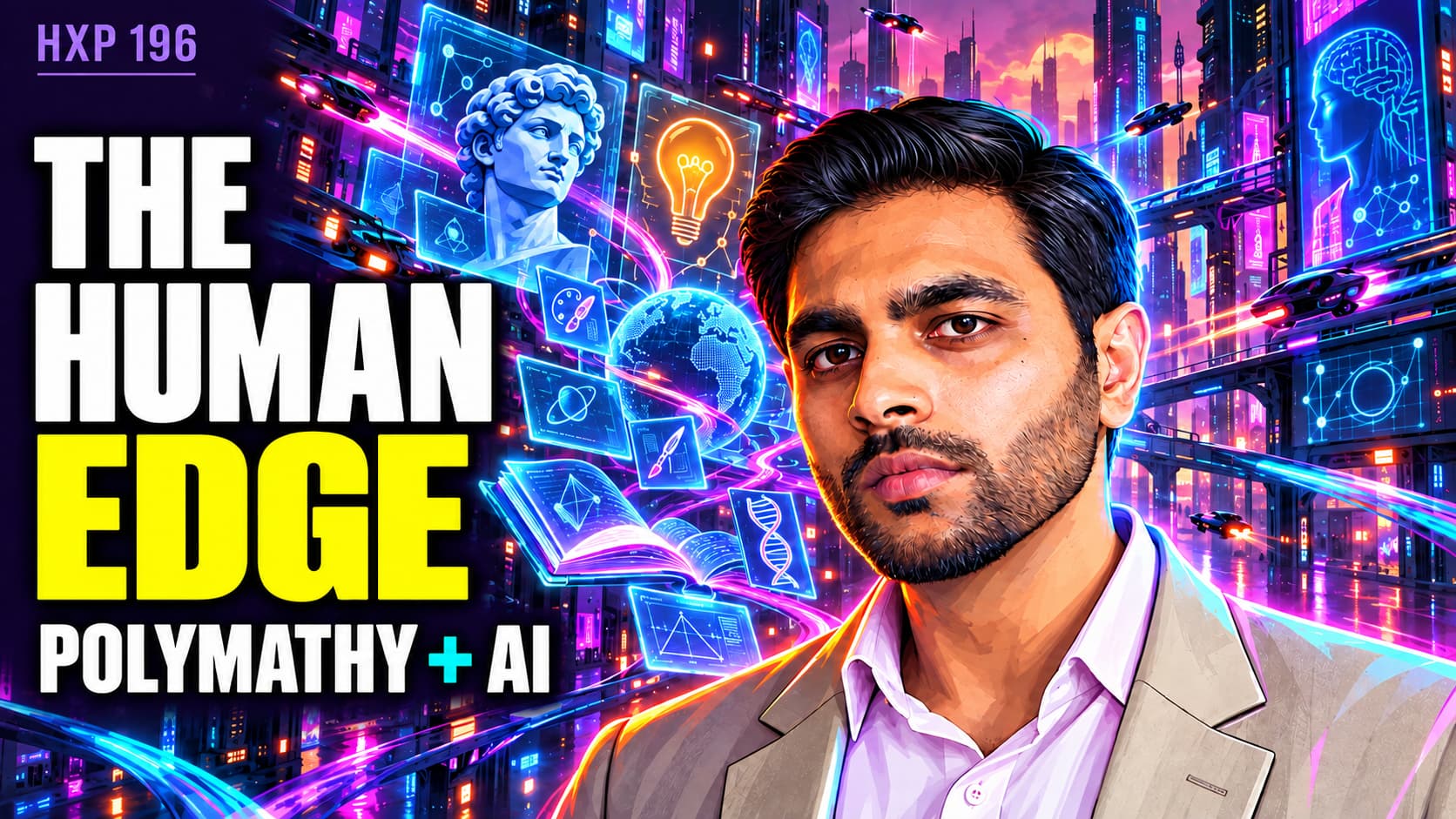
Episode 196: Waqas Ahmed — Polymathy, AI & the Future of Human Creativity
A conversation with Waqas Ahmed
Author of The Polymath and founder of The DaVinci Network, Waqas Ahmed returns to The Human Experience to explore a question at the center of the AI era: what remains uniquely human when machines can generate answers across almost every field?
Stay with the full conversation.
Episode field notes
Show notes
Listen to Waqas Ahmed’s earlier HXP conversation: Episode 154 — Unlocking Human Potential, Awakening Creativity & The Polymath.
What remains uniquely human when AI can move between almost every subject at speed? Waqas Ahmed returns to The Human Experience six years after The Polymath to revisit the case for versatile minds. With Xavier Katana, he explores why curiosity across fields matters for individuals and organizations, where current AI systems fall short, and how human intelligence might grow alongside powerful tools.
Episode 196: Human versatility is not simply a career strategy. In Waqas Ahmed’s view, it is a way to connect ideas, cultures, and people while facing complex problems.
About Waqas Ahmed
Waqas Ahmed is the author of The Polymath: Unlocking the Power of Human Versatility and founder of The DaVinci Network. His work connects education, art, organizational practice, and interdisciplinary thinking. In this conversation he also discusses Da Vinci AI, a project exploring how AI might encourage more divergent, human-led thought.
Episode Summary
Ahmed explains how his thinking has expanded since The Polymath. What began as an argument for personal fulfillment now reaches into organizations and society: how can people combine different kinds of knowledge to address problems that do not fit inside a single discipline?
Xavier asks whether AI has made the human polymath obsolete. Ahmed describes both its breadth and its limitations, including a tendency he sees toward familiar answers. They discuss cognitive offloading, creative judgment, embodied experience, and why working with AI should develop rather than replace our ability to think.
The conversation then moves from intellectual tourism and interactional expertise to Ahmed’s Da Vinci AI work. It broadens again through his film A Thousand Colors, the value of cultural diversity, the risks of stereotyping and misrepresentation, and the question of who holds power when institutions claim to be inclusive. In the closing stretch, Ahmed asks whether human wisdom can grow quickly enough to guide the tools we build.
What You’ll Hear
- Why Ahmed sees polymathy as a social and organizational practice, not only an individual pursuit
- Whether AI strengthens or weakens the case for human versatility
- How overreliance on AI can erode creative and critical thinking
- Why breadth, depth, humility, and interactional expertise belong together
- What Ahmed hopes Da Vinci AI might contribute to divergent thinking
- How A Thousand Colors connects film with cultural diversity
- What is lost when cultures are omitted or flattened into stereotypes
- Why institutional diversity also requires questions about power and motive
- What progress in human intelligence might look like twenty years from now
Key Ideas
- Human versatility has a collective dimension. Ahmed connects personal range to the way teams and societies approach complex problems.
- AI can assist without becoming the whole creative process. The discussion distinguishes access to information from the human ability to judge, synthesize, and take an original leap.
- Curiosity needs humility. Exploring a field widely can be valuable; contributing to it requires enough understanding to ask good questions and work with its experts.
- Representation is also about power. Visibility alone does not settle who shapes an institution’s decisions or why it presents a culture in a particular way.
Chapters
Chapter timecodes refer to the supplied 1:04:41 MP3, including its produced opening.
- 00:00 — Produced introduction
- 00:38 — The Human Experience is in session: meet Waqas Ahmed
- 01:38 — Six years after The Polymath
- 05:14 — From individual fulfillment to social value
- 10:24 — The future of work, education, and human versatility
- 11:18 — Does AI challenge the case for the human polymath?
- 15:27 — Cognitive erosion and overreliance on AI
- 18:25 — What AI can do, and where human synthesis differs
- 22:31 — Intellectual tourism, breadth, and humility
- 24:53 — Interactional expertise and meaningful contribution
- 26:54 — AI slop, authenticity, and original thought
- 27:53 — Da Vinci AI and divergent thinking
- 36:31 — A Thousand Colors: choosing film to express an idea
- 40:59 — Cultural diversity, preservation, and exchange
- 45:13 — Omission, misrepresentation, and stereotypes
- 48:05 — Who holds power inside a diverse institution?
- 54:53 — Will human wisdom keep pace with our tools?
- 58:25 — The DaVinci Network and where to find Waqas
- 59:22 — Bonus conversation preview: belief, inquiry, and uncertainty
- 1:03:30 — Closing invitation and thanks
Explore Waqas Ahmed’s Work
- The DaVinci Network
- The Polymath — official book page
- The Polymath on Amazon UK
- Waqas Ahmed on LinkedIn
Continue the Conversation
The final minutes offer a preview of a more personal bonus conversation. Find HXP membership information at thehumanxp.com/membership. Availability of a particular bonus release should be checked in the member library.
About the Transcript
The transcript clock begins at 00:00 with Xavier’s “The Human Experience is in session,” approximately 38 seconds into the MP3. Chapter times above use the MP3 clock. The transcript was automatically generated from the supplied recording and lightly formatted; it is not speaker-labeled and may contain recognition errors, especially names and short exchanges.
About the guest
Waqas Ahmed
Listen to Waqas Ahmed’s earlier HXP conversation: Episode 154 — Unlocking Human Potential, Awakening Creativity & The Polymath.
The complete conversation
Transcript
107 timestamped passages · 8,160 spoken words · Xavier and Waqas distinguished from the episode audio
Transcribed from the canonical Episode 196 audio. Speaker names were inferred from verified voice samples, then mixed-speaker handoffs were reviewed at word level. Automated wording may contain occasional errors. Select any timestamp to play the episode from that exact moment.
Find the moment
Search this conversation
Search 107 passages and 8,160 spoken words.
- Xavier Katana:
The human experience is in session. My name is Xavier Katana. Our guest for today is Mr. Wakas Ahmed. He's the author of The Polymath and founder of The Da Vinci Network. His work moves across art, science, education and international affairs. as executive director of the Khalili Foundation. He teaches in interdisciplinary settings, has published research on the representation of non-Western visual art across Wikimedia platforms, and is developing DaVinci.ai, a project inspired by aspects of Leonardo DaVinci's mind. Mukas, welcome back to HXP.
- Waqas Ahmed:
Xavier, thank you so much for having me. It's been a while. We're just discussing, but a lot has happened since then. And I'm sure we're going to speak a bit about that.
- Xavier Katana:
Yeah, it's been about six years since, I guess, the polymath came out and we had you on the show for that. What's changed for you since then?
- Waqas Ahmed:
Well, since the polymath came out, I've had to speak a lot about the ideas within the book. So I've done a variety of lectures and speaking tours. The polymath itself has been translated into multiple languages. It's got quite a bit of attention from both the education area, but also the world of work as well. And quite a lot has happened in terms of the state of the world and the progress of technology since then. namely and I'm sure we'll come to this in more detail the wave of AI especially as the amount of people that are now using it and the way that it's become ubiquitous across society so so these all these things have and also the complexity of the problems that we're generally
facing as a society and all of these things in my view at least and certainly amongst those that I've been speaking with make the notion of the polymath ever more relevant and in fact pertinent in many ways. So myself, I've been obviously speaking about the polymath. The Da Vinci Network, which essentially is an organization developed out of those ideas, has gone on to produce two major ideas festivals. It's called the Polymath Festival. And the Polymath Festival is basically an assembly of not just leading polymaths or aspiring polymaths, but also more generally looking at how we might take the polymathic approach to tackle complex world
problems within different areas. And also just generally celebrating the notion of the polymath in an age that usually celebrates the single-minded, single-disciplinary specialist. And so part of the kind of the journey, the message has been over these years to help people navigate what the polymath means for them. Often that has meant going into organizations, not only talking, but delivering workshops and consulting programs. And also, of course, the festival, which I mentioned to you as well. And more recently, since the advent of AI, looking at how what implications the AI revolution can have for polymathic thinking. So much of that has been occupying my mind.
But as we mentioned last time, Xavier, myself, I'm more of a practitioner in the sense that my work spans the arts, the sciences, international affairs, education. So I do a lot of work within each of these spaces. So the polymathic disposition might be there, but actually I'm doing what you might consider real world work within this space, whether it be research, whether it be building and growing organizations or whether it be teaching. So I do a lot of work within those spaces and the polymathic principle or instinct is just there that runs like a thread throughout.
- Xavier Katana:
Yeah, I mean, and you're right, a lot has happened and you're still a segue artist because you hit on many of the questions that I have set up. One of them being AI, of course, but when we talked six years ago, we made the case that the world needed more polymaths. We need to recognize them better. Looking at the world now, what do you feel that you got right and what do you feel that you got wrong?
- Waqas Ahmed:
Good question. I think I'm not sure that there's much wrong in the thesis, apart from the fact that it needed developing further. So whilst in the past, we would speak more about the importance of what I would speak, focus more on individual fulfillment. the polymathic way being important way is being an important approach for us all to realize our many-sidedness and to self-actualize in that fuller sense and and to kind of experience and bring to life our various dimensions which essentially was quelled and suppressed as a
result of the last 150 years of societal conditioning. And so for me, it goes beyond the individual now, not just because of AI, we were speaking about this to some degree before, but it's not just about us reaching our own potential as individuals, but also what this thinking and the resultant insights can have on society as a whole? How can it bring about novel insights, new innovations? How can it lead to a better understanding of our world, but also then a better, a greater propensity to act in the world in a positive way? So for me, it's the
evolution of the concept has been from the individual to society and also within organizations as well. So what is the impact or the implications of a polymathic way for the way organizations structure themselves, how they operate, how they go about innovation, and therefore for what their view of the world actually is. Is it one that focuses exclusively on their own market or their own function or their own sector or their own hierarchy? Or is it one that is more widely cognizant of the wider human experience, the various stakeholders at play and how it all forms part of one big system or even ecosystem?
I think for me, the thinking has evolved to understand what the polymathic revolution of the mind, of the individual mind, might have for the way we operate with other people, the way we engage with the planet, the way that we go about our learning journeys and the way we become more fruitful in the world of work.
- Xavier Katana:
I mean, that's a lot. Can you condense that down into one or two sentences just so any listener can understand more clearly what you're saying?
- Waqas Ahmed:
yeah so for me uh the importance is the evolution of the idea of the polymath from being one that resonates with the individual at the individual level uh so trying to self-actualize in that multi-dimensional sense that we spoke about um quite a lot in our last discussion uh to the implications that polymathic thinking and the polymathic approach might have for one's role Therefore, how it might have implications for the way we tackle complex problems, which by their very nature are multidimensional and interdisciplinary. So that's basically the evolution of the journey.
And then, of course, more recently, the relevance of an individual human in the age of exponentially growing artificial intelligence. what is the value and my argument generally is that our value lies in our innate polymathy
- Xavier Katana:
is there anything in the book that you would rewrite today six years later
- Waqas Ahmed:
um the book the the book was important for its time And I say that because that particular book was making the case for the fact that the polymath and the polymathic way is important and has always been part of the human experience over history. So actually, a third of the book was focused on history, essentially. If I were to rewrite it today, maybe that wouldn't be such a big focus, because there is a growing acceptance of this historical narrative now. Now, whether or not that's down to my own work is another question.
But the point is that now I think we've moved on from having to do that and to make that statement to now talk more about what value would have in the world of today and what value would it have in the future of work and in the future of education. So, yeah.
- Xavier Katana:
so so with the advent of ai because it can move so quickly between physics philosophy biology history coding whatever you throw at it has it changed your definition for the human polymath or has it strengthened it or undermined it
- Waqas Ahmed:
AI has led me to question the thesis of course it has really led me to question what the value so previously I was talking I was saying that actually there is an important value to the polymath because they see the world differently they operate differently and they operate in a way that adds a unique value to an organization or to a society. With the advent of AI, I started to question whether even the polymath will be relevant in the next decade or five.
And my conclusion has increasingly come to, instead of actually it went from me thinking, wow, like AI is becoming increasingly capable. And it seems like the ultimate polymathic machine. It seems to be able to have access to diverse forms of knowledge. It seems to be able to combine that knowledge in interesting ways, according to how it's prompted.
is the notion of the human polymath redundant because of this machine? I think initially, I think it was, we were all really captivated by what AI could do. But as time went on, notwithstanding the progress that even AI has made over these last three or so years, um we many of us have grown quite disillusioned by um by the limitations of ai in different contexts one example is innovation which i think we'll come to a bit later in the conversation when we talk about da vinci ai but um but another one is that actually uh ai is not the polymathic machine in the way that humans are polymathic beings.
It's completely, it's very, it's nowhere near as sophisticated. It's, and by the way, I'm speaking as though the machine, the human brain or the human mind are indeed sort of machines in a way. And I don't necessarily accord with that paradigm. But even if we are to say that, then the human brain and the human mind and the way it functions, the way it thinks, the way it operates is infinitely more complex and therefore capable of producing infinitely more interesting results. Not necessarily in the same way, but it does.
So in short, going back to your question, I think that AI is able to be polymathic, but not uniquely polymathic in the way that a human can. So for me, the human polymathy is a kind of a higher form of human existence. And I think if we strive towards that, we will be able to add a very interesting value to the human intelligence, artificial intelligence collaboration process.
- Xavier Katana:
Do you think that AI could make people less polymathic?
- Waqas Ahmed:
absolutely yes and this is one of the problems that i've been thinking about and seeing how we might be able to tackle it um more generally so polymathic aside it is uh making humans and i think this is um a widely accepted phenomenon uh right now which is that It's making humans generally less intelligent. It's reducing their capacity to be creative. It is reducing their capacity to think critically. It is reducing their capacity to grow in any cognitive or even affective way.
And that problem of sort of cognitive erosion resulting from an over-dependency on AI, which we all, to some extent, are culprits of, is a major, major problem. So if we're to take that issue, which is that AI dependency, which is a widespread phenomenon now, AI dependency is causing a kind of cognitive erosion, which is affecting our ability to think critically and creatively. um so if we if we um if we then subscribe to the fact that actually ai is very polymathic it can do it can make the connections we need to make for us um it can think critically and have a kind of
judgment and taste um in in a way that doesn't really need me to do it if you subscribe to that And unfortunately, because of the cognitive offloading that we spoke about, this is happening. If we have that, then there is no motivation for us as humans to develop our polymathic abilities. so so but if we're to look beyond that which i intuit many well not many people do but if we are to look beyond that and realize that ai is not polymathic it can be a polymathic collaborator but essentially it's it it we need to work independently of it and with it in order to
I think we could actually really accelerate our ability to be polymathic. But I fear that's not happening.
- Xavier Katana:
Yeah, I would agree that there's a general cognitive decline happening among society, especially as we use AI more and more and less critical thinking is involved in our active decisions. Our attention span is lower and lower as we move through social media and swipe up. People are on their phones all the time. So what's the difference between a human polymath and an AI system that's really smart?
- Waqas Ahmed:
Sure. Now, AI has tremendous computing power that will only increase. AI has access to a lot of data, not all data. We should remember this. And also not always true data. We should remember that. So AI, like us humans, has the tendency to be biased. So AI is limited in that way. AI is also limited by its very own architecture. One example of this is how, by its nature, it needs to converge towards a statistical mean, towards common ideas.
And so it is not by itself without serious prompt engineering. it's not um it's not able to deliver really interesting highly alternative radical new ideas and this anyone involved in innovation right now um not just in the creative sector anyone involved in innovation right now that has consulted ai i i i think will be able to relate to this this initial excitement that wow you know this thing can provide us with a lot of ideas but actually very architecture it's not really delivering where it really counts and so I think in that respect
AI in its current form has many limitations. And whereas humans also have been conditioned to kind of converge, not only converge, they've been conditioned to hyper-specialize and compartmentalize themselves from the rest of world knowledge and from the rest of society. That's the nature of, you know, the job structure, the employment and professional structure. That's the nature of the academic and education system that we're in right now. That's the nature of society right now. It's very fragmented in that way, very compartmentalized. And so we also have a lot of limitations. We also have a lot of biases.
But we also have this ability to synthesize both consciously and subconsciously between seemingly different domains and areas. You can, to some degree, prompt engineer an LLM to be able to do that to some degree. But actually, the way that that's done as part of the embodied experience is something that is just inimitable. So I think that that is the thing that really has allowed us to take those real leaps of creativity in a way that AI, frankly, for all its compute power, for all its knowledge, has not been able to do by itself.
I mean, who would have known that, you know, three or four years after that initial excitement with the LLMs, that still an AI by itself is not able to make significant breakthroughs in science or in the humanities or in art. so um so yeah i think i think because one of the reasons is is because of that embodied experience and the ability to be polymathic in in a much more authentic way um but yeah i think therefore we need to be very uh we need to be very confident in our own abilities as humans um and and also um watch closely where ai is heading in terms of its capability
- Xavier Katana:
Do you think there's a point where this type of curiosity becomes a type of, say, intellectual tourism, where a person can pretend to be a polymath or a pseudo type of polymathy?
- Waqas Ahmed:
yes of course i mean you we are all like that to some degree right we all have a kind of curiosity that takes us to different areas and some of us are more predisposed to be curious and others less so some of us are more predisposed or have that tendency to be curious within a particular domain going deeper and deeper and deeper and some of us have that tendency to go wider and to just kind of scoop up knowledge and ideas from a whole host of different domains. I think all of that is useful. I think the depth is very useful and the breadth is very useful. And by kind of by increasing your range, I don't think you're becoming a kind of pseudo polymath or becoming,
a um uh as you as you mentioned like an intellectual tourist in fact you probably are being an intellectual tourist but there's nothing wrong with that at all um much like when we go on holiday as tourists we might be doing so like we're not having necessarily the most authentic experiences within wherever we go but that exposure alone uh does enrich you in ways that you don't we don't really understand always. And so therefore, I think, you know, exploring the range is always going to be useful. Doing so with humility, so understanding that actually knowledge produced within those domains has been done by both specialists and by those that have come from outside of the field and have worked at the intersection of this field and another field. So having that healthy respect for those that really have contributed to that,
assuming that just because you've visited that space that you you now know all the ideas or the knowledge within that space and it's that is that is something to be wary of but i think um i think as long as you have that humility there is nothing wrong with that range whatsoever and but i feel that actually the and i mentioned this in the book that those that can really I'm not sure one could one can or should call themselves a polymath but if for one to be called a polymath for me they need to have they need to have developed a necessary breadth within a particular area not necessarily to the same degree as an uber specialist within that area
but enough to be able to have what I call or what actually is called an interactional expertise, whereby you can actually have a meaningful conversation with a specialist in that domain. You can ask the right questions. So like Xavier, when you speak to all these different specialists on your podcasts, the reason that you're able to have a great session with a great conversation is because you do sufficient work to be able to know which questions to ask and to therefore make the conversation meaningful. If you're able to get to that level, then you're also able to get to a level where you might even be able to contribute to that space because you've understood the first principles or the core principles.
you've understood some of the fundamentals and you also are now be able to bring in knowledge and ideas from other areas that you've understood to a reasonable degree and that intersection is where new knowledge is ultimately created so you you're therefore well positioned to not just be a tourist but also be a contributor
- Xavier Katana:
yeah it makes a lot of sense And I think this idea of intellectual tourism is interesting because a lot of people are using AI so much that it's become a huge part of the way they communicate. They're writing an email. They're putting it through AI first. And you can even, I think it's called AI slop, is when you can tell something has been written by AI. So how does daVinci.ai differ from these other LLMs?
- Waqas Ahmed:
Yeah, so AI slop is a real thing. And those of us involved in education, especially, and our marking assignments and essays and so on, are increasingly familiar with it. And funnily enough, in a way, AI is so good that it can produce great work, possible work. But on the other hand, it also reveals itself quite explicitly at times. And those of us who might be more AI literate can see that. And it can see when AI has been used very sloppily and lazily. And it's therefore not the authentic work.
So, yeah, that is definitely a thing. Now, the question of Da Vinci AI is interesting because I've always so this this was for me, this was the research question, right? It was, how can we develop an AI system that is polymathic, but that which is designed to develop polymathic individuals? So how can we develop a polymathic AI, but one that doesn't have all the answers, doesn't claim to have all the answers, is polymathic enough to take others on the journey to develop their own human polymathic
abilities? So with that in mind, I thought about, I asked the other question, which is, is AI, let's say the current crop of LLMs, is it polymathic? Is it truly interdisciplinary? polymathic inherently and that's where i kind of learned started to learn more about speaking of intellectual tourism this is where i went into more technically into the world of machine learning and ai systems and architecture to understand a bit more from those that are really working within that space how the architecture works in order to you know answer this question or at least shine some light on this question is whether it's actually polymathic or not.
Suffice to say for now that I was not convinced at all that it is polymathic in any deep way, perhaps superficially. It can combine ideas and draw ideas from different areas and give you an interesting response. But it's not doing so in the way that human polymaths traditionally have not near not nearly actually and i think that actually that's a that's a because if you have a non-polymatic AI system that's interacting with generally non-polymatic people, and I say that in the nicest way because the reason why people are generally non-polymatic is not because that's not how they naturally are. I argue, as you know, that there is a natural polemathy within all of us.
But actually, the problem is how society and the education system has conditioned us out of that. So if you have a whole range of people that are conditioned in a particular way to think in a particular way, for example, in a reductive, hyper-specialist way, and then you have this AI system that they're working with that is also that also kind of is built from those intellectual foundations and also of which the output is is kind of converging then I don't think you're going to get you know the best work out of AI and you're also not going to get the best work out of humans so that's why I'm interested in in kind of developing the the polymathic capability of both the AI system itself, as well as the human. And imagine a
polymathic AI working with a polymathic human, what can be produced? So that proposition really fascinated me to the degree that I thought, okay, so if we're going to develop a polymathic AI, not necessarily a completely new model, but let's start with kind of seeing how we might develop a cognitive control layer, which forces divergence as opposed to convergence. What might that look like? And also, if we're going to say we're going to make it polymathic, which archetype of the polymath can we use to model the cognitive architecture on? So this is where my work with Professor Martin Kemp, who's the world's leading expert on Leonardo da Vinci,
kind of explores not only what Leonardo produced his work, not just his life, but also, and more importantly for me, what was his cognitive process? How did he approach complex problems? And what was his approach to innovation? What was his creative process cognitively? How did it work? What do we know about it? What were the mental models that really defined how we thought? So because we have a lot of primary and secondary data, so his own notes, of which there are copious amounts, but also five centuries of scholarship and analysis and interpretation of Leonardo's thinking.
And so because we have a lot of that data and we have the world's leading Leonardo experts, we decided to kind of see if we can encode those mental models, firstly develop the mental models and codify them, which we are publishing a paper shortly on that. And then how can that be encoded into an AI system to deliver a kind of thinking that would be unique? So we've developed a prototype. We launched it at the Royal Institution in London. It's been really well received so far, but we have a long way to go. And so we're kind of a very early stage of developing that. But so far, the results in terms of innovation, in terms of novelty, are looking really exciting.
And so, yeah, that's basically DaVinci AI. only a reimagination of Leonardo da Vinci's intelligence, which would be fascinating in its own right. But also, how does that thinking, how could that thinking increase our propensity to innovate radically in whatever field we're working in?
- Xavier Katana:
That's absolutely fascinating. So how is it different? I mean, is it because it operates through the sort of simulated version of da Vinci's intelligence?
- Waqas Ahmed:
yeah because one way is that it um it kind of uh counters the tendency of the model to converge so by that by its very nature it therefore delivers outputs that are non-obvious and one of the ways that it does that and one core principle you might say is one of uh interdisciplinarity and transdisciplinarity where there is um uh there is there is uh conscious deliberate connection making not just analogy making but actual connection making between concepts and ideas and looking at the relationships between them between seemingly different areas so it is
predisposed so just imagine you spent um xavier you spent a lot of time with an with an llm a lot of time i mean training it to to think in ways that are non-obvious things think in ways that are inspired by nature and therefore transdisciplinary not confining one's thoughts or ideas or principles or discipline, but basically exploring connections between a range of different disciplines, because, of course, ideas borrowed from different areas can shine a new light on something else. So imagine an AI, imagine an intelligence that's predisposed in that way. What you have is probably
a range of ideas that may not be feasible, sometimes even ludicrous. But then within those set of ideas, you'll find some real gems that are feasible, that are workable, and are visionary. And so that's what we're aiming to produce, because otherwise, that wouldn't happen.
- Xavier Katana:
Yeah, that's very interesting. I'm very excited to see sort of the results of that and try it out. I want to switch gears because you made a short film called A Thousand Colors. What shifted for you when you went from being an author and a researcher to a director? Yeah,
- Waqas Ahmed:
so for me, again, in that same, I suppose, polymathic fashion, it's the the skill or the output is it's not the important thing the important thing is the idea and how that idea can come to life and so when you have a particular idea about something and this is something I encourage people through the book to do if you have a particular idea or a vision and you want to bring it to life um then you need to understand like like what form could it take um is it is this idea best communicated or explored through an um an artwork a painting
um through a research paper through a scientific investigation through a film through what purpose? Through a novel? How would you best express this? And for me, that's always been the question. It's like, okay, this is an idea. So the film that you mentioned, A Thousand Colors, is about the notion of cultural diversity and the idea that cultural diversity is as important to humanity as biodiversity is to nature. and so the so so that idea uh which is something that i've been working on through my through my other work um uh was was was best expressed in my view at the time in the form of um a film
where we gathered different perspectives on this whole concept uh where we were able to use music and visual imagery and a story and and kind of bring it to life in that way um people needed to see the manifestation of different cultures um by its very nature of the of the idea and so for and and also i've always been really fascinated by film as as an art form and um and the wonders that it can do so for me um film became the the natural way of that project and so I had to of course learn many of these many of the important foundational principles of filmmaking working with some of the best within that area and learning from them and
and then trying to come come in with some of my own ideas that I had developed through other areas or other fields and the result was a film that was produced for UNESCO or in collaboration with and that's where it was launched and premiered in the screen and where it's been used to promote the idea of promote the universal declaration on cultural diversity around the world so so that's what took me to that space but I think an interesting segue would be from what we're talking about when it comes to interdisciplinarity is this idea of for me it's always been about
appreciating and leveraging the power of diverse perspectives. So in whether that's disciplinary perspectives, so different disciplines or fields, whether it's cultural perspectives, so different art forms, different cultural ideas from different communities and traditions, different faiths and worldviews. these are all perspectives that we can all learn from and i think if we have a diversity of them and we can explore a diversity of them it will make us richer for it and so uh so for me it's part of the same principle right exploring cultural diversity is like exploring disciplinary diversity and um the result is um the result i hope is something that's novel
- Xavier Katana:
hmm it's intriguing uh so when an idea crosses from one culture into another what has to survive for it to remain the same idea
- Waqas Ahmed:
that's a really good question xavier um there is there is this uh how do i say this there is a battle between uh shall we say a debate a debate between two ideas within culture. One is that there is such a thing as a single culture, for example, a national culture or a community's culture that is kind of manifested through its sort of art, its language and so on, which ought to be preserved because it's at risk of dilution or even extinction. It has to be preserved and protected in that form. And there's another perspective, which is that culture has never really been one thing. Different cultures have
always interacted and exchanged and borrowed and fused. And so at any given point in time, culture becomes evolves and becomes something new um so as you can imagine these two worldviews of culture um are at odds in many ways my view it don't have to be but they're they're often at odds and so i think uh your question becomes really important how do you kind of how do you bring together different ideas or import a cultural idea from a different tradition um keep its integrity kind of creating something new.
It's difficult. I think a lot of it comes down to acknowledgement. Acknowledgement that a particular cultural idea existed at a particular time and place, and it added value to lives in a particular way. in that particular way it may continue to add lives for long periods of time or it may cease to do so and it might require some kind of evolution and that evolution often takes place when that cultural tradition comes into contact with another and when it comes into contact with another um can something new be created that will add value to people's lives that will enrich
people's lives and if it if it doesn't then uh then then that tradition is either preserved or then moves on to exchange with a different one uh and that process has been ongoing um for as long as humans have been i've been here and so i think um i think it's it's a really interesting things even when i when we speak about cultural diversity uh we speak about exchange as
- Xavier Katana:
well as about preservation yeah and i can i can feel your passion about this subject i can i can tell that it means a lot to you this this idea of uh you know cultural diversity and and exploring ideas from different cultures and and understanding where they intersect
- Waqas Ahmed:
yeah i mean it stems from my own multicultural multilingual background you know and um and and understanding of the richness that that has always bought me um for some people it creates some confusion of identity and and stuff like that but for me um it's always been an enriching thing and i think that is something that that that that a lot of people can really benefit from and so And I've also been acutely aware that many communities, nations, groups have been robbed of their own traditions, whether it be because of some form of exploitation or slavery or colonialism or whatever it might be, general inequality and power imbalances, whatever the reasons might be.
But that has been the case. And it's unfortunate that I'm always very interested in underrepresented cultures and how we can keep them alive to the extent that they're adding value to people.
- Xavier Katana:
so what's the difference between an idea that that causes damage by being left out of a story or which which one is worse uh an idea that is is is damaged by being left out of the story or an idea that's that's become distorted
- Waqas Ahmed:
yeah so that's kind of a difference between non-information and misinformation right so it's like um it's it or shall we say misrepresentation so non-representation and misrepresentation am understanding you right yeah yeah um good question i think uh i think even Even misrepresentation can raise questions about that idea to the degree that people can really seek out the truth relating to it. But not always.
For example, I don't know, you've seen many, many movies, big blockbuster movies that appropriate different cultures and different points in history and tell various historical stories. And doing so perhaps in a stereotypical way. And it doesn't capture the complexity and the nuances of that era or that place or that culture. But it does expose people to the idea that something like that existed or something like that did happen. and so what that can do is two things on the one hand it can uh people are people are generally people can be generally quite intellectually lazy especially given what we've just been speaking about with regards to ai and so therefore they can take it for granted that that is what
happened uh that is what that culture is all about and that will shape their worldview and that could be dangerous on the other hand uh uh the fact that they're exposed to the fact that there is another uh occasion that happened there is another culture that exists there is another worldview or story to tell even if it's not 100 told truthfully truthfully um it might uh expose people to the general idea that it exists and for those that are more intellectually curious and critical in their thinking they will um they will get to the heart of the matter and and those that are not unfortunately um it could lead to a warping of their view about the matter so it's a it's a tricky one i don't know the answer xavier what do you think is more dangerous
- Xavier Katana:
do you think and and institution that calls itself culturally diverse or an institution that has power inside that institution that we should examine as being diverse?
- Waqas Ahmed:
Can you repeat that question?
- Xavier Katana:
So before we can call an institution itself culturally diverse, whose power inside that institution should we examine?
- Waqas Ahmed:
We should certainly understand the power dynamics within that institution, but not only within the institution, within the society that it's operating in. or even what paradigm we're operating in at the time. So to give you an example,
when Black Lives Matter happened, which I believe was just after, not shortly after, kind of we spoke last, and that caused a ripple effect on people's kind of attitudes and behaviors in many areas after that. There was, and we're talking specifically within organizations, you had people that were responding in favorable, non-favorable ways. So when that happened, all of a sudden, you had this compulsion by organizations to make their workforces more diverse, perhaps, to signal to the world that they
not only are representing more black people, but people of other non-white origins, generally speaking. Because the Black Lives Matter movement was taken as something for underrepresented people in general, rather than just black people in the United States. That whole idea really captivated culture in general and organizations had to respond. Now, their ad campaigns were including more people of color, for example. The question really with that is how authentic was that?
And the other question is, does it need to be authentic in the way that we hope? mean by that is um do do the powers within the organization who's let's talk about companies profit making companies for-profit companies big corporations who run now ran an ad campaign with more culturally or shall we say ethnically diverse people um did they do they really woken up to the idea ethically and morally speaking that they should be more representative of people that they should be more diverse in the way that they express themselves
or are they responding to the market um or so the market might demand it um or are they uh is it part of their i suppose corporate social responsibility um uh agenda them seem like more virtual virtuous entities in the system like on the right side of history so so i think um in in a hyper capitalist system where where many of these uh many of these decisions are based around the bottom line based around commercial longevity
these are were the responses that i've just mentioned authentic or genuine and what was the reason for it so coming back to your question um does it matter that they're showing us that they are ethnically and culturally diverse all of a sudden and that does it does have a net not net positive on the society and the communities that they serve? Or is it just a case of them doing what it takes to excel commercially and competitively vis-a-vis other organizations? And I think that in the system that we live in, I think that power lies with capital.
So we have to just think very critically about why organizations are engaged in a particular activity, why they align themselves to certain movements, and what's the real reason behind it.
- Xavier Katana:
Yeah. I mean, this seems to the Black Lives Matter movement, all the things that happened after we spoke seem to have really hit you, like they really affected you.
sorry can you say that again would you would you say that the things that happened after we spoke like covid black lives matter all those things that changed the world forever it seems like they really affected you
- Waqas Ahmed:
oh yeah 100 for any uh thinking person who who who tries trying to understand the world and trying to understand why things are the way they are uh and trying to understand culture and power and trying to understand how humans can navigate this complexity, I think they would most certainly have been affected by some of the more seismic shifts that have happened over the last few years.
- Xavier Katana:
So 20 years from now, let's say we fast forward into the future. how would you say that we've evolved or advanced our intelligence rather than degraded it?
- Waqas Ahmed:
Sorry, can you repeat?
- Xavier Katana:
20 years from now, what evidence would show that humanity has advanced its intelligence rather than degraded it?
- Waqas Ahmed:
hmm that's a very uh very important question uh for me it's whether uh our own human intelligence and wisdom is uh is is operating at is advancing at the same speed or if not at a greater speed than the tools that we are developing to help us. The big problem right now, in my view, is that we are in such a rush to develop the tools that they are completely outrunning us, outrunning us in terms of our ability to catch up
regulate it that might help us take a more measured approach to how this is going to better society. I think before we can even have that conversation, let alone legislate it or regulate it, technology is just running at this ridiculous speed. And also capital is being accumulated at a ridiculous speed for a small group of people. And many of those people involved in developing these technologies. So that speed, which is exponential vis-a-vis our own ability as individuals and as a species to try to understand what is happening and therefore how best to steer this is a problem. So going back to your question, what would be
a success in 20 years is if um if we focused more on developing um human intelligence invested more in human intelligence than we did in artificial intelligence to the degree that we we to the point that we get to a situation where we feel well prepared enough um ethically intellectually spiritually and so on to be able to navigate these powerful tools that could really be a real boon for society and for humanity but i fear that at the rate it's going um and the trajectory and the imbalance of the human uh intelligence and artificial intelligence is going to be difficult
- Xavier Katana:
yeah i think it's going to be very difficult to to find us at a place where we we've advanced not rely so much on something that seems to have the answer for us already in front of us yeah yeah absolutely well we've reached the end of the first half where where can people find your work where can they go to get more information where i mean polymath is still available on amazon we'll make we'll make a link for that in the show notes but uh where can people find
- Waqas Ahmed:
yeah well the organization that i'm now focusing on on scaling is the da vinci network and that is we're doing consulting and training to develop this this polymathic capability in humans but also that's the organization under which da vinci ai is being developed too so trying to develop a more polymathic ai system and also trying to develop more polymathic capabilities in humans So DaVinci Network, more information could be found at davinci-network.com. And if you want to reach out to me personally, you're more than welcome to do so. You can find me on LinkedIn.
- Xavier Katana:
Okay, we'll make those links available. Wakasa has graciously decided to stay for our bonus episode. guys if you want to get there go to the human xp slash membership and you can hear the rest of this episode that's how we make conversations like this possible what costs welcome to the bonus episode that we offer our members um i just i've got like seven questions for you that are more a little bit more personal um what's what's something that you've changed your mind about in the last 10 or 20 years that you fundamentally changed your mind about in the last 10 or 20 years
- Waqas Ahmed:
i would say
My understanding of reality has become less rigid, more, and in a way, more clear, but also in a way that's more open. So what I mean by that is I often describe myself as simultaneously a believer and a seeker. most certainly has a clarity of vision about what I think reality is, but also always constantly checking that in a critical fashion and also in an open-minded fashion. So to be critically minded and open-minded simultaneously, or at least in an alternating fashion, is, I think, very, very healthy. And that's something I've grown to do more.
at times more confused and less conclusive as a result of doing that. But if you can push past the complexity through that inquiry, I think you get to a place of more clarity. And I think that's what I urge people to do, is that when you find something that you're grappling with to be very complex sometimes you know futile how complex it is persist with it in an open-minded way and resist the urge to feel like you need to make a decision until you kind of you've ridden that storm and you you're kind of out there into the clear and you have a clearer view of the horizon And so for me, that's basically what's changed.
I've become more of a seeker and a believer simultaneously than just a believer in one thing, as was previously the case.
- Xavier Katana:
I love that. What's something that you believe that you can't prove?
- Waqas Ahmed:
Hmm.
leave that i can't prove i mean i think as cliched as it sounds i would say some notion of god
which actually i've come across many arguments by both philosophers and scientists to suggest that actually you could put up a case, a strong case for the existence of and the agency in this world of some form of God. And I think it's difficult to prove in that standard scientific method sense that we've been that's been drilled into us for a long time. But it's certainly something I intuit. And even if we were to put a case for it, there'd be a very strong case for it. there'd be a strong case against it too actually if we're just speaking exclusively intellectually i think there's a strong case for and against it but i think that's where intuition imagination and a sense of spirituality comes into it where um where you don't really need to you don't really
need to prove you just have to um just have to intuit and feel it i'm
- Xavier Katana:
really impressed by your evolution from the our first conversation with kass i have to say like it it seems like you've really gone into yourself and done deep work, like deep examination of who you are as a human being. So on to my next question, which is what do you think that human beings take the most for granted? You're hearing just a teaser of what comes with the bonus episodes that we do with our guests, where we get a little bit more personal. And if you want to hear the rest of it, to the human xp.com slash membership and you'll get access to the full conversation and the full conversations with all the guests that we've had in the last few weeks i think you'll really enjoy
wakasa's answers if you decide to join after hearing this one thank you so much for listening
Thank you.
Episode 194 Dr. James Fadiman – You Are Not One Self: Microdosing, Multiplicity and the Mind
September 4, 2026 · 1:14:38

Episode 195: Dr. Satchin Panda — Circadian Rhythm, Sleep & Meal Timing
September 21, 2026 · 1:09:04

HXP SHORTS: #001 – Deconstructing Death: What Happens When We Die?
September 14, 2026 · 11:37
Episode #189 – Dr. Bernard Beitman – The Science of Synchronicity and Meaningful Coincidence
January 6, 2023 · 1:14:27

Episode #186- Positively Angela – The 7 Hermetic Principles & Living a Better Life
December 20, 2022 · 1:26:56
Episode 193 – Kingsley L. Dennis, Ph.D. on AI, The Threshold, and Reclaiming the Human Soul
August 30, 2026 · 58:59
Independent conversations
Help make the next one possible.
Membership sustains ambitious, unhurried interviews and keeps the complete archive open to curious listeners everywhere.
Become a member