

The Human Experience · Episode
Episode 122 – Dawson Church PhD – The Power of Intention
A conversation with Dawson Church PhD
New research and new discoveries in epigenetics, neuroscience, electromagnetism, psychology, cymatics (the study of wave phenomena), public health, and quantum physics are demonstrating that thoughts can indeed be profoundly creative.
Stay with the full conversation.
Episode field notes
Show notes
Dawson Church is a health writer and researcher who has edited or authored a number of books in the fields of health, psychology, and spirituality. His principal works are The Genie in Your Genes (www.YourGeniusGene.com), which reviews the research linking consciousness, emotion, and gene expression (USA BookNews “Best Health Book”), and Mind to Matter (www.MindToMatter.club), which examines the science of peak mental states. He has published many scientific papers in peer-reviewed journals, collaborating with scholars at various universities on outcome studies of posttraumatic stress disorder (PTSD), depression, and anxiety. He is the editor of the peer-reviewed journal Energy Psychology: Theory, Research, and Treatment (www.EnergyPsychologyJournal.org) and general manager of Energy Psychology Press, which maintains a research bibliography and case histories at EFT Universe (www.EFTUniverse.com), one of the most-visited alternative medicine sites on the web. He is a blogger for the Huffington Post and science columnist for Unity magazine.
In his undergraduate and graduate work at Baylor University, he became the first student ever to graduate from the academically rigorous University Scholar’s program in 1979. He earned his doctorate in Integrative Healthcare at Holos University under the mentorship of neurosurgeon Norman Shealy, MD, PhD, founder of the American Holistic Medical Association. After an early career in book publishing as editor then president of Aslan Publishing (www.aslanpublishing.com), Church went on to receive a postgraduate PhD in Natural Medicine, as well as clinical certification in Energy Psychology (CEHP certification #2016). Church and Shealy coauthored the book Soul Medicine (www.SoulMedicine.net), which surveys the role of consciousness in medicine from the earliest times to the modern day. In 2007, Church founded the National Institute for Integrative Healthcare (www.NIIH.org), a 501(c)(3) nonprofit institution dedicated to education and research on evidence-based healing modalities. He has worked with over a thousand pain clients, with average symptom reductions of 68% [18], and co-developed the Skinny Genes program which results in long-term weight loss.[13]
In 2008 the National Institute for Integrative Healthcare initiated the Veterans Stress Project (www.StressProject.org), a clearinghouse to connect veterans suffering from PTSD with energy therapy practitioners. Over 20,000 veterans and family members have received counseling through the Project, and Church has twice been invited to testify before US Congressional committees on his work. Church is a former president of the Family Connection, one of 53 nonprofits named as Points of Light by President Bill Clinton, and is also a member of the Transformational Leadership Council. Books on which he has worked have won over two dozen awards, including Best Health Book (Independent Press Awards) and Best Science Book (USA Booknews Awards). He has been quoted in USA Today, CNN, BBC, the Los Angeles Times, San Francisco Chronicle, Parenting, and many other national media.

Find Dawson and his work here: http://www.dawsonchurch.com
Read the complete recording
Transcript
Existing transcript, with its original wording and timestamps. Automated transcripts may contain errors.
Find the moment
Search this conversation
Search 805 passages and 10,377 spoken words.
Welcome to the Human Experience Podcast. The only podcast designed to fuse your left and right brain hemispheres and feed it the most entertaining and mentally engaging topics on the planet.
As we approach our ascent, please make sure your frontal, temporal and occipital lobes are in their full upright position.
As you take your seat of consciousness, relax your senses and allow us to take you on a journey.
We are the Intimate Strangers. Thank you for listening.
Sorry to cut you off. We can't just sit back and intend things and expect them to appear. Can we do that?
Well, it's such an interesting realm of human inquiry because sometimes what I found is you can.
If I were to tell you Xavier, you too could be that happy and ship your brain function.
And all you need to do is spend four hours a day, 30 years meditating.
It's like, that's unrealistic.
So I wanted something that would let people get to those states really, really quickly.
I can tell you we just had the World Cup and a lot of those people, a lot of people, those teams were tapping.
They were meditating. They were doing all kinds of performance hacks to improve their performance.
So that's the next phase is not just how do you not suffer, but how do you take your baseline of health and happiness and well-being and get a lot happier.
The astounding thing Xavier that people in coherence can do, they can literally change
the fundamental forces of physics and that's the power we have with the coherent mind.
So what I argue for is that what you will create when you're attuned to non-local mind
is infinitely grander and more brilliant and more aligned with the flow of life.
What's up folks, Xavier Katana here. You are listening to the Human Experience Podcast.
This is our episode with Dr. Dawson Church. He is an award-winning author. He wrote a book called
The Genie in Your Genes. He's been hailed by reviewers as a breakthrough scientist that
is helping people understand the link between emotions and genetics. In this conversation,
we talk about the power of intention and how your mind is crafting the reality in front of you.
enjoyed this conversation. It was a really good one. Here is our episode with Dr. Dawson Church.
Thank you so much for listening. The human experience is in session. My guest for today
is Mr. Dawson Church. Dawson, thank you so much for being here. Xavier, pleasure to be here.
So Dawson, why don't you give the crowd an idea of who you are, please, and what you do?
Sure, I'd love to do that. And what I am really inspired to do is see people get out of suffering
that's preventable. And I think that in every life, there is suffering that's not preventable.
There are things that happen to us out of the blue that we can't really change.
but so much of our lives we can change. And so in my work, in my nonprofit endeavors,
in my writing, I try and help people find the things they can change. And that turns out to
be an enormous amount. So I have a nonprofit called the National Institute for Integrative
Healthcare. And we do research there into promising new evidence-based medical cures,
as well as psychological shifts. I also have a big program called the Veteran Stress Project,
We offer those types of mental health shifts to veterans who have PTSD.
And then I have a training company called EFT Universe, which trains therapists, life
coaches, and others in those breakthrough methods.
And finally, I write books about them to encourage people to really focus on what they can do
to improve their own lives, their own health, their own happiness levels.
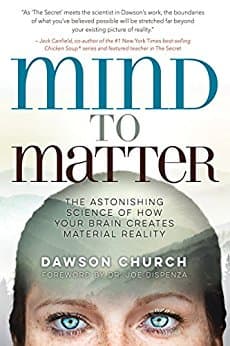
And my newest book is called Mind to Matter.
It's all about how our minds can shift external and internal reality inside and outside of our bodies.
Yeah, I've got Mind to Matter in my hand right now.
And what was the primary focus of this book?
Two things.
The book is really in two parts.
And I wanted to answer the question, what can we do with our minds?
And so right now I have a cup of tea in my hand.
manifested that cup of tea, you'd say, well, how? And so if I told you I manifested that cup of tea
by walking to the kitchen and turning on the kettle, putting in a teabag and pouring hot
water on the teabag, you would not be too impressed by my manifestational powers. But if I told you
that if I was on video right now and I held my hands out and magically I manifested a cup of
steaming hot tea in my hands, you'd be like, whoa, okay, that really works. So there's
manifestation, there's ordinary manifestation, and what are things we can manifest? Like,
for example, I have friends who have manifested millions of dollars. One fun example from my life
today is I've always wanted to meet Tony Robbins, and he's a famous guy. He's really an influential
guy. I've read his books, love his work. And today in my email inbox, I got an email invitation to
to share the stage with him at a big conference he's doing in Abu Dhabi in October.
So a thought became a thing, just in this seemingly magical way.
I didn't do anything, catalyze that.
I had the thought and became a thing.
So what things like that can we do with our minds?
But I can tell you, Xavier, I would love to be 25 years old again.
Is that going to happen?
Probably not.
In the next reincarnation, you can come back.
Manifest that way.
So what's realistic?
we really do? And the book Mind to Matter answers that question. Right. Yeah. So what is the limit
of Mind to Matter? I mean, what can we really manifest into our worlds? And why isn't the
explanation as simple as you walking over to your coffee machine and doing all those things versus
manifesting it with your mind? I believe we think we can manifest certain things. Everyone knows
they can manifest with a cup of tea. People, though, don't realize how much they can manifest
with their minds alone. The book is broken into two parts, and the first part is all about
manifestation in our bodies. I'll give you an example. I have a friend of mine who last year
in March, she got a diagnosis of breast cancer. There was a large lump in her right breast. She
She got thermography scans, other scans.
Eventually, they measured the lump at two inches across.
This is a big, big lump, five centimeter, two inch lump in a right breast.
They also found that all of the lymph nodes under her right armpit were full of cancerous cells,
and there was increased blood supply to them.
So clearly, the cancer had spread, metastasized beyond the primary tumor to her lymph nodes.
And then further scans found three spots of inflammation on her lung, her right lung.
So it looked like the cancer was spreading throughout her body.
This is a very serious diagnosis.
And so she is a believer in energy.
And in the book, I say, you know, by all means, use material medicine.
That pill might be perfect.
That drug, that surgery might be necessary.
But don't just look to what you can do with matter.
What can you do with energy?
And she was a believer in energy.
She also emailed me in some panic because she did a gene test.
And she knew I was an expert on epigenetics.
how our genes are turned on and off from outside the cell.
So she said, I've had this gene test,
and they found eight defective genes,
some of which predispose me to breast cancer.
So she was thinking that she was genetically predisposed now.
And I said to her, Beth, you have 24,000 genes
that don't predispose you to breast cancer.
Let's focus on those.
So she went and spent a week doing intensive qigong.
We got her some energy medicine treatments.
We got her some energy psychology treatments.
she went through a complete shift in the way she thought about her life she eliminated all sources
of stress she turned off all of her alerts on all of her devices she resigned from some activities
she was doing that were good but but stressful to her she had a decent diet but she then had a
rigorously perfect diet after that and so this was in march she got the diagnosis by may two months
Her new scan showed that all of her lymph nodes were clear.
All of those cancer cells that had been in the lymph nodes before were gone,
and the tumor shrunk to about a half an inch in size and diameter.
And then the surgeon said, well, we should operate anyway.
There's still a tumor, and it's still there.
But she got several different opinions from various doctors.
One of them said, you know, I think that's not an active tumor.
I think it's a dead tumor.
and it's shrinking because your body is reabsorbing that tissue.
And so she did not get surgery, did not ever get a biopsy.
And then a couple months later, all of her scans were clear
and the tumor was gone and all of her markers in her blood work
was totally
Of her thoughts, her body, her lifestyle. And energy shifts matters. What I argue in the book over and over and over again is focus on energy. How can energy shift your body? How can it shift your money? How can it shift your relationship? What's the quality of your relationship?
I've been married for a long time and I can tell you if I have a lousy energy in my marriage or toward my kids or toward people on my team, I may never say a word materially, but the energy transmits itself.
If I have good energy, kind energy, compassionate energy, that energy also transmits itself.
So we can do a lot, a huge amount to shift our external world by shifting our internal energy.
So the first half of the book is all about energy and about how it shifts the matter, the genes, the hormones, the enzymes in your body.
And it's supported by about 400 scientific studies showing that energy, literally the energy you create by your thoughts,
the energy your neural pathways in your brain create as they transmit signals from one part of the brain to the other,
All of that is shifting energy, material, that energy shifting material substances like hormones, like neurotransmitters, like genes in your body.
And this is not a belief.
This is not a hypothesis.
This is scientific fact.
And it's backed up by tons of evidence.
The next part of the book is about a different topic, which is all about how energy shifts the material world outside of your body, which is equally fascinating.
But that's generally speaking what the book is all about.
Love that definition. How would you classify consciousness? Do you see consciousness
as a sort of lens in which we are viewing the world and that lens is shifting based on where
we put our energy? How is reality manifesting? Consciousness is the subject of immense debate
and controversy in scientific circles. The materialist scientist, materialist point of view
says that we've been evolving for 3.4 billion years. Eventually, evolution resulted in single
organisms, eventually in complex organisms. Eventually those organisms grew even more
complex with nervous systems. Eventually nervous systems were organized by brains and then brains
threw up this complex thing called mind. And so the summary of the materialist point of view
is that mind is an epiphenomenon of a complex brain. In other words, it depends on its existence,
for its existence on a complex brain. And another famous scientist said, mind is what brain does.
So that's the materialist point of view of consciousness, is that consciousness is in the
mind and the mind is triggered by the existence of the activity of the brain. The other point of
view that I really advocate and talk about in the book is that consciousness is present in the
universe. The universe itself is conscious and that we know from a hundred years of the double
slit experiment. The double slit experiment shows that consciousness, the act of observation,
literally collapses reality from a swarm of possibilities into a single probability. And so
as individuals, we're literally collapsing reality, material reality around us,
all the time by our observation, which comes from our beliefs, our worldviews, and our mental
activity. So with our thoughts, we're literally creating the world around us. Now, we can be
doing this on a local level unconsciously, and we are creating the world around us on that local
level all the time, but far better to do it consciously and consciously create the reality
that serves you and serves the universe. Now, that limited model of a local mind is mildly
interesting and mildly impactful. What I'm really focused on in the book, both in the very first
part, the introduction, and then finally in the last chapter, chapter seven, and the afterward,
I talk about non-local mind. And non-local mind is that great universal consciousness.
and you don't want to be creating from a limited local consciousness steeped in your conditioning,
in your limitations, in the worldview and perspective of your upbringing and your tribe
and your culture because then you're creating small and you're creating the same old stuff
you've always created. You're creating the same stuff your neighbors are creating. What you want
to do is you want to use the tools. In the book, I give people many, many tools that will accomplish
tools that will shift your perspective out of local mind and local reality and into non-local mind and into universal reality.
And now you are conscious as that universal reality and aware of your local mind as a node, a local node, a local receiver.
Like the way, for example, the people listening to this broadcast right now, they're listening to it on a device.
coming from the device. There's something far beyond the device creating the broadcast. Your
device is simply able to translate that those invisible spectra of energy into material sound
which you then hear on the device. In the same way your brain is able to be a transducer of universal
consciousness into your local reality and that's how you want to live because then you're one with
the universal consciousness. You are just dreaming up what you want for your money and your house and
and your marriage, and your kids, and your old age, and your retirement plan, and your career,
you're now focused on that same awareness that makes the seasons, and the planets, and the birds,
and the animals, and the earth, all of these things are in the state of attunement with that
universal consciousness. It's only us human beings with our little local minds that are capable of
bringing ourselves out of that. So what I argue
for is that what you will create
when you're attuned
to non-local mind
is infinitely grander
and more brilliant and
more aligned with the flow of life.
That's why it's synchronous because now
if you have the thought, I'd like to
share the stage with Tony Robbins
and suddenly out of the blue
you get an email saying, will you
share the stage with Tony Robbins?
It's uncanny
when you get into that synchronous state how these things
just happen to become very careful and conscious of your thoughts and your level of attunement,
because you know you are that creator. So that's how it works on that grander scale
outside of our human bodies. Yeah, I mean, but it's not like we can just sit back and let the
energy do the work for us or let intention do the work for us. We have to actually take action,
right? One of the things I show in brain scans, we've now done brain scans of hundreds of people.
My friend Joe Dispenza at his workshops has done brain scans of close to 10,000 people.
And looking at those brain scans, there is a huge difference between people who have coherent brain
waves, coherent mind, mental function, and people who have incoherent brain waves. And it's kind of
like in the book in chapter two, I have graphs of what an incoherent brain looks like, what a coherent
brain looks like. And in the coherent brain, you see a whole bunch of squiggly lines going running
horizontally across the monitor, but all of those squiggly lines are in sync. And then if you look
at an incoherent brain, you see a whole bunch of squiggly lines running across the monitor,
and they're not in sync, they're all over the place. And so people who are master manifestors,
people who are able to create things, are people in sync. In one famous experiment I talk about in
the book, these people were told to intend to alter the degree of twist of the DNA molecule.
This is something we can measure using certain scientific equipment. We can measure in a sample
of DNA. DNA has a double helix shape and we can measure how tightly twisted those molecules are
on average. And so what these intenders were told to do was there was a vial of DNA
They were told to alter the degree of twist in that vial of DNA, but not in the vial of
DNA right next to it.
So they were told to intend to do this.
People with non-coherent minds, people with non-coherent mental and physical function,
their intentions had no effect on the DNA at all.
People who were incoherent, they could affect the DNA.
In fact, in one study, they were given three beakers of DNA in front of them and said,
we want you to change the degree of twist in the middle beaker and leave the two side ones untouched.
People who had no coherence were not able to do that.
People who were in coherence were able to do exactly that.
Then they moved the three beakers 50 miles away.
So now it's not just a local effect.
They thought, well, how there's a plausible explanation that maybe the person's own local electromagnetic field
is affecting the conformation of the DNA molecules.
move the beakers 50 miles away, there was no possibility of electromagnetic interference or
effects of that, and still the effect persisted. Those incoherence were able to do that. So,
I show you in the book how to get incoherence and some of the astounding things, the astounding
things, Xavier, that people in coherence can do. They can literally change the fundamental
forces of physics. And that's the power we have with the coherent mind.
I mean, it's fascinating. I find this subject highly intriguing, the idea of, you know,
manifesting something with your mind. But I mean, I'm not sure if you answered my question
or not. Once I intend something, that's not the only thing that I have to do, right? I have to take the steps necessary to make that intention flourish, right?
Well, how much do you have to do? That's the question.
I mean, we can't just – sorry to cut you off. We can't just sit back and intend things and expect them to appear. Can we do that?
Well, it's such an interesting realm of human inquiry because sometimes what I've found is you can.
In chapter one of the book, I tell the story of a trip I took.
I had to finish a book many years ago on a tight deadline, and I wasn't getting it done in my office.
So I decided to fly to Hawaii for a week.
I'd have no interruptions.
I could just work with it uninterrupted in a condo of looking at the beach.
So I rented a condo, flew out to Hawaii, and then I'd sit there in my condo.
I'd look out at the beach, and occasionally I would jump in the car and go for a swim.
And there was a lot of lovely beaches in that part of the south part of Kauai.
I'd explore different beaches.
I'd all my snorkeling gear in the back of my car.
And so one day I drove the car to a beach.
I grabbed the snorkeling gear out of the trunk.
I went to the beach, went snorkeling for the whole afternoon.
And when I got back my car, I reached into the pocket of my bathing suit and my car keys weren't there.
And I'd also clipped the keys to my condo to the keys of the car.
So now I was locked out of the car and out of the condo.
So I went back in the water and this was a huge bay.
This bay is about 300 yards wide and long.
So it was a big, big stretch of bay, about 6 to 12 feet deep, car all over the bottom.
around this place trying to find a tiny set of car keys. And it was just a fool's errand.
But I just stayed in my heart and I had the intention of driving the car back, having my
keys. And I searched for the car keys for like an hour, swimming all over the bay, nothing.
And eventually it was getting dark. And I realized that the odds of my finding these tiny keys,
10 to 12 feet down in this huge bay were remote.
So I began swimming back to the beach to leave the water.
And this father and three sons had just gotten into the water for just a quick dip before
the sun went down.
And I just had this intuitive nudge.
I swam over to them and said, I see you guys have been swimming around here.
Did you find anything on the bottom?
And the youngest son held up my car and condo keys.
So again, what did I do?
take action. I did swim around and look for them, even though the odds were a million to one against
me finding them. And then very mysteriously and synchronistically, someone else found those car
keys. So yes, you do sometimes have to take action. I mean, if I want a job at a certain place,
I need to create a resume and circulate my resume. If I want to find a companion for my life,
I need to put myself in places where I'll meet people. I can't lock myself in a closet,
never meet anybody and hope the universe has somebody come and knock on the door of the closet.
So yeah, you need to take action.
What do you find over and over again?
Even writing the book was synchronous.
Like I was writing the chapter on synchronicity.
And eventually, I thought when I planned the book, well, you know, synchronicity is a mysterious phenomenon.
There's no science behind that.
That chapter of the book will be science free.
It'll just be a collection of nice anecdotes about how synchronicities happen.
That is now the longest chapter of the book, and it's packed with science.
I found all kinds of synchronicities happening while I wrote the chapter on synchronicity that mysteriously brought the very scientists to me who are doing the primary research proving the link between individual coherence and universal, global, and large-scale coherence.
So I tell some of the stories in the book about this.
So there are healing stories in the first half,
but the second half of the book is these remarkable stories
of the science of synchronicity and how you do have to take action.
What do you find is the action you're taking then is synchronous.
You're at the right place at the right time
to get just the piece of information you need to make your dreams come true.
So you aren't putting out effort.
You aren't sweating.
You aren't goal setting.
you are just one with that universal flow, and if you train yourself if you want the universal flow,
then whatever action you do take is effective. Lightning swimming up to those four people and
saying, did you see anything on the bottom when you were diving down?
Yeah, but if you didn't ask those people anything, if you were just sitting back
and not doing anything about that, you would have never gotten the answer that you needed, right?
Right.
I want to switch over to a book you wrote, and epigenetics, you mentioned epigenetics earlier.
You wrote a book called The Genie in Your Genes, and you were looking at the way epigenetics plays this role in our bodies that is conducive to healing.
What are immediate early genes, and why did you focus on those in your book?
Immediate early genes, there are different categories of genes, and it has to do with how long they take to peak expression.
And so some genes get turned on or turned off, and then they're turned on or they're turned off, they're expressed or they're silenced for your whole life.
Just one simple example is eye color.
You have a certain color eyes, that gene got activated when you were very young, and that gene is stable throughout your whole life.
That gene is not going to suddenly give you green eyes if you have brown eyes now.
There actually are very rare cases where that does happen, but for most people, those things are fixed.
eye color. There are all kinds of physical, phenotypical appearances of how your body is,
how it works, which are fixed genes. But other genes turn on and turn off in cycles. The Nobel
Prize for Medicine went last year to a researcher who helped figure out how our cluck genes work,
because when it gets dark at night, you start to feel drowsy, eventually fall asleep, and the genes
that code for certain neurotransmitters and hormones are changing when you get drowsy.
Same thing happens around 6 a.m. in the morning.
At 6 a.m., the genes that code for cortisol turn on.
Suddenly, you have a big flood of cortisol in your system.
Your cortisol hits peak expression at about 8 a.m.
And so these genes are on a 24-year clock genes are in a 24-hour cycle.
But immediate early genes are genes that turn on very, very quickly in just one, two, or three seconds.
But examples of those are stress genes.
If you're walking past a dog park and there's an owner there who has a huge, ugly, mean-looking pit bull,
and the pit bull looks at you and snarls and breaks free from its owner's leash
and rushes to you with fangs bared and gruel streaming from its mouth,
you have a really quick stress response.
And your genes that code for stress hormones,
like adrenaline and cortisol,
they turn on, they're turned on
by those immediate early genes
in one or two or three seconds.
You have a huge spike of those stress hormones
and that enables you to activate
the fight or flight response.
And then you are able to take appropriate action,
fight or flight or freeze.
So those immediate early genes,
like stress or govern biological processes, but you need a very rapid response.
Do you think there's an intention gene? Like maybe some people are better at intention and
manifestation than others? I don't think there's an intention gene as such. I think that there are
people who, when they have intentions, are triggering genetic cascades. And in that state
coherence, you are definitely shifting gene expression. For example, we know from research,
I did a study at, well, I do a lot of live workshops every year. I could teach at Esalen,
I teach at Kripalu, I teach at the Open Center in New York, teach at Omega Institute. And so we
did a study of people at one of my week-long workshops. They were meditating in the morning,
they were doing EFT, emotional freedom techniques, tapping, acupuncture tapping,
in the afternoon, and so they were also bringing in their intentions. And we showed over the course
of a week that their baseline levels of cortisol dropped by an astonishing 37%, and then their
levels of immune function rose by 113%. We were measuring their biological markers of immunity.
So massive changes happening in their genome. And so when you intend, then anywhere in that
which tapping and meditation bring you into,
when you attend in that state,
you're literally triggering the expression of different genes.
In one study, RBFT, done by a colleague of mine,
she looked at people's gene expression
before and after a one-hour tapping session.
And after the hour, 72 genes had changed their configuration.
It upregulated, 72 genes, it upregulated it.
It turned on genes that fight breast cancer, prostate cancer, thyroid cancer, and colon cancer.
It turned on genes that improve the insulation of neurons in the white matter of your brain.
It turned on genes that code for memory and learning in the limbic system of the brain.
It coded for genes that improve your metabolism.
It improved genes that code for cell repair.
all of these genetic changes happening as
people shifted into those states of coherence.
So not an intention gene per se, but is intention changing genes? Absolutely. Many of them and those genes have a direct impact on your health.
Thank you guys so much for listening to this episode. We are going to take a small break for a message from our sponsors.
What's up, guys? Let's talk about mattresses. Let's talk about sleep. Sleep is an absolutely
crucial part of a human need. I mean, it's like eating or drinking and breathing. Like other
needs, sleep is the foundation for good health and well-being throughout your lifetime. Spoiler,
this is where Helix Sleep has completely changed the game on mattresses and sleeping. Whether you're
sleeper or a hot sleeper, whether you like a plush or firm bed with Helix, there is no more
guessing or confusion. Get to helixsleep.com slash HXP, take their two-minute quiz, and they'll match
you to a mattress that will give you the best sleep of your life. Right now, Helix is offering
up to $125 off of all mattress orders. That's right. $125 off at helixsleep.com slash HXP.
That's helixsleep.com slash HXP for your $125 off your mattress order. One more time,
helixsleep.com slash HXP. Stop losing sleep. Stop affecting your productivity and change
the way you attack life. So get to helixsleep.com slash HXP and change your sleep game.
There was a Huffington Post article that you wrote called Personal Epigenetics,
a New Era in Health and Medicine. And you were looking at the effectiveness of emotional freedom
techniques and changing the expression of genes. Can you just spell out what EFT is for anyone who
doesn't know, please? Yeah, EFT, for those who haven't heard it before, is a very simple method
that combines acupressure. So it's not acupuncture, it's pressure with the fingertips by tapping
on those acupuncture points. And you do it yourself, no one else does it for you, it's just
self-help method. And you combine that with affirmations and with elements of cognitive
therapy. And what we do, for example, at the Veterans Stress Project is we bring in veterans
who are traumatized, who maybe been through both childhood traumas and combat. And we then have
them remember those events. Like I worked with one young Iraq veteran. He fought in the Battle
of Fallujah. And in his, like the first week he was there, he was a medic. And he had to gather up
the personal effects of a friend of his who'd been killed. And so there we have to take this
blood-stained uniform and clean it up, send it back to the dead soldier's family back home.
Again, terrible, terrible triggering sights, sounds, smells.
And before EFT, this young man was traumatized.
We've now done seven randomized controlled trials, and they show that EFT is extremely effective for PTSD.
In one clinical trial I did, we looked at the PTSD levels in veterans,
and they declined 64% over the course of six one-hour treatment sessions.
And EFT was effective for 85% of veterans.
Colleagues of mine then did a replication study where they replicated that study
and they found that the same decline in symptoms,
so flashbacks, nightmares, intrusive thoughts, all of those symptoms went away.
And not only that, they found that it was effective for 90% of veterans.
and in long-term follow-ups,
we find the effects then persist over time.
And in the meta-analysis of those seven studies,
the researchers found that
they had a huge treatment effect.
And a treatment effect means
how effective is your treatment?
So you take a pill,
you go and get behavioral therapy,
you get cognitive therapy,
you do coaching,
and you can measure how effective it is numerically.
Like, is your anxiety going down by 12%?
or 85% that's a huge difference and some therapies will bring your anxiety down a lot others a little
bit so effect size is something that we can measure statistically in a meta-analysis and
effect size is measured on a scale with two being some effect with five being a moderate effect
and with eight being a big effect.
So two is a very minimally effective treatment.
Eight is a very effective treatment.
On that scale of two, five, and eight,
the researchers who did the meta-analysis
found that the number for how effective EFT was for PTSD
was 29.
On the scale of two, five, and eight,
EFT was effective at the scale of 29.
In other words, massively affected at bringing down symptoms.
So that's the power of what EFT can do for people suffering from PTSD.
Yeah, I mean, so EFT not only reducing illness and helping with PTSD, it also boosts performance, right?
This is a study that you guys worked on.
This is so fun.
I just presented at another conference where one of the really weird things about psychology, Xavier, is that we've had these assessments now for 40, 50, 60 years sometimes.
Things like the back anxiety inventory, the PTSD inventory, the depression inventory, all of these things.
And what they do is they measure, like if you have a score of zero on the back depression inventory, that means you have no depression.
You have a score of 16, that means you're highly depressed.
Okay, so zero means no depression.
And the whole psychological research for decades has been on how much better you're getting if you're treated.
And that's a very fair question to ask.
But what people began to realize about 20 years ago was that, you know, just having no depression,
maybe there's a little bit of life beyond just not being depressed, not being anxious, not having flashbacks and nightmares.
How about thriving?
So we have, for example, a coaching psychology course that is absolutely the most state-of-the-art course in coaching psychology that my colleagues and I put together.
And so that course ends in the last two modules with peak states and thriving.
What would happen if you were to be able to walk onto the tennis court and play at a much higher level of play?
I can tell you we've just had the World Cup and a lot of those people, a lot of people, those teams were tapping.
They were meditating. They were doing all kinds of performance hacks to improve their performance.
So that's the next phase is not just how do you not suffer, but how do you take your baseline of health and happiness and well-being and get a lot happier?
So, for example, at that same week-long workshop at Esalen, where we were measuring things like salivary immunoglobulin A and cortisol and brain waves,
we also measured happiness. And people over the course of the week, their baseline happiness
improved by 31%. So again, as their cortisol is dropping, as their biochemistry is changing,
their mood is improving, anxiety and depression goes down, and positive things happen. So there's
a lot of EFT now in professional football, National Football League, professional baseball,
Major League Baseball, American League Baseball, a lot of athletes are now discovering that it gives
One of my favorite quotes is from one of our certified practitioners.
And I urge people to check out getting a practitioner and working with them on either whether it's a physical issue or a performance issue, but work with someone who's certified.
This woman had been a medalist in the 2000 Olympics.
and she said, Dawson, in my sport of swimming, the difference between gold and bronze
is one one-thousandth of a second. She said, you don't get one one-thousandth of a second quicker
by effort or by muscular strength. It's the mental game. And so much of improvement is the
mental game. In my book, Mind to Matter, I talk about how high performers like people at Google,
the Google executive suite, are using these methods. People in the Nike innovation team,
people at Reebok using this, the Navy SEALs know that using these methods is important to not be
stressed. They just built a huge facility called the Mind Gym in Norfolk, Virginia, where they're
applying these methods to their high performers, to these Navy SEALs. They're putting millions of
training these people, mental training is a key part of it. And they find that it raises productivity
by over 250%. It doubles creativity, it improves their ability to think in difficult crises like
hostage rescue missions. So they learn to acquire these mental states before a hostage mission and
after as well, so they don't get PTSD and improves their performance during as well. So yeah, high
performers of all stripes that are discovering that you can
learn, train yourself into these elevated brain states.
Yeah, it's amazing. And I mean, you have your hands in all this work. You're really pushing it forward.
You created something called eco-meditation. Can we get into that? What does that involve?
It is for people who, like me, are terrible meditators, which includes most of us.
So most people, when I'm doing live workshops, I say to people, I ask questions like, how many of you here in the workshop have taken a meditation class or read a meditation book?
And like everyone raises their hands.
They've all taken meditation classes.
Then I say, and how many of you meditate daily?
And like maybe one person in 20 raises his or her hand,
and then the other 19 stare at the floor in embarrassment
because they, like me, like I took a meditation class,
my first meditation class when I was 15 years old.
I was living in a spiritual community and we were taught meditation.
And the teacher said, meditation is very simple.
All you have to do is still the mind.
I thought, still the mind? Still my mind? My mind is never still. So I helped develop meditation
along. I was in dialogue with a lot of other pretty smart people when I was developing it,
like Dr. Edna Spenza, Roland McCready, the chief scientist at HeartMath, Dean Radin,
the chief scientist in the Edometic Sciences. We were talking, though, about what's common to all
of these effective practices. And I developed meditation, eco-meditation, to be so simple
that even people like me who constantly
are minds, constantly sits still for five minutes
are able to do it. And so it's
very simple, it's very mechanical
it's just doing
seven things with your body, breathing
a certain way, sitting a certain way
relaxing certain muscles, but
in it you mimic the physiological
state of that
mentally coherent master
meditator. It turns out when you just mimic
their physiology that you drop
into that deep state yourself. So it's
very powerful and the research we're doing
Now, on eco-meditation is showing that it's having all of these powerful effects on brainwaves,
neural functioning, brain functioning, hormones, immunity, and mood.
So it really improves people's markers in all of those dimensions.
So how does one sit down and do eco-meditation?
What's the difference between regular meditation and eco-meditation?
Eco-meditation is really simple, and it's physiologically based.
You do these seven things and they send signals to different parts of your brain and your body to relax in certain ways, but also become hard coherent.
And so other meditation traditions might say, well, come to this ashram, chant these words.
Here's what the spiritual teacher says you have to do.
Go through these cleansing practices.
Eco-meditation just dispenses with all of that.
What we've done is we've secularized meditation.
We've taken meditation.
the spiritual and religious and philosophical trappings from it, and it's down to the bare
bones of what you do with your body to trigger that state of being in physiological coherence
like a master meditator. And so we've stripped away all of the mythology around it.
That mythology can be useful, but you don't need it. Those Navy SEALs are not being trained to
believe in a certain kind of spiritual religious practice. They're being trained to acquire these
independent of those practices. And so we've now found, because we have advanced tools,
I mean like when meditation, big meditation studies that put meditation on the map in terms of
a neurobiological phenomenon were the ones done by Richard Davidson at the University of Madison,
Wisconsin, where he examined Tibetan monks who've been meditating for 30 or more years.
So these guys have been sitting there in meditation four hours a day, 30 plus years, and he hooked them up to EEGs and MRIs, and these monks were happy.
All the happiness centers of their brains were lit up, and all the fear centers of their brains were shut down.
Also, the personality parts of their brains were shut down.
the parts that think I'm me, the parts that think my name is Dawson Church, that think I'm wearing a black and white shirt,
think I'm sitting in an office at a standing desk, think I'm staring at a Macintosh monitor.
That part of the brain just went dark in those studies.
So those studies really showed that meditation was making us happy and shifting the brain.
The thing is, though, if I were to tell you, Xavier, you too could be that happy and shift your brain function.
and all you need to do is spend four hours a day for 30 years meditating.
It's like, that's unrealistic.
So I wanted something that would let people get to those states really, really quickly.
And I took those MRI and EEG patterns and said,
how about if we just put people in that same MRI and EEG signature state
and we skip all of the mythology, we skip all of the religion,
And we say, do this, do that, do that.
And the thing is, at the retreats I teach, we have people in that same state in about
four minutes.
It does not take 30 years.
You can train your body to do it in just a very short period of time.
You wrote a really fascinating editorial in Energy Psychology Journal called Set Points,
Unconscious Triggers Governing Our Behavior.
Can you talk about set points and what they are, please?
illustrated with two different people.
So you have somebody who is a pessimist.
And whatever you tell her, she finds a way, a frame for that,
to turn it into something that is bad, is miserable, is negative.
And all the people like that.
Whatever you tell them, they find a way of, you know,
something good happens, they say, well, I'm waiting for the other shoe to drop, or what goes up must
come down. They have some kind of rebuttal of every good thing that happens in the world. So they're
having these thoughts all the time. So they're having these thoughts. These thoughts aren't
abstractions in their brain. They're signals being passed along neurological pathways in their
brains. So if you pass a signal through a neural bundle over and over again for an hour, you double
the number of synapses.
In other words, that neural bundle is getting bigger
and bigger and bigger the more you think that thought.
So now, the thinking that thought,
that thought is triggering mental
activity, sending signals
through those neural bundles.
Those bundles are getting bigger and bigger
and bigger, and over time
they're now reshaping
their brains. Their brains are
changing in response.
Neural plasticity
is changing their brains in response to that.
a negative thinker is shifting their function. What then happens is they're triggering stress
hormones like cortisol. And so now they maybe had a moderate set point for cortisol. And
we measure it on a scale that goes from like 2 to 12. So maybe their natural set point was 6.
But now the triggering fight or flight in their body with that brain activity over and over and
again. And gradually over time they raise that set point to seven, then to eight, then to nine,
then to ten. Now suddenly rather than having a moderate set point for cortisol of six,
on a scale of two to twelve, they have a set point of ten. Somebody else now is a positive thinker.
Same things happen to them, but they are relentlessly positive. So they're sending,
they're having positive thoughts, they're sending signals through different parts of the brain to do
Those neural bundles are growing, those parts of the brain are getting bigger, and now those positive signals are taking them out of fight or flight.
Their cortisol is dropping.
They were also six originally, but now it drops down to five, and then four, and then three.
And so now their set point is three.
So both people began with the same brains, the same set points.
The optimist has now dropped her set point down to three for cortisol.
The pessimist has raised hers to 10 for cortisol, and you now have a different set point.
And that set point has radical effects on your body.
Cortisol literally produces calcification, hardening of the memory and learning centers
in the brain.
Calcium is the stuff your bones made out of.
You're not supposed to have calcium in your brain, but literally there are these calcium
deposits on the memory learning centers of the brain so that inhibits the ability of neurons to
conduct signaling. So now over time, you have one person with high cortisol, one person with low
cortisol, and it shows up in health span and lifespan. So optimists, I talk about in mind to
matter, the differences in lifespan between optimists and pessimists. Optimists live on
average eight years longer than pessimists. That cortisol is producing a degradation in people's
health, in their brain function, in their cognitive abilities. They have more dementia,
more Alzheimer's, more cognitive decline over time. The optimists have a much healthier and
much longer life. So these set points then govern our behavior. So set points are hormonal,
they're neurological, they're physiological, and they then become the way we respond to the world.
So it's super important to start to regulate your set points, shift your thinking,
and then have healthy set points for all of these neurotransmitters and these biological functions.
Yeah, it's really fascinating. I want to
jump back into Mind to Matter. I want to talk about intuition and premonition. This is something that I've been waiting to ask you. How much do you think intuition plays into the idea of manifestation and being connected to the sort of non-local aspect of consciousness?
it? Intuition is really interesting. And some people, for one thing, it has something to do
with belief. There are people who believe in intuition, who believe in clairvoyance, who
believe in telepathy, who believe in psychic phenomena like that. And there are people who
don't believe in it. Now, one of the really fun things I've discovered in reading studies in this
feel is, Xavier, this is just hysterical. This is like some big cosmic joke being played on this
by the universe. So people who have a strong belief in these phenomena like intuition
have experiences of intuition frequently, but those people who do not believe in intuition
do not have intuitive experiences nearly as frequently and sometimes never. So our experience
of these psychic phenomena is tied to whether we believe in them. And so if you believe in them,
they tend to happen to you. If you don't believe in them, they tend not to happen to you. And so
it's something that is happening, but only for those people who are believers in it.
And intuition is really powerful. One of the most interesting forms of intuition is precognition.
Precognition is, I have a big section on this in the book about the research
into precognition. Precognition is the belief that I can know the future in some way, not that
I can foretell the result of the next election or know where the stock market's going, but that I
get little intuitive hints, hunches about things that are happening in the future. And so people
are precognitive. People have this ability of precognition. And the book has a review of over,
I don't know how many studies there are in this review, certainly over 200. I can't recall the
exact number, but the preponderance of evidence is that precognition exists, and that intuitively,
we certainly can, in many cases, know something about events that aren't supposed to happen.
So yeah, intuition and these other phenomena are real, but the more you believe in them,
the more real they are for you. Yeah, it's such an interesting paradox. I mean,
I mean, is there a sort of halfway point where you want to test it first?
Well, I love science because science gives you those halfway points.
And I also do a lot of debunking in the book of myths.
People believe this, things can happen.
People believe in miraculous things that might happen.
And I don't want to discount the possibility of a miracle, but science shows you the extent
which it is possible.
And I think that that's why it's useful reading a book like Mind to Matter and knowing what
possible. So you're trying to do the things that you can do, like affect the number of circulating
immune cells in your body, how many stem cells you have in your system, affect things like your
body's ability to suppress cancer tumors. All of these things are things you can do. But don't try
and do things that are difficult or impossible. And science gives you the parameters of what those
are. I mean, the idea here is that we are affecting matter with our minds. This is the
title of your book, right? So what are some of the things that have happened in your life that
you've noted where it would sort of promote this idea? Yeah, I do talk mostly about other people
and about other people's experiences, but I have had quite a few really startling experiences in
my life of synchronicity, intuition, and being in the flow. When you're in the flow, those experiences
happen to you more often. One simple one was that when I was scuba diving last a few weeks back,
I scuba dive three or four times a year, and I was in the Florida Keys, and there's a very unusual
kind of fish called the scrawled
filefish. And it's unusual because
it swims at a 45 degree angle.
It's just a very ordinary
looking fish, except that
it looks like, it always looks like a crossbar.
It's always swimming at a 45 degree angle.
So it's a very distinctive fish.
I'd never seen one before in 75
scuba trips.
And I was swimming
down at the depth of about 30 feet.
I just had this thought, wow.
It would be
fabulous to see
a scrawled file fish.
I had a diving buddy.
I was moving along with him.
And then my intuition gave me this little nudge and said,
look behind you and up.
And I did.
I turned all the way around and looked up for the surface.
And there, silhouetted against the sun,
was a scrawled file fish.
And it was just interesting.
I'd had that thought that morning.
And then on that 75th diving trip, I saw one.
I then admired it for a while
but again it wasn't right in front of me
I had to then hear the intuitive nudge
to turn all the way around
and normally in scuba diving you're looking
horizontally or you're looking down
I had to look up
against the sunset and sunrise
there it was right against the sun
so that was just one little nudge
I just enjoyed the fish for a while
I turned around and kept on swimming
and then I had this memory
I thought you know I've never been
scuba diving in Mexico in this place called the cave of the sleeping sharks. And I had this thought,
I was swimming along behind my scuba buddy, and I thought, oh, one of these days I might go see
the cave of the sleeping sharks, which is a famous cave where these sharks lie on the bottom.
And I was swimming along, and this guy was in front of me, and he was looking around,
I was looking around, and I noticed a small cave around the next bend, and looked inside the cave,
So I'm going to swim a little further down, a little deeper.
I can see further in the cave.
So I swum down a little further, like three feet further.
And there was a shark on the bottom of this cave, just lying there, hanging out.
Which, again, my buddy hadn't seen.
So I swum with my buddy, grabbed his fin, pulled him back.
We both went back, looked at the shark.
Now, again, these are just little nudges you get, little hints you get.
And you get in the habit after a while of listening to them.
And when I was younger, I'd hear them, but I would override them.
My logical mind would say, that's silly.
Don't do that.
But now in my, you know, I've had a few years of doing research and looking at them.
I listen to those intuitive nudges.
And I find that they happen to me pretty much every day.
I wake up, meditate, then say, universe, what amazing synchronous surprises will I encounter today?
I can't wait to see what you have in mind for me as I coordinate, as I entrain myself with that non-local mind.
When you're entrained with non-local mind, you also are entrained with everyone else who's also entrained with non-local mind.
So you find things happen synchronously for you all the time.
Yeah, wow, so much going on here.
And, you know, it's amazing through this whole interview, you've mentioned things that literally on my list of questions, word for word almost.
It's really interesting.
I mean, you mentioned flow state.
That's literally the next thing that I was going to bring up or mention.
I wanted to ask you about how Mind2Matter talks about flow state and what flow state
is.
We talk about flow state here a lot, but I'd like to hear your interpretation of that.
flow states are states where you feel a frictionless sense of
flow with everything around you. And the sense of friction, of bumping up against people and
events and things goes away. And you're in this state of feeling as though things are effortless
and easy. And athletes talk about this. They say that when they're in the flow,
they know everything's okay. Time
seems to slow down. They have all the focus and concentration they
can need. They're in this altered state. The cool thing about flow states is
when they were first described by Mikhail
Xavier, I cannot pronounce his last name,
sent Mihaly, his book called Flow came out in the 70s
and catalyzed our awareness of flow experientially.
He described what people who are experiencing flow feel like.
We know what they feel like, what it looks like to them.
What we now have, though, with advanced imaging tools
is we know what the brain looks like in flow.
And there are different names for it.
And the name that I use most in my book, Mind the Matter,
is this EEG signature state called the awakened mind.
We hook people up to an EEG, and when they're in flow, we can see what their brainwave patterns are.
And in the book, I show you what those exact brainwave patterns are, what they look like.
We know when they're in awakened mind.
Another word for flow in the Navy SEALs don't call it flow.
They call it ecstasis, E-C-S-T-A-S-I-S, and off the Latin word ecstasy.
they use this phrase called
ecstasy so they know you can feel
when you're
in flow, when you're in awakened mind, when you're in ecstasis. And so we know what
that looks like in terms of a brainwave pattern. We know what it looks like in terms of a human
experience. And the cool thing about it being an experience is that when you've been trained
to acquire that brain state through eco-meditation, through tapping, you know what it feels like in
your body and you don't need an EEG to be able to acquire it. I was on a panel, a science panel
recently with a guy who's an executive officer with the company that makes the Muse headband.
And he says, after you've trained yourself using a Muse headband for a while to acquire these states,
you don't need a Muse headband. You know what it feels like internally. So you know the set point
of cortisol, of immunoglobulin, of DHEA, of serotonin, of dopamine, of GABA, of acetylcholine.
You know exactly what all of these ratios are. You no longer need these external ways of
That's the beauty of these internal states.
So you change your set point, you know what it feels like then to be in flow, and then
you use the tools that get you in that state and keep you in that state for as long as
you want.
Yeah, I mean, do you think this is the new science?
Do you think this is sort of the next thing that we're going to be finding out more on?
Do you think that's happening right now as we speak?
the new soft science is going to be meditation and eft and derivatives of meditation and eft
and the new hard science is going to be wearable devices that monitor this and help you get into
the zone and maybe ones that can stimulate you to be in the zone that's quite hard um because
we know these brainwave ratios. I can build a device that will artificially induce those into
you, but that device will work well for some people and will traumatize other people because
the way our brains come to the experience is very different. But wearables, miniaturized devices,
wireless devices, right now to use the Muse headband, I have to put the headband on my head.
To use the EEG, I have to use electrodes and attach them to my scalp. What's coming soon
to a brain science center near you
is a wearable device and a wireless device
that'll do all of this for you
without you having to go to all the trouble
of hooking up all those electrodes
and having a power source.
So the software is going to be tools like energy medicine,
energy psychology, tapping, meditation.
That'll be the software that gets you there.
The hardware that measures it
will increasingly be miniaturized,
be wearable, and be unobtrusive
charging and connection. So that's where I think we're going in terms of hardware and software.
Yeah, Dawson, such a fun interview. Where can people find Mind2Matter?
Go to the website for the book, which is mind2matter.club.club. So it's not .com
or .net or .org. It's mind2matter.club.club. So mind2matter.club, you can order the book.
You can also get free meditations.
I also give you access to several ways of really using the book effectively, like ways
of meditating along with each theme chapter.
The book also has an extended play bonus section after each chapter, which gives you access
to videos, to research sites, all kinds of information lists, lists of practitioners,
people who can apply these therapies with you, performance coaches, and so on.
But all that's accessed through the .club website, Mind of Matter.club.
It's all there.
Okay.
And do you have a personal website that people can go to to see your other work?
That'll dump you on.
It'll give you access to all of those things through the Mind of Matter website.
Okay, great.
Dawson, thank you so much.
Guys, we are going to get out of here.
My guest is Dawson Church.
The book is called Mind to Matter, The Astonishing Science of How Your Brain Creates Material Reality.
out, put it into Google, and find it there. Thank you guys so much for listening. You will hear from
us next week.
About the guest
Dawson Church PhD
Dawson Church is a health writer and researcher who has edited or authored a number of books in the fields of health, psychology, and spirituality. His principal works are The Genie in Your Genes (www.YourGeniusGene.com), which reviews the research linking consciousness, emotion, and gene expression (USA BookNews “Best Health Book”), and Mind to Matter (www.MindToMatter.club), which examines the science of peak mental states. He has published many scientific papers in peer-reviewed journals, collaborating with scholars at various universities on outcome studies of posttraumatic stress disorder (PTSD), depression, and anxiety. He is the editor of the peer-reviewed journal Energy Psychology: Theory, Research, and Treatment (www.EnergyPsychologyJournal.org) and general manager of Energy Psychology Press, which maintains a research bibliography and case histories at EFT Universe (www.EFTUniverse.com), one of the most-visited alternative medicine sites on the web. He is a blogger for the Huffington Post and science columnist for Unity magazine.
Episode 156 – Mantak Chia – How to Find Inner Balance, Connecting with your Purpose, Chi, Energy, Prana
January 17, 2020 · 59:08
Episode 126 – Massimo Pigliucci – Stoicism, Virtue & thriving in a world out of control
May 3, 2019 · 1:23:16

HXP SHORTS: #001 – Deconstructing Death: What Happens When We Die?
September 14, 2026 · 11:37
Episode #189 – Dr. Bernard Beitman – The Science of Synchronicity and Meaningful Coincidence
January 6, 2023 · 1:14:27
Episode #186- Positively Angela – The 7 Hermetic Principles & Living a Better Life
December 20, 2022 · 1:26:56

Episode #185 – Brad Klausen & Chance Gardner – Esoteric Egypt, Pineal Gland Activation, Kundalini, and more
December 14, 2022 · 1:50:21
Independent conversations
Help make the next one possible.
Membership sustains ambitious, unhurried interviews and keeps the complete archive open to curious listeners everywhere.
Become a member