

The Human Experience · Episode
Episode 66 – Anders Ericsson Ph.D. M.D. – The Science of Expertise
A conversation with Anders Ericsson Ph.D. M.D.
ERICSSON, K. ANDERS Ph.D. M.D. , is Conradi Eminent Scholar and Professor of Psychology at Florida State University. In 1976 he received his Ph. D. in Psychology from University of Stockholm, Sweden, followed by post-doctoral fellowship at Carnegie-Mellon University.
Stay with the full conversation.
Episode field notes
Show notes
ERICSSON, K. ANDERS Ph.D. M.D. , is Conradi Eminent Scholar and Professor of Psychology at Florida State University. In 1976 he received his Ph. D. in Psychology from University of Stockholm, Sweden, followed by post-doctoral fellowship at Carnegie-Mellon University. In 1980 he moved to University of Colorado at Boulder, where he remained until 1992 with the exception of a two-year leave during 1987-89 at the Max-Planck Institute for Human Development and Education in Berlin. His dissertation examined how verbal reports on cognitive processes provided insight into the structure of problem solving on the 8-puzzle.
Ericsson’s research with Herbert A. Simon on verbal reports of thinking is summarized in a book Protocol Analysis: Verbal Reports as Data, which was revised in 1993. With Bill Chase, he developed the Theory of Skilled Memory based on detailed analyses of acquired exceptional memory performance (Chase, W. G., & Ericsson, K. A. (1982). Skill and working memory. In G. H. Bower (Ed.), The psychology of learning and motivation, (Vol. 16). New York: Academic Press). One of his most striking experimental results was training a student to have a digit span of more than 100 digits. With Walter Kintsch, he extended this theory into long-term memory to account for the superior working memory of expert performers and memory experts (Ericsson & Kintsch 1995)
Currently, Ericsson studies expert performance in domains such as medicine, music, chess, and sports, focusing exclusively on extended deliberate practice (e.g., high concentration practice beyond one’s comfort zone) as a means of how expert performers acquire their superior performance. Critically, Ericsson’s program of research serves as a direct complement to other research that addresses cognitive ability, personality, interests, and other factors that help researchers understand and predict deliberate practice and expert performance. In the domain of deliberate practice, Ericsson published an edited book with Jacqui Smith Toward a General Theory of Expertise in 1991 and edited a book The Road to Excellence: The Acquisition of Expert Performance in the Arts and Sciences, Sports and Games that appeared in 1996, as well as a collection edited with Janet Starkes Expert Performance in Sports: Recent Advances in Research on Sport Expertise in 2003.
The four main areas of the research Anders is conducting are:
1. The Acquisition of Expert Performance and Deliberate Practice 2. Professional Development 3. Superior Memory of Experts and Long-Term Working Memory (LTWM) 4. Protocol analysis and Verbal Reports on Thinking
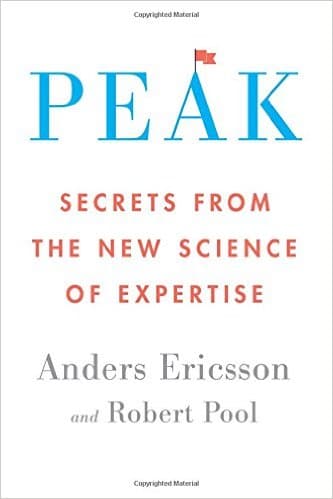
About Peak: Secrets from the New Science of Expertise:
From the world’s reigning expert on expertise comes a powerful new approach to mastering almost any skill.
Have you ever wanted to learn a language or pick up an instrument, only to become too daunted by the task at hand? Expert performance guru Anders Ericsson has made a career studying chess champions, violin virtuosos, star athletes, and memory mavens. Peak condenses three decades of original research to introduce an incredibly powerful approach to learning that is fundamentally different from the way people traditionally think about acquiring a skill.
Ericsson’s findings have been lauded and debated, but never properly explained. So the idea of expertise still intimidates us — we believe we need innate talent to excel, or think excelling seems prohibitively difficult.

Click image to purchase (highly recommended)
In this episode we spoke to Anders regarding some of he common misconceptions of what it takes to be a “genius” we de-mystify the elusive state of expertise and teach you how you yourself can be world class at what you do – and so much more
This conversation will inform, entertain and enthrall you.
Editorial Reviews on “Peak: Secrets from the New Science of Expertise”:
“This book is a breakthrough, a lyrical, powerful, science-based narrative that actually shows us how to get better (much better) at the things we care about.” –Seth Godin, author of LINCHPIN
“Most “important” books aren’t much fun to read. Most fun books aren’t very important. But with Peak, Anders Ericsson (with great work from Robert Pool) has hit the daily double. After all, who among us doesn’t want to learn how to get better at life? A remarkable distillation of a remarkable lifetime of work.” –Stephen J. Dubner, co-author of FREAKONOMICS and SUPERFREAKONOMICS
“Ericsson’s research has revolutionized how we think about human achievement. He has found that what separates the best of us from the rest is not innate talent but simply the right kind of training and practice. If everyone would take the lessons of this book to heart, it could truly change the world.” –Joshua Foer, author of MOONWALKING WITH EINSTEIN
“[Ericsson] makes a strong case that success in today’s world requires a focus on practical performance, not just the accumulation of information. Especially informative for parents and educators in preparing children for the challenges ahead.” –Kirkus Reviews
“Wonderful. I can’t think of a better book for a popular audience written on any topic in psychology.” –Daniel Willigham, professor of Psychology at University of Virginia and author of WHY DON’T STUDENTS LIKE SCHOOL
“Conventional wisdom conveys we have to make do with what we’re born with, but, as Ericsson and Pool prove here, we all have the potential to be truly extraordinary if we apply the principles of deliberate practice. Learn how in this amazing guide!” — Marshall Goldsmith, author of the #1 New York Times bestseller TRIGGERS
Find Anders Visit psy.fsu.edu.
We rely on listener support to keep this show AD FREE – If you value even one of our shows, help us sustain and scale the show up; Become a member for 5$/mo (a cup of coffee) or Donate.
Read the complete recording
Transcript
Existing transcript, with its original wording and timestamps. Automated transcripts may contain errors.
Find the moment
Search this conversation
Search 561 passages and 8,559 spoken words.
Welcome to the Human Experience Podcast. The only podcast designed to fuse your left and right brain hemispheres and feed it the most entertaining and mentally engaging topics on the planet. As we approach our ascent, please make sure your frontal, temporal and occipital lobes are in their full upright position. As you take your seat of consciousness, relax your senses and allow us to take you on a journey. We are the intimate strangers.
What's up, folks? This is our episode with Dr. Anders Ericsson. In it, we cover a range
of topics, but mainly we deconstruct, demystify the idea of being a genius. I mean, this is
so important because I feel like there is this vague representation of what a genius
is. And we, when in our society, we put it in a place where it's sort of this unreachable
goal. So what Dr. Erickson's work is doing is kind of giving the power back to the people in that
we can all do this. We can all become geniuses. We have that gift already innately within us.
So I think you will truly enjoy this episode. It was really fun to have Dr. Anders on the show
just to discuss it. The book is called Peak Secrets from the New Science of Expertise.
Highly recommend this read. Wonderful book. You can find us on Facebook and Twitter,
both at TheHumanXP. Please make sure that you get there, follow us on Twitter,
find us on Facebook, give our page a like. If you enjoy what we're doing here, obviously just
become a member, help us cover server costs. Bandwidth right now is just overloaded. And
I'm of course paying for that out of my own pocket. So if you guys could just help us cover that,
I would, I would be sincerely thankful, but otherwise this was such a fantastic episode.
And I just felt so passionate about this work. I had to bring Dr. Anders on to the show and just
really, really dig into, you know, what makes people so good at what they're doing? How do we
figure out, you know, what, what makes a genius a genius? So I think you guys will really enjoy
this episode and thank you so much for listening. The human experience is studying the science of
expertise with our guest, Mr. Anders Ericsson. Anders, my good sir, welcome to HXP.
My pleasure to be talking to you.
So Anders, the book we are talking about is Peak, the book that you wrote with your co-author,
Robert Poole. I found this book amazing. I found an article actually that you wrote
and I read it and I knew that I just wanted to bring you on to the show.
But we'll get into the book.
We're going to get there.
I kind of want you to, how did you become, I mean, how did you get into studying this
expert kind of, how did you get into studying experts?
Well, you know, it's like most things in life, you know, there are kind of accidents, but
that goes through almost as far back as I can remember, you know, that I and I know a lot of other people are really interested in,
you know, what is it that you can do if you really want to be as good as you can be?
And I think I was brought up in a family that really supported this idea that, you know,
if you were willing to seek out the right kind of teachers and do the right kind of things,
there really weren't any things that limited you from being successful.
And I think, so my real first commitment was when I did my dissertation,
I started studying problem solving.
And I did that by having people think out loud while they were solving,
you know, sort of laboratory type problems.
And what I found interesting is, you know, the differences in the thoughts,
and especially you can understand a lot of the differences in people's success in solving problems
by kind of hearing what they're thinking about as they're trying to solve the problem.
Right.
And then I guess the next step here, I was invited to go to the United States
and kind of apply this methodology and I met a researcher who was interested in the question here of
can you really increase your short-term memory?
And so we basically agreed here.
He was interested in whether you could,
and I was more interested in what are the differences in the thinking
that's associated with different performance.
Your background is in psychology then, right?
That's correct.
I actually started out in nuclear physics at the Royal Institute of Technology,
but eventually I got more interested in psychology at the university,
so I kind of transferred over.
Nuclear physics, wow.
fix my hair. I found this book intriguing from, you know, the different levels and the different
steps that you go through. First of all, the first kind of thing that you say is that there is no
gift. Like no one is kind of born with this sort of talent. Am I on track here?
Exactly. And I think what we're kind of saying is something, you know, very similar to what you
were saying but slightly more in the scientific flavor where we don't know that there are people
who exhibit very exceptional performances in any domain that do so without there being kind of a
training history that would be sufficient to explain how they're able to do that and i guess
we start out in our book talking about mozark and his ability here of just listening to any kind of
sound and being able to tell which kind of musical note that was associated basically with that
sound frequency for the average person these these ideas can be daunting and learning a new language
and picking up chess i mean i'm an avid i love that you use the chess analogy in your book i'm
an avid chess player and you know and and the the thinking for me it very much applies because you
A chess player can walk away from a game and kind of in their mind through memory, they can remember where the board is and where the pieces go.
Let's talk about that a little bit.
And I think that's kind of is the key idea that goes through all types of expertise is that you're actually changing your mind and your brain.
So you basically can actually mentally generate information.
so you know like some chess players as you were pointing out you know they can play without seeing
the chessboard so you have one player who sees the chessboard and another one who's looking away
and a skilled chess player can pretty much play as good a game of chess while they're watching
you know can't see the chessboard and i think that idea here of that you can see that not just the
photograph of the chessboard but you can actually analyze it and see opportunities and you can plan
of moves so you would be able to tell now what is the most, the best move for you in
a given situation.
That kind of ability of being able to have that, the mental thoughts and the kind of
support that you need for that type of planning and reasoning, that I think is the hallmark
of expertise.
And what we're claiming here is you're not born with that.
That is something that you acquire over very extended periods.
you kind of gradually refine your abilities to get to the highest levels.
But I mean, don't you think that there are certain genetic factors
that may give an advantage to some people versus others?
For me, for example, running this show,
I mean, I have a voice that is kind of easy to listen to through the radio.
I mean, doesn't that give me sort of an advantage
versus someone who doesn't have a voice that is suited for radio?
would respond to that is that when we've looked here at performances and i think when it comes to
being a good host for a radio show i guess there aren't really any established metrics that would
allow different people to sort of be measured on on that uh performance scale but if we look at
sports and music and chess and uh i guess we've also looked at professions like you know success
in surgery, how well your patients are basically the outcome of your patients after a certain
amount of time, so you can really judge whether somebody removed all the cancerous tissue.
We actually can't find now what are those limits that would actually exclude some people
from being successful in these domains, with one exception, and that exception is body
size.
Your bone seems to be influenced by a process that you can't influence by training.
So I guess it's good to be,
if you're a center in NBA, being very tall is going to be critical.
If you want to be a world-class gymnast, being very short is actually going to be very advantageous.
And then there's all sorts of intermediate relations to your body size.
But when it comes to pinpointing anything else, I'm not saying that it doesn't exist.
What I am saying is that having searched for it for like 30 years, I've yet to find compelling evidence that some people are born with certain kinds of abilities or characteristics that basically is really critical to their success when it comes to performance.
Okay, so moving past that, then it comes down to deliberate practice.
You talk about deliberate practice and purposeful practice.
Just the idea of putting the practice in, right?
Right.
And I think that is probably where I think our book is making a sort of a major contribution or point is that all practice is not equal.
You know, some people talk about when you go out and play a game of golf, you know, that you're kind of practicing.
and I guess when you play doubles with your friends
you're kind of engaged in practice
and people talk about a doctor diagnosing patients
that's that sort of practice
and our point is that most of the time
when you're actually doing things like that
you're really not changing your performance
you're not able to actually improve how well you're doing things
it's more that you do the same thing
a little bit less with less effort.
So like a muscle memory type thing?
Well, we basically argue that in order to change your behavior, you have to engage in
what we call purposeful practice.
So instead of just trying to do as well as you can, you're actually pinpointing something
in your performance that you can change.
And this would give an example that I often refer to.
Assume that you miss in a doubles game a backhand volley.
Well, the game will just continue.
Okay, so let's assume that you encounter the same situation the next day.
Are you going to be more able now to react to that situation?
And the argument is probably not.
So if you want to change your backhand volley, if you instead now engage here in purposeful practice, trying to improve your backhand volley, if you have a coach that now can basically allow you to stand there ready to return the backhand volley, and as you now acquired kind of the fundamental correct way of hitting the ball,
He can then make it more difficult by forcing you to move away from the net and then eventually embed it here in rallies.
That type of very focused training where you're allowed to do several very similar actions, that is actually effective in changing your performance.
So much more than basically accumulating more playing time in tennis.
And you can take that same example and pretty much any activity and basically hone in on one thing and then you develop a training environment that allows you to do this thing and thereby really improve that particular aspect that is then sort of embedded in how you react to future situations.
Right. I mean, I feel like becoming an expert, becoming world class in what you're doing, I mean, everyone wants that. Everyone kind of strives for that. Or the people who are really driven in whatever regard in what they're doing, they're trying to be the best at it, right?
So, I mean, what is that one common thing that you found while you were studying these experts that was the common denominator?
So let's go back to chess where there's actually some really good data on.
And they've actually interviewed people, chess players, who are playing in tournaments.
So they have chess ratings.
And then basically asked the question, what is the kind of activity that you can engage in?
So if we try to estimate how much you've been doing of this activity, that actually correlates with how good a chess player you are.
and what they found was that the best kind of or the activity that seems to be most highly
correlated and actually explains almost half of the variance in chess ratings is the amount of
time that you spend by yourself studying chess and one way that you can study chess is to you
know play out master games from books but instead of just looking to see what moves they're making
you can kind of put yourself in that situation and now try to make the next move and then you
can immediately see here did you actually pick the move that the master players picked
and if you didn't you may have to sort of really think through here why would the world-class
players pick a different move and i guess today you know we have such good uh programs for chess
playing that you can actually ask the chess program when you're actually playing out a particular uh
chess game uh and that and you get immediate feedback and that will now lead you to sort of
question how you actually analyze that situation because if you picked a different move from the
one that actually is the best move for that particular position, then there's room for
improvement. And you need to now figure out here why you didn't consider that move and figure out
how you need to rethink in order to be able to uncover that move when you encounter a similar
situation in the future. So, I mean, are we talking about a sort of level of heuristic
learning where you're kind of learning it for yourself or I mean is is that part of what's
important to this or is I mean you I know that in the book that you say that you need someone
there teaching you and someone kind of giving you feedback on what you're practicing and how
you're practicing it right so you need somebody to kind of give you feedback so I guess you know
when you play chess you know if you lose at the end but you don't necessarily know what kind of
moves you should have been doing differently during the game to basically have avoided that loss
so the more that you actually have either a program or a very skilled person actually give
you immediate feedback as you're doing something like picking a chess move or hitting a chess ball
where you actually try to place it.
Then you can get actually that immediate feedback
and now you can more easily train
and make changes to your performance
so you incrementally over time
making all these gradual changes
that eventually will now kind of give you
this expert performance that you desire.
And I guess our point is that
much of those changes is really happening in your mind so when you're actually you know returning a
serve a very skilled tennis player can actually even before the server make contacts with the ball
start making guesses that are better than chance about where that ball is when going to go okay
yeah and and and the same thing in other kinds of sports and and even when it comes to teachers
of the findings is that the best teachers, the teachers that are able to help their students
improve most during a school year, they are the ones that when they look at a video of
a class situation, they will be able to pick out potential problems.
A student who is no longer engaged and may actually now disturb their neighbor or do
something disruptive so they can actually intercede well before now that student is
doing something.
that virtually any human interaction has that element that skilled individuals are able to
kind of anticipate what's going to happen and can therefore get an advantage over other people
who lack that skill of anticipating what's going to happen. So it's also a pattern recognition
that's happening. Right. So basically your previous experience allows you now to kind of
see the situation in a much richer fashion. So, for example, we know that soccer players,
because you can't see all the players at once, they actually move their head around. So they have
a description here where all the players are and where they're kind of heading to. So if you were
to get the ball, you would now be able to pass it to somebody who would have a much better opportunity
to do something with a ball because of your, you know, view here of what is going to happen
and by then, you know, basically taking advantage of that knowledge.
So it's clearly patterns that you recognize, but it's in some ways more, I would argue,
like a clear situational description that even allows you now to sort of think about options rather than more instinctively trying to do something that seems right.
because experts, they seem to actually have that opportunity of reviewing their options
and thereby, you know, if they make something that doesn't turn out,
they can actually return to that situation and try to figure out
what is it that they actually didn't pay attention to
that would actually explain now why that wasn't a very good option.
So we're starting to develop a kind of picture of how this happens, I think.
I want to bring this up because the 10,000-hour rule,
I think this was popularized by Malcolm Gladwell.
And Mr. Gladwell, if you hear this, my apologies for what I'm about to say.
But I think it was parroted by a lot of my friends in the startup industry,
in the entrepreneurship industry.
You have to have the 10,000 hours in.
and it would just make me want to kind of vomit.
And you kind of changed the thinking on this.
I think even Mr. Gladwell even put out a retraction on the rule itself
and that perhaps the data was misinterpreted, right?
Well, you know, I think there are basically two points.
that I want to make about Malcolm Gladwell,
he cited our work on musicians,
and he basically made the claim
that there was something magical about 10,000 hours
because he found that our group,
now the problem was that it was just the average
that was 10,000 hours at age 20,
as opposed to that everyone was above that limit.
But I guess our point was two things.
There's no magical hours that are necessary, and it depends on the domain.
And in fact, if you want to be winning an international piano competition, I guess I estimate that it's more like 25,000 hours that is necessary for somebody to actually win a competition.
There are other domains where you basically can become world class.
So in this kind of curious memory task where you remember numbers, we showed that at least when we did the research, we produced somebody who got the world record here for a number of digits that they could memorize when they're presented one per second.
But that was 400 hours was basically all that was needed to kind of reach that extreme level.
so I think the point is
and maybe the most important issue
that people are not paying attention to
is it's not hours that you do things
it's hours where you actually engage
in this purposeful practice
where you ideally are working with the teachers
so then I guess it would meet the criteria
for the deliberate practice
so you actually are identifying things
that you want to change
and then the teacher is actually helping you
find out what is the kind of training that would allow you now to make that kind of inching up of
gradually stretching yourself to a higher level and then once you reach that goal you know you
look for something else that you can gradually stretch while you're engaging in this purposeful
practice by doing similar things with immediate feedback where you actually can inch yourself
to the goal that you set.
So this idea here that just doing things for 10,000 hours
does not produce experts.
And in fact, as I was pointing out here,
playing 10,000 hours of chess
is probably not going to get you anywhere close to that.
And in fact, apart from the initial training
that you get when you actually start playing chess,
but once you get to where you're competing in chess tournaments,
just playing more chess is just more or less that you're executing the same skill.
You really need to challenge yourself.
And if you can find ways that you fail, that's an opportunity to improve.
That's a beautiful segue.
Perfect.
Because you talk about comfort zones.
And I hear this a lot from people who talk about self-help and improving yourself.
Just growing as a human being, we need to grow or move past where we are comfortable.
Exactly.
And I think anybody who has tried to make a change in their habits of some sort, you know, realize that it's so easy to just keep doing what you have been doing.
But if you want to change it, that's actually going to require you to be consciously aware so you can actually now control your behavior and then gradually gain that new sort of habitual skill that you were really desiring.
And it's sort of, I guess I often mention, if you want to improve the weights that you can lift in a maximal lift, if you keep basically just lifting weights that are very light, it's not going to make a difference.
So what you really need to do is to push that limit.
And we talk about in the book here about when you push your limits, you put pressure on your bodily system.
So actually, the cells will now signal and produce biochemicals because they're being pushed outside of this comfort range.
And that will then elicit or activate genes that will produce capillaries and do all sorts of physiological adaptations.
Now, obviously, it's really critical that you don't push that boundary so much that you actually break something.
So it's a very tenuous, there's this ideal zone where you actually are stimulating this growth,
but you're not basically putting yourself at risk for breaking something.
Hmm. You know, I love what you guys are doing because it's just, it demystifies this sort of
elusive, amorphous, unreachable level of, oh, you're a genius. And in our world, in the way
things are, there's such a high level of competition and you're constantly competing.
someone who is just naturally or, you know, whatever it is, a prodigy at something, you just,
it's almost a sense of defeat. You almost feel defeated, you know, and as an average person,
you just, you're just like, oh, okay, well, I'll never be able to do that, you know? So,
what your work has done, I think, is it has demystified it and it has removed this sense of
enigma from, you know, this idea of becoming an expert, becoming world-class at doing something.
Well, thank you so much. I think that's a terrific summary. And what I would argue that a lot of
people have talked about that you can improve. What I'm hoping that our book is doing is providing
additional information now on the path that other people have taken who actually reached a higher
level of performance. And I guess what we're finding, the more research we're doing, we're not
finding these people who, you know, just discover their gifts. And in fact, I think it's a very
counterproductive view that a lot of college students and other people have, that they kind
of go around sniffing at different activities, hoping that they will find their gift. And I guess
what Robert and I talk about in the, especially in the last chapter of the book, you know, is this
You're the creator of your own performance.
You're actually creating your own gifts by engaging now in the kind of training activities that will then allow you to actually be able to do the things you want to do.
So it's really key here to kind of start your quest here towards doing something.
I mean, you can always change and do something else, but just basically being there waiting for you to discover something that, I guess, from the evidence that we have, just doesn't exist, is a very unproductive way of spending your college years.
it's it's interesting i mean it i mean when we think about when we think about someone who's
attempting to reach this peak level of performance and everything that they have to do to get to that
point i mean where would you say you know through the research you've done and the people you've
studied where would you say the biggest stumbling block is for a person well i personally think that
one of the issues is this conception here that you know you're starting to
doubt yourself and that you should be doing something else now there obviously
are domains that are so highly competitive that
you know, even if everyone was equally able to succeed,
you know, there would be a low probability here
that you would be one of them.
But I think in general, I believe how parents
and other individuals can actually provide you
with support and help here to, you know,
and especially by finding the right kind of teacher,
that's how you can grow.
And I think the focus should be maybe more on this idea here that you can acquire skills that really allow you now to be independently contributing to basically all sorts of experiences of yourself and of other people.
So if you're a musician and you can actually produce music that other people will actually be moved by, then you can really do something.
guess I think acquiring that level of skill and if you end up now finding a path where you can be a
professional composer or you know musician you know that's great but maybe the focus should be on
having a lot of people being able to reach that kind of point where they can really assess what
they're doing and they're sufficiently skilled that they can actually produce things that are
valued by other people, whether it's by drawing or basically music or basically writing or
basically thinking through various kinds of problems. So, you produce scientific solutions
or other types of solutions, but generally giving people those mental tools that allow them to be
contributors to our society. I think that is probably where I see the more general implications.
I agree that some people should be given the opportunities here to push the bounds and getting resources so they would be able to do this full time.
but obviously not all of us can do that.
And so helping people here to develop these abilities
in activities involving social interaction
and other things that they really enjoy,
I think should be the main goal.
And then we can see here how some of them,
some people would be able to give them the time here
to kind of, you know, be making it full time
and reaching sort of world or international level.
Yeah, and I mean, there's many ways that I could take
kind of this conversation at this moment,
but I want to bring up the case of Sir Roger Bannister.
You know who I'm referring to, right?
I certainly do.
Okay, so, sir, for anyone listening,
Sir Roger Bannister, the year is 1954,
and no one thought that anyone could run a mile in under four minutes.
And suddenly this guy named Roger Bannister,
he is able to do it within under four minutes
and suddenly everyone else is also able to run the mile in under four minutes.
Where, I mean, what is, Anders, what is, tell me,
explain to me what is going on in this sort of network of belief
have when something is impossible when we think something is impossible and then we see someone
do it accomplish it and then suddenly people are able to do it themselves well and i think
when it comes especially to motor skills and sports and music what you do see is that there is
not just a change in how high people can perform but there also is a difference in how people are
And I guess we kind of associate these changes now in the type of training that you're doing
and sometimes how early you start training as explanation now how people can actually reach higher levels.
And I think in the running example, there may be, you know, we had runners, especially long distance runners,
that were so vastly superior to everyone else.
But once it became clear, the kind of training that they engaged in, now it was actually something that other people could acquire. And actually, by training in this new way, they were able to reach and even surpass those pioneers.
but I mean I want to get into the psychological aspect of it because I mean it because there it
did seem like there was a psychological barrier to this I mean outside of just I mean yes of course
the the training aspect and working hard for to get to this point yes that that factors in but
also, if you believe that something is impossible, then it will be that. It will be impossible,
right? That's certainly true. And I think that actually Bannister, you know, he was,
you know, a medical doctor. So, he was actually forced to train in a little bit different way
than many of the other runners who were kind of not basically training to become doctors.
And I don't know to what extent, you know, basically the need for him to actually get effective training during much shorter time was contributing now to his ability here to actually do this.
And I think the other issue that I've read was that people were kind of afraid that if they push themselves maximally that they may actually die.
You know, it was sort of, but I think partly because of his medical training, I think he realized that basically, unless you have a pathological condition, you don't really are able to push yourself so hard that you're going to die from the process.
and that may actually have at least been kind of part of the issue that once other people saw here
that it was possible then those fears here that you would basically exhaust yourself to the point
that you were going to drop dead you know those were not realistic but I think that's part of what
the exciting thing is when you're exploring the limits of performance is you don't really know
what the limits are and I guess what we sometimes find is that the way you get beyond those limits
is not by kind of pushing them but actually finding now a different way of training that
actually allows you now to get results without actually you know changing that particular
constraint it's interesting your answers are intriguing because I mean it's it's not what I
expect. I mean, you're not saying, oh, okay, well, do it this way, but kind of change. I mean,
you're not saying change your mentality, change the way that you're training and the way you look
at training. And am I interpreting that correctly? Yeah, I think you're completely right. And I think
that idea that training should be a preparation now for you being able now to find ways that you
can rely on when you're competing. And during training, you can actually explore all sorts of
possibilities. Because when you're competing, and especially the Olympics, I mean, that's
a one-time thing, you really need to have prepared so you can give your very best performance. You're
not trying to change anything during the Olympics. All the training is actually happening before
you engage in the run. And I think kind of that idea of understanding yourself and experimenting,
having a trainer and coach that can actually help you see how making that particular change
will actually improve you somewhat. And once you start looking at the difference between the very
best runners or athletes, they're minuscule very often. So basically making some small changes
may actually be sufficient, you know, to allow you to, you know, be a winner as opposed to coming
in second or third. I mean, so do you think that, do you think that picking, like, for example,
picking up piano at a late age or something, do you think that that would inhibit the amount of
or the amount of proficiency versus picking it up while you were 10 or 11 or 15?
Well, I think there is some evidence suggesting that when you actually compare people as adults,
you find that there's a different kind of myelinization.
So basically these fast circuits of the brain,
that there are areas that are myelinated, which is at least correlated now with an early start of music training.
And we know from other domains that, for example, ballet, that you have this turnout of your feet for ballet dancers.
And that is something that you need to actually practice between ages 8 to 12, because that's when the bones calcify.
But it's not that the joints are more flexible in ballet dancers.
It's more that the resting position of the feet has actually changed because you've actually pushed
that development of the joint. And that turns out to be something, changing the joints is not something that you would be able to do as an adult.
So that is kind of, it's more that you have to catch that period during development when you can actually now get the training changes and adjustments.
and now how much is basically something that you wouldn't be able to acquire when you're an adult
you know that's a really interesting question that we're just starting to learn
in a book we kind of point to for example the cab drivers in london you know memorizing some
25 000 streets and their interconnections you know and that all that learning is happening when
they're adults. So, it's very clear here that, you know, we find all sorts of examples of people
who can learn tremendous amounts as adults. Now, if you actually put people in, you know,
in competition, would there be an advantage for somebody who did some training as a young
individual? Now, that is something that I guess we don't really know. But the potential for learning
as adults is vastly underrated and and we see all sorts of examples here of people
you know achieving amazing things as adults um interesting and it it really is i i find this work
so intriguing just because i you know i personally i i push myself to you know that point that brink
of madness where I feel like I have to master everything that I do.
And, you know, but let's make this conversation a little bit practical.
We've gone through the theory and, you know, what can an average person do to, you know,
for their everyday lives to get, be better at, you know, something that they're doing
that they want to get better at doing?
well uh i i guess uh to be sort of general i think the important thing is to kind of identify
something that you really care about um so you want to be better at something and and and i guess
we talk about in the book you know people who uh various ages you know want you know they've been
playing the guitar for, you know, years and years. But they basically found that they sort of reach
kind of a plateau. In those cases, I think the ideal is to go to a music teacher who's worked
especially with people, adults. And that basically seems to just open up doors, because it's very
hard to know by yourself here what you need to do. But a teacher can actually take a look at what
do and now actually, you know, kind of create a map for a path that would actually allow
you now to be able to do things that you thought were impossible.
Now, there may be domains here where we don't really have available teachers and then our
recommendation is, you know, identify somebody who is able to do what you would like to do
and then maybe try to find out some kind of social exchange
that would allow you now to have this person help you improve
and share what experiences they had about improving.
Basically, Freakonomics Radio invited people who wanted to improve various things
to volunteer to be subjects for some radio shows they were going to be doing.
And they got like 6,000 responses.
And now I guess what they're trying to do is to organize this in groups
of particular skills that people are interested in
and provide now the opportunity for teachers to connect up with students
and especially those teachers who have experience of teaching students with a particular background.
So you would actually be able to point to your students and show, ideally with videotapes,
how they were able to get from this point to some other point.
And I think as this is going to happen, hopefully there will be a sharing of that experience and knowledge
that would allow now people not having to sort of find the path to improvement by themselves,
but they can actually draw on the successful paths that other people have discovered.
Yeah, I get that.
You know, it's interesting because the ideas that we've had through science
in regards to the brain and neuroplasticity
and our ability to kind of learn new things and generate new synapses,
I mean, that paradigm has changed in the last 20 years or so.
So, I mean, 20 years ago, people, scientists were saying, no, the brain stays a certain way.
You have a certain amount of brain cells and that's it.
And that's the way it remains.
But now, we're talking more about how the brain has this capacity to regrow and continue to learn.
And, I mean, what are your thoughts on that?
Well, you know, I think it's very interesting that we know that there are these changes.
But I think personally, I'm more interested in the behavioral implications.
And I guess I've been looking for limits, you know, things that you really can't change by training.
And by more or less looking for those limits, what I found is that it's very hard to find hard evidence for limits.
when I talked to people who were near elite
and then for various reasons they decided to stop
it wasn't like they felt that they had hit a ceiling
it was more that they didn't really see that compared to other people
of the same age that they weren't very likely here
to be able to improve sufficiently to be able to
overcome these individuals that had a higher performance
But I think the question here about searching for limits, and if there are such limits, I think that would be really helpful.
And I'm not saying that there aren't any limits.
What I'm saying is I've yet to find affirmative, hard evidence for those limits.
And as long as we don't have evidence for those limits, I think we should encourage people to explore.
And that's what I'm so excited here about people, middle-aged individuals who are now putting in, you know, a couple of hours, maybe every other day, you know, pursuing some skill or some kind of expertise that they always wanted and finding now that, you know, they're able to make achievements here that they kind of thought were impossible.
Yeah, definitely. I agree. I think that we do need to encourage people to learn new things, especially people who think that they can't or have this idea in their mind that maybe they are too old to do such a thing.
um in the book you talk about the dark side in of believing in innate talent and what did you i
mean what did you mean when you were when you were talking about that part in your book well we
would basically you know if you believe that you can't do things that obviously is the killer here
it's not going to make you very motivated to engage now and trying to stretch it's sort of
you know, this kind of sense here that you are, you know, behaving irrationally here,
trying to do things that it's well known that you will never, ever be able to master.
And I think that is a really destructive idea. And I think I mentioned similarly, this idea here of
going around looking for your unique ability, I also think is sort of a destructive. So if you
use the time by basically finding, you know, a working goal that you want to basically pursue,
so you find some activity that you want to improve, I believe that you will, as soon as you get to
that point of being independent, so you can actually evaluate what you're doing and you can
kind of help yourself keep learning and you can, you know, generate things that other people value,
now you've kind of gotten the experience here
what it takes to reach that level
and I guess what we're hoping is
that if you can give that experience to children and adolescents
you know they can draw on that experience in one domain
and generalize to see here what it really takes
because if you have the view here that
if you can't get it without effort
you know then it's basically wasted time
then obviously you're going to be limited by that belief
yeah yeah uh certainly um you know we're we're approaching the end here anders but i i kind of
want to i want to touch on uh people or just the idea of um being good like i i found myself
kind of um getting really good at anything that i tried so i would get extremely bored at
I mean, is there, what's the danger in, you know, either being good at studying or being good at learning things quickly versus having one thing that you are good at and kind of, you know, the master of all trades or, you know, that old saying?
well i'm i'm a great believer that if you could you know pick at least one area and maybe some
people can pick a couple of areas where they can really kind of develop uh expertise i think that
provides sort of meaning and and i think that's one of the nice things at least for me i've always
felt that, you know, you never reach sort of the limits. And if you even reach kind of the highest
limits, and I talked to people who, you know, reach world class, now you can basically go one
step further. So it's basically, you know, you can keep challenging yourself. And I think by
basically excelling in that, you know, one or two domains, it also provides you with all sorts of
social opportunities and it provides for a career path where, you know, maybe during the beginning
here, you're acquiring and you're learning from your teachers and then you become a teacher and
then eventually you will be kind of a mentor and helping young people by supporting them.
So it's almost like, you know, you provide sort of an opportunity here where you actually can
contribute as an individual not just to yourself but to you know your society and make uh you know
the world a little bit better place uh because i think it is really important here to find a way
here in which you can link what you're doing uh in the domain of expertise here uh that it really
has consequences for making things better for other people yeah let's let's definitely hope that
we are making the world a better place for our children's children and their children.
I mean, the world seems like a really scary place lately.
But one last question here, Anders, and we'll start to close.
But do you believe that IQ is a variable thing?
Well, you know, IQ is just sort of, I guess, what you get when you test people with a particular
training procedure.
What I've found is that IQ is correlated with how well you do in school because it sort of was designed to kind of test your ability to very rapidly understand things.
and basically, but what we're finding here is that when you look at domains like music,
Go, and other kind of domains here where people keep improving,
what we find is that IQ correlates with performance when you're starting.
Now, this is when you're actually learning kind of the rules and stuff like that.
But as you're getting better, we find that it seems like the way you're finding now and generating your performance is mediated by things that you've acquired.
You've actually changed the way your brain is working and how you can actually plan and think about things.
So at the more skill levels, it doesn't seem that IQ and other general cognitive abilities are correlated with performance.
It's almost like you've now acquired new structures that are actually responsible for your higher level of performance.
Yeah. And that's what I really love about what you guys are doing is just you're removing the kind of unreachability, like this sort of idea that, okay, well, some people are geniuses and other people aren't.
And that, through your work, you're just leveling the playing field.
And you're saying that with enough practice, with the right practice, with deliberate practice, and with the right guidance, and by putting yourself outside of this sort of comfort area that you're in, you can be just as genius, just as good as some of the world-class performers out there.
right and and and i think you know this kind of idea here that that people you know really can
grow and and change and and what i like about the expert performance work is that when people are
performing you know like in sports and other domains you want to have fair conditions and
basically somebody who is performing better than other people everyone recognizes well that person
someone's doing better. And I think that the more that we can actually find ways here of
using objective performance on tasks that matters, the criterion for, you know, who should basically
be doing various things. That's, I think, what I'm hoping for. I think a lot of our current system
is based on this idea that if you're going to be doing well in school, that automatically is
you're going to be as a doctor or whatever. And I think once you start looking at some of that
research, the correlation between how good you were doing when you were being trained in medical
school doesn't seem to be a good predictor of how well you will actually be as a medical doctor.
So the more that we can basically, you know, emphasize how well people are doing as professionals
and then see here how we can actually help people, you know, reach that level.
I think that would be having the chance here of improving outcomes for patients
and helping other professionals, you know, be able to do a better job that they're assigned to do.
Yeah, well said, my friend. That's, yeah, well put. I love that.
You know, Anders, I really appreciate you making the time to be here with us today.
Where can people find your work, buy your book?
Well, basically maybe the best place is a website that Robert Poole and his wife has set up, which is peakthebook.com.
And, you know, Amazon would probably be a good place for a lot of people to find it at a discounted price.
Yeah, I highly recommend the book to anyone listening. It really does open your eyes to kind of the mystery behind these high-level performers that, you know, for so long have been unreachable.
And, you know, and the book is, it's a long read. It's not like an overnight book. But in that sense, there's a lot of information in it. And, you know, we had an hour here today. So I definitely recommend people pick up the book and kind of check out the work for themselves.
Well, thank you so much.
And, you know, the more that I think people, you know, feel empowered, and one of the greatest compliments that I know is when people say, you know, when I read your book, I actually contacted a teacher.
And boy, has that made a difference in my life.
Now, basically, that may not be for everyone, but that idea here of possibilities, we shouldn't rule out anything.
And when you look carefully at the science, there's very little information that shows that people cannot do things.
Yeah, beautiful.
It's so beautiful.
This is The Human Experience.
Such a great episode with Anders Ericsson and his co-author Robert Poole, who was not able to be here today.
The book is called Peak.
Go pick up a copy.
we will see you guys
you will hear from us next week
thank you guys so much for listening
Anders my good sir thank you so much for being here
it was my pleasure
About the guest
Anders Ericsson Ph.D. M.D.
ERICSSON, K. ANDERS Ph.D. M.D. , is Conradi Eminent Scholar and Professor of Psychology at Florida State University. In 1976 he received his Ph. D. in Psychology from University of Stockholm, Sweden, followed by post-doctoral fellowship at Carnegie-Mellon University. In 1980 he moved to University of Colorado at Boulder, where he remained until 1992 with the exception of a two-year leave during 1987-89 at the Max-Planck Institute for Human Development and Education in Berlin. His dissertation examined how verbal reports on cognitive processes provided insight into the structure of problem solving on the 8-puzzle.

Episode 157 – Conquering Fear, Addiction & Alcoholism, w/ Karla Juvonen
January 24, 2020 · 1:11:16
Episode 170 – Unlock your Superhuman Memory & Learning w/ Mattias Ribbing
June 9, 2020 · 1:08:44
Episode 110 – Rob Bell on Success, Money vs Happiness, Creativity and Living in the moment
March 21, 2018 · 44:42

Episode 196: Waqas Ahmed — Polymathy, AI & the Future of Human Creativity
September 28, 2026 · 1:04:41
Episode 195: Dr. Satchin Panda — Circadian Rhythm, Sleep & Meal Timing
September 21, 2026 · 1:09:04
Episode 194 Dr. James Fadiman – You Are Not One Self: Microdosing, Multiplicity and the Mind
September 4, 2026 · 1:14:38
Independent conversations
Help make the next one possible.
Membership sustains ambitious, unhurried interviews and keeps the complete archive open to curious listeners everywhere.
Become a member