

The Human Experience · Episode
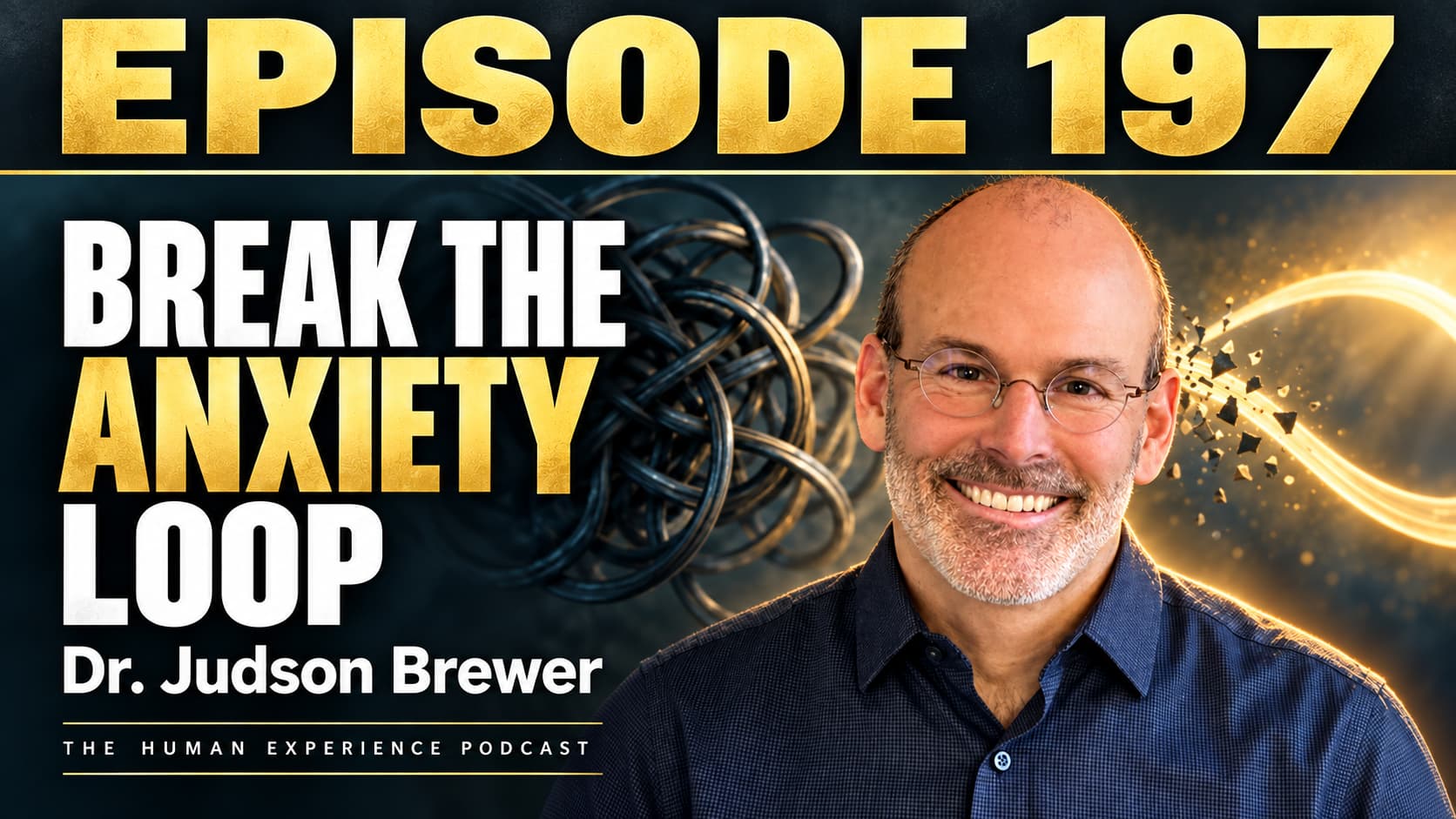
EPISODE 197 – Dr. Judson Brewer: The Anxiety Trap. How to Break the Loop of Worry and Stress
A conversation with Dr. Judson Brewer
Previously: Episode 196 with Waqas Ahmed on polymathy, AI, and human creativity. Why does worrying feel like solving a problem—even when it keeps you stuck? Dr. Judson Brewer joins Xavier Katana to explore the anxiety loop: how uncertainty triggers worry, why the brain learns to repeat it, and how curiosity can help…
Stay with the full conversation.
Episode field notes
Show notes
Previously: Episode 196 with Waqas Ahmed on polymathy, AI, and human creativity.
Why does worrying feel like solving a problem—even when it keeps you stuck? Dr. Judson Brewer joins Xavier Katana to explore the anxiety loop: how uncertainty triggers worry, why the brain learns to repeat it, and how curiosity can help you respond differently.
Episode 197 of The Human Experience Podcast explores the science of anxiety, habit change, mindfulness, and compassion.
About Dr. Judson Brewer
Judson Brewer, MD, PhD, is a psychiatrist, neuroscientist, and author known for studying how habits form and how mindfulness can help change them. He directs research and innovation at Brown University’s Mindfulness Center and is a professor at Brown. His book Unwinding Anxiety explores how to recognize and work with cycles of worry and fear.
Episode Summary
Xavier and Judson begin with a deceptively simple question: what is anxiety? Judson connects uncertainty about the future with his own experience of panic, then explains how worrying can become a habit that feels rewarding because it creates a temporary sense of control.
The conversation moves from brain science to practical experience. Judson describes mapping a trigger, a behavior, and a result; noticing what worry actually feels like; and bringing curiosity to a craving or anxious sensation. They discuss why trying harder is not always the answer, how to distinguish the possible from the probable, and why returning to the body can interrupt an escalating mental loop.
They also explore meditation, kindness, doomscrolling, research on mindfulness-based approaches, and the difference between compassion and empathic distress. The episode closes with advice for listeners facing anxiety or panic and links to Judson’s work.
What You’ll Hear
- Why uncertainty is central to anxiety.
- Judson’s personal experience with panic attacks.
- How reinforcement learning can turn worry into a habit.
- The three gears of habit change.
- How curiosity changes the way an urge or anxious feeling is experienced.
- Why willpower can falter when stress rises.
- The difference between a possible threat and a probable one.
- How bodily sensations can reveal the effects of worry and curiosity.
- What doomscrolling teaches us about attention and reward.
- How kindness and compassion fit into working with anxiety.
Key Ideas
- Map the loop: identify the trigger, the behavior, and the result before trying to change a habit.
- Examine the reward: notice the actual experience of worrying, rather than assuming it helps.
- Get curious: explore sensations and urges with interest as they unfold.
- Return to the present: use direct experience to step out of imagined future scenarios.
Chapters
All timestamps use the supplied episode audio, including the opening introduction. Select a bracketed timestamp in the transcript to listen from that point.
- 00:00 — Welcome to The Human Experience
- 00:40 — Meet Dr. Judson Brewer
- 01:55 — What anxiety is—and why uncertainty matters
- 02:46 — What happens in the brain during anxiety
- 06:43 — What Judson learned from panic attacks
- 08:55 — How worry becomes a learned habit
- 12:08 — Curiosity and the three gears of habit change
- 16:37 — Why willpower is not the whole answer
- 19:10 — Anxiety, suffering, and the illusion of usefulness
- 21:44 — Recognizing contraction and expansion in the body
- 24:56 — Possible versus probable
- 26:02 — Practical steps for working with an anxiety loop
- 29:26 — The anxious brain and returning to the present
- 33:15 — Meditation and curiosity in everyday life
- 36:11 — Kindness as a way to meet anxiety
- 38:08 — Unwinding Anxiety and Going Beyond Anxiety
- 42:42 — Research, outcomes, and the power of curiosity
- 47:22 — Doomscrolling and attention traps
- 52:21 — Compassion versus empathic distress
- 56:07 — Closing advice for anxiety and panic
- 58:03 — Where to find Dr. Jud’s work
Explore Dr. Judson Brewer’s Work
- Dr. Jud’s official website
- Unwinding Anxiety: New Science Shows How to Break the Cycles of Worry and Fear to Heal Your Mind
- Going Beyond Anxiety — book and preorder information from the publisher
- Going Beyond Anxiety program
- Research and publications
- Dr. Jud’s biography
Resource note: Going Beyond Anxiety is both a program and a forthcoming book. The publisher currently lists the book for April 13, 2027.
Continue the Conversation
Explore more conversations about science, consciousness, and being human at The Human Experience Podcast.

About the Transcript
This transcript was generated from the supplied MP3. Xavier is the host and asks the questions; Judson is the guest. Timestamps begin at the start of the full audio and are approximate. Automated transcription can contain errors in wording, punctuation, names, or speaker attribution; the audio is the authoritative record. Research results discussed here are statements made in the interview and should be read in their original study context.
Read the conversation
Transcript
Welcome to the Human Experience Podcast. The only podcast designed to fuse your left and right brain hemispheres and feed it the most entertaining and mentally engaging topics on the planet.
As we approach our ascent, please make sure your frontal, temporal, and occipital lobes are in their full upright position.
As you take your seat of consciousness, relax your senses, and allow us to take you on a journey.
We are the intimate strangers. Thank you for listening.
Ladies and gentlemen, welcome to the show. We’ve got a tremendous program set up for you today.
Today, we’re talking to Dr. Judson Brewer. He is an American psychiatrist, neuroscientist, author, and researcher, and best known for studying how habits form and how mindfulness can help people change them.
He’s a professor of behavioral and social science and of psychiatry and human behavior at Brown University, where he also serves as the director of research and innovation at the Mindfulness Center.
He graduated cum laude from Princeton University, earning a degree in chemistry and a certificate in music performance.
He then attended Washington University School of Medicine, and he did his doctoral research, which examined how stress hormones regulate the immune system.
He subsequently completed his psychiatry residency at an additional neuroscience and addiction research training at Yale University.
Jud, what a credential list. I mean, it’s awesome. Welcome to HXP.
Thanks for having me.
So let’s get right into it, man. Like, I mean, anxiety affects so much of our lives for so many people.
How do you describe it? How do you deal with it?
Well, I’ve certainly had plenty of anxiety myself, including full-blown panic attacks.
You can look at a dictionary definition, which goes something like, you know, feeling of nervousness or unease about an imminent event or something with an uncertain outcome, which is basically the entire future.
So, you know, that might be helpful or not.
But really, it’s that feeling of nervousness, that feeling of unease.
And there can be a spectrum, you know, where anxiety happens so much and we worry so much that it becomes a disorder or even people can get full-blown panic attacks.
Yeah. I mean, describe that to me when, neurologically, what’s occurring in the brain when a person has an anxiety attack?
Well, there’s a lot going on and I’m not sure that we know all of the mechanisms, but there are certainly a couple of parts of the brain that seem to be talking to each other and some networks.
For example, there’s a brain region that doesn’t get enough airtime.
It’s called the BNST or the bed nucleus of the stria terminalis.
You know, often people hear about the amygdala, which is associated with fear and fear responses, for example.
But there’s a kind of a part of the extended amygdala called the BNST, which seems to be involved in vigilance.
So, when there’s something, you know, when danger is near and we’re not sure if the danger is still around, we’ve got this.
We often have a very adaptive survival mechanism where we’re going to stay vigilant until we know that the coast is clear, so to speak.
And then there’s a part of the brain or a network of brain regions called the default mode network.
Ironically, it’s what we default to when we’re not doing anything.
But that network involves self-reference and we’re thinking about ourselves and we tend to be thinking about the past or the future.
My lab’s even done, we just finished a three-year study looking at how the brain activates when we worry.
And in particular, the default mode network or a region of that network called the posterior cingulate gets really activated when we worry.
Ironically, that region also gets activated when people crave a number of different substances ranging from cigarettes to chocolate to cocaine.
Yeah, so, I mean, okay, so an average person on an average day, they wake up, let’s say they’re feeling anxious about something that they’re about to do.
They’ve got a meeting, a presentation, something that they’re about to do.
What’s going on for them when they have this feeling of anxiousness, nervousness in the brain?
And well, there’s often that bodily sensation of anxiety where we feel that nervousness.
And then that nervousness can actually feed a mental behavior.
And this is where the default mode network seems to get activated when we start to worry,
when we worry about the future.
That seems to be particularly associated with activation of the posterior cingulate cortex.
Okay. So, I mean, what do we do when a person is having an anxiety attack?
Is it different than just having normal anxiety when it moves to an attack?
Well, it depends on what you mean by anxiety attacks.
Somebody can certainly be feeling increased anxiety.
And that may be what commonly is described as an anxiety attack.
And that’s probably, it’s different than what’s described as a panic attack when somebody’s,
you know, this wildly unthinking behavior happens when somebody feels like, you know,
literally, and when I’ve had panic attacks, I feel like I’m dying.
You know, literally thought those thoughts are going through my head.
You know, this feeling of impending doom.
We get this tunnel vision, you know, feel short of breath, all these things.
So that’s kind of at the far end of the spectrum.
But I think more generally speaking, when somebody has something like an anxiety attack,
or let’s call it increased anxiety, it tends to be this ramp up of these feelings of nervousness,
this feeling of, you know, can’t stand still, have to do something.
And that’s, you know, that kind of feeds this cycle of worrying, oh, no, oh, no, oh, no,
which feeds back and drives more anxiety.
So you’ve spoken publicly about experiencing panic yourself.
What did panic teach you that your medical training hadn’t?
Well, I would say panic, when I’ve had panic attacks, they taught me that the, you know,
the criteria that I learned in residency, in my psychiatry residency, were actually pretty true and accurate.
You know, it was hard to really understand what it was like for somebody to have a panic attack.
I could read the symptoms, and in particular, this feeling of impending death, like I’m dying.
So it taught me that, you know, the description is actually pretty accurate.
I mean, that’s hardcore.
So what distinguishes that line between generalized anxiety and the attack itself?
Well, I would say generalized anxiety is this, when somebody is basically just worrying all day,
and having that feeling of nervousness and being on edge all day.
So that’s something, you know, people can generally function when they are, even if it’s not very well,
when they’re having, you know, they’re feeling heightened anxiety.
With a panic attack, it’s hard to do much at those moments, besides just kind of feel, you know, feel like you’re frozen.
Your book begins with this idea that there was nothing wrong, and that was the problem.
What is a form of suffering that you were trying to name in that instance?
Yes, in the Going Beyond Anxiety book, I’m talking about something that is even, it’s even more prevalent,
where, you know, in modern day, there’s, you know, often people are, you know, very safe in safety of their homes.
And this story that I start with is somebody on a Saturday night, a woman in her 40s, who, you know, there’s nothing wrong.
In fact, everything’s going right for her.
She’s about to purchase a home, and yet she is kind of stuck in this dread that she can’t shake.
So, I mean, what would falsify the material claim that anxiety is maintained through reinforcement learning?
I haven’t, you know, I’ve actually found more evidence that it is supported through reinforcement learning than it’s not.
And so, just to give a little bit of history here, there was a paper that was published back in the 1980s that kind of got buried in the lead of the promise of Prozac.
It was written by a psychologist named Thomas Borkovec, and he suggested something that seemed kind of radical at the time.
And he said that anxiety could be driven through negative reinforcement.
And another way of putting that is that anxiety could be driven like a habit.
Now, I never learned that in medical school or residency, but when I was really struggling to help my own patients with anxiety, it was, you know, I went back and looked at the literature like, you know, a good scientist.
I guess, and found this paper and had this aha moment because I realized, oh, wait a minute.
Well, I’d seen some of this, you know, these pieces in my patients.
And so I wanted to see if that was actually true.
So I started mapping out these habit loops around anxiety with my patients.
And the way any habit loop forms is through it needs three things, a trigger, a behavior, and a result.
So the trigger in the case of anxiety is the physical experience or those feelings of anxiety, that feeling of nervousness.
The behavior in this case is the mental behavior of worrying.
And then the result in the case of anxiety is that people, it gives people this illusion of control, you know, and it feels, you can think of it this way.
It feels better to do something like worry than to do nothing and just kind of wallow in the feelings of anxiety when we don’t have the mechanisms to cope with it.
And what happens in that case of anxiety triggers the behavior of worrying, and then it, you know, it has this rewarding quality to it because it feels like we’re doing something that feeds back so that the next time we feel anxiety, we worry more.
And it becomes this very, you know, unvirtuous circle where they drive each other.
And that’s exactly what I started to see in my clinic.
This was probably 15 years ago.
And then started to develop programs to see if we could actually target that mechanism itself.
So, you know, the hypothesis was put out there a long time ago.
And then we went and tested that hypothesis through, you know, rigorous clinical trials.
And that supported the fact, you know, the suggestion or that hypothesis that anxiety could be driven through reinforcement learning.
We haven’t found anything that falsifies it yet.
And I would say, you know, when I work with patients in my clinic, I see this all the time.
And so, you know, it gives more evidence that supports it than refutes it.
Yeah.
I mean, you talk a lot about curiosity in your work.
And your approach involves noticing an urge, investigating the experience, how it feels in the body, what the behavior actually delivers, and then whether that payoff matches expectations.
So you’ve got this three gears framework.
Can you explain that framework to us?
Sure, sure.
Sure.
So that first gear, you can think of this as, you know, riding a bicycle or driving a car, where we need different types of gears to get us moving.
And so the thing that really gets us moving from a standstill or even moving from, you know, moving backwards.
So if you think of being stuck in one of these anxiety loops is going backwards, what can help us stop in reverse direction is noticing that we are in that loop.
And so noticing and just mapping out the feeling of anxiety, the behavior of worrying, and then starting to see what the results are.
That’s what I think of as first gear.
And it’s relatively straightforward for anybody to be able to do that.
In fact, we have a free habit mapper on my Dr. Jud website that anybody can download and use.
And that’s something that I use in my clinic and that we offer for folks in our Going Beyond Anxiety program so that anybody can just start to map out these habit loops.
It takes, you know, a few seconds.
And in fact, we can simplify that first gear process to just noticing every time we’re doing whatever the behavior is.
So in this case, with anxiety, it’s worrying.
So you just stop yourself in that moment, engage some level of curiosity in why you’re doing what you’re doing?
Is that what you’re saying?
The why actually can get us into another habit loop.
So this isn’t about why, it’s about what.
What am I doing right now?
And the what is whatever the behavior is, which tends to be worrying.
Now, the reason I mentioned that why can be a trap.
And in fact, in my previous book Unwinding Anxiety, I wrote an entire chapter called the why trap because I’d seen this so much in my clinic that we can get because we can get stuck in these loops of why.
Like, why am I anxious?
Why am I anxious?
And we start looking for the reasons that we’re anxious often in, you know, looking back at our past, our history.
But the fact that we are in a habit loop is more important than whatever set it off.
Okay.
Okay.
So, you know, so there are these reoccurring habit loops and you say stay away from the what and go into the why?
Stay away from the why and go into the what?
Okay.
How to reverse it.
Yeah.
The why is a dead end.
Okay.
And why is what so important?
Well, the what helps us recognize that we are in a habit loop.
Habits by definition are things that we do automatically.
A lot of people don’t recognize how much of their day they spend worrying.
And so it’s important to start to wake up to the fact, oh, I’m worrying again.
Oh, I’m worrying again.
That’s where that curiosity comes in so that we can start to see how often we are doing the behavior.
So what does curiosity look like in the 30 seconds when someone desperately wants like a cigarette or food or needs reassurance?
Well, that curiosity can come in and flip.
So the examples you gave tend to have this quality of, oh, no, right?
Oh, no, I have this craving for something.
Oh, no, I have this urge to do something.
Or, you know, simply the oh, no of worrying.
The curiosity, we can train people to bring in that curiosity and flip that oh, no to oh.
And the idea is to move it from getting stuck in that behavior to really getting curious about what the physical sensations feel like in the present moment so that we can start to step out of the loop.
So that looks like this where we’re like, oh, no, I’m, you know, this or that.
And it’s like, oh, what does that urge feel like in my body?
Or, oh, where do I feel anxiety most in my body?
Is it more on the right side or the left side?
What’s something that people most misunderstand about this anxiety loop and anxiety itself?
I would say one of the things people most misunderstand is the idea of, you know, this why am I anxious?
And they try to fix it.
Another thing that they most misunderstand is that they can think their way out of anxiety.
You know, we can’t think our way out of a paper bag, most humans.
And so we get we waste all of this energy, you know, trying to fix or solve a problem when it’s really about understanding how our brains work so that we can learn to step out of these habit loops.
I would say another thing.
There are several things that people struggle with.
Another thing is related here is this myth of willpower, where they think if they can, you know, if they just have more willpower that they can power their way through worry or anxiety.
You’re a segue artist.
That was literally my next question was going to be that, you know, you argue that willpower is weak and the brain is strong.
What’s the difference that you’re making there?
Yes.
So there’s this story that is out there pretty, you know, pretty prominently in the world that we are beings that have willpower and that willpower is how we get things done.
Well, unfortunately, there’s little to no evidence for willpower from a neurobiologic perspective.
There are no brain regions or networks that have been linked to willpower.
And the studies that have been done around, you know, the concepts related to willpower, the most common one is called ego depletion, where people feel like they have the most willpower in the morning.
And then that gets depleted throughout the day and then they can’t they can’t avoid or or control themselves from eating that proverbial cookie at night or worrying at night.
There’s really no evidence suggesting that it’s true.
Now, where the evidence is and is very strongly supported is that the brain has this process called reinforcement learning.
And in fact, that process is evolutionarily conserved all the way back to the sea slug.
That’s why I say the brain is strong, because that’s a pretty well-known process.
Eric Kandel got the Nobel Prize back in the year 2000 showing that that evolutionarily conserved process and how we form memory.
Is there a link between prolonged anxiety and suffering?
What’s the distinction there?
Well, I would say there’s a link between any type of anxiety and suffering.
So when nobody I’ve never had a patient come to me and ask, hey, doc, how can I how can I become more anxious because it feels so good?
You know, anxiety is basically this fear of the future.
And it’s you know, it doesn’t feel good.
Fear is not supposed to feel good.
Fear as a you know, is a very helpful survival mechanism in the present moment.
But fear of the future is very much an evolutionary bottleneck because we can’t protect ourselves or run away from danger when it’s not actually right in front of us.
So is there a time where anxiety can be good?
There is no evidence to date that anxiety is helpful at all. In fact, there’s research showing that there’s an inverse relationship with the level of anxiety and performance at work, for example. So the more anxious somebody is, the worse they perform.
There are certainly some myths around anxiety being useful, and it’s important to dispel those. I think those, you know, one of the caveats to the internet. There was a study in 1908 in Japanese dancing mice, I kid you not, where they measured arousal. So you can’t ask mice if they’re anxious. They measured arousal.
And somehow that got perverted, I guess. I don’t know if that’s the right word or misconstrued somewhere in the 50s. And then, you know, this kind of took hold on the internet where there’s this inverted U-shaped curve called the Yerkes-Dodson Law. It’s more the Yerkes-Dodson lore suggesting that some level of anxiety is helpful. In fact, there’s no level of anxiety that is helpful.
Okay. So how did you make that determine? I mean, is this something that your research has shown that no anxiety is helpful?
I’ve certainly seen that in my clinic. And there have been people that have, you know, done a lot of research showing this inverted relationship, meaning this inverse relationship, meaning showing that the more anxious somebody is, the worse they perform.
Anxiety also has been linked to, I mean, psychologically, it doesn’t feel very good and it can decrease our mental health, but even affects our physical health as well.
You use contracted and expanded as bodily clues. What are those? What do they mean?
Mm-hmm. So we’ve done some research just asking people a simple question without even defining these terms. And I think anybody can do this experiment themselves.
Let’s take anxiety as an example. If they had to put anxiety into one of two buckets, you know, if they had to put anxiety into one of two buckets, whether it feels expanded and open or contracted and closed, they can pretty readily see that anxiety actually feels closed and contracted.
And so there’s this embodied experience of feeling closed and contracted that is kind of a signature of a number of different mental states.
And in fact, you know, we can, there’s pretty good agreement without even having people, we’ve done this in hundreds of people now, people will self-report pretty clearly that things like frustration, anxiety, those feel closed and contracted.
And then mental states such as curiosity, kindness, connection, all feel more open and expanded. And people can use this as a marker just to notice kind of how caught up they are in an anxiety habit loop in any one moment.
So it’s something that the body feels that you’re contracted or expanded and it’s a feeling that you experience in your body?
Yes.
Okay. So, so what is false control and why does planning sometimes soothe uncertainty while other planning feeds it?
Well, it depends on the type of planning that we’re doing. So our brains are these prediction machines where they’re trying to predict the future and that’s done because it helps us survive and also helps us get through our days in our lives.
So, you know, generally when we’re planning something like our day or a trip or an event, that planning can be very helpful.
From a standpoint of anxiety, when we get into, when we start adding a little bit of commentary on top of the planning where it’s like, oh no, I wonder if this is going to happen.
Oh no, I wonder if this will go poorly. When we start to get into these loops of worrying where it seems like it’s planning, but it’s actually going over the same thoughts over and over and over, which tend to be more related to like, is this going to go well or poorly?
And that’s where it, that planning flips into worrying and is unhelpful. And it’s relatively, I, what I’d say to my patients is, you know, if you’re planning something, check, you know, check it twice and just make sure you haven’t missed anything.
Maybe even a third time, if it’s a very complex plan that you’re trying to work out, but then check to see how many times you’re going over that same territory over and over and over without changing the plan or discovering something new, where it’s just, you know, going over that well-trodden territory where you’re worrying about something.
That’s when we have flipped from the helpful planning to the unhelpful worrying.
Okay. And so you, you argue in the book that the possible can be the probable in the anxious brain. What are the differences and how do we distinguish between those two?
Yes. So our brains are not good at doing statistics. Let’s just put it that way. And so the idea is that we will think of the worst case scenario. And if it is possible, we will kind of latch onto that.
Like, Oh no, you know, it’s this, this is, this could possibly happen. And I better do something to make sure I avoid it, you know, to keep me alive, basically, which is different than the probable, which is how likely is this to happen?
Uh, for example, there are a lot of people that have, uh, that are afraid of flying. So it’s possible that a plane could crash, but it’s actually very improbable that a plane is going to crash.
Plane travel is a much safer than driving in a car yet. Most people, you know, get around, uh, driving in cars and buses, uh, every day.
Yeah. So, okay. So let’s just break this down. You know, there’s someone listening to the show right now and they suffer from anxiety all the time. What do you tell them? How do they beat this? What are some steps that we can give people that are actionable?
Yes. I lay out these steps in the, in going beyond anxiety. Also, you know, on a broader sense, uh, laid this out in my first book on anxiety called Unwinding Anxiety. And the idea is, you know, to be able to bring in these gears, you can think of these also as steps.
So the first step or the first gear is to recognize that we’re caught in a habit loop. The second step is to ask a question that might seem counterintuitive at first. And the question is, what am I getting from this?
And what that question does is it actually taps into the reinforcement learning process itself so that we can really see how rewarding worrying is in that moment. And the important piece here is that if we can see that worrying is unhelpful, we start to become disenchanted with it.
We’re less excited to worry in the future because we see that it’s not keeping us safe. And in fact, it’s actually driving more anxiety and that disenchantment, uh, helps us start to step out of the loop.
The third step is really about finding something I call it, finding the bigger, better offer so that we can find something that is more rewarding than worrying.
Now, simply not worrying is more rewarding than worrying itself. So it could be as simple as just worrying less. That’s already more rewarding.
But on top of that, we can start to inject this curiosity. And as we start to build that habit of curiosity, and we talked about this before, where we can turn that, oh, no, of worrying to, oh, what does this feel like in my body?
And it helps us start to ground ourselves in our present moment experience rather than being lost in the future.
And so we can start to recognize just how much better it feels to be curious than worrying.
And so our brain will start to gravitate toward curiosity instead of being stuck in these habit loops of anxiety and worry.
Okay. So to, to break that down, a person that stops, sees what they’re feeling in their body and then what?
Well, the nice thing is that it’s, that’s all there is to it. And you might sound simple, but not necessarily easy. But the idea is if we’re worrying, we can step out of a worry habit loop in any one moment. And by grounding ourselves in our present moment experience, we have stepped out of the loop.
So it might pop back up again, and we can just repeat the process.
Okay. Okay. So why is relief rather than pleasure such a powerful reward for anxiety habits?
Well, it’s often much of a relief to just step out of a habit loop of worrying. It’s tremendously, you know, cognitively taxing. It takes a lot of energy away from us when we worry. And so simply, you know, stepping off that worry treadmill can feel like a relief. And I would have to say, you know, it feels much more pleasant than worrying.
Your book emphasizes the bed nucleus of the stria terminalis or the BNST. Where does that explanation illuminate anxiety? And what region of that network is a problem?
Yes. As I mentioned at the beginning, the bed nucleus of the stria terminalis is part of the extended amygdala. And what it is seems to be associated with is this vigilance process. And that vigilance kind of gets stuck in the on position driven by
The mental behavior of worrying associated, which is associated with the default mode network. And so the BNST, when functioning properly, is actually a very helpful part of the brain, you know, where we’re going to be vigilant when there has been danger in the area to make sure that the coast is clear.
But it’s supposed to turn off when, you know, when danger is no longer there. When we are anxious and when we worry, that just keeps that vigilance process going and keeps that brain region activated.
Okay. So when you say that anxiety can take the prefrontal cortex offline, what’s the reason for that? Why does that happen?
It’s unclear why it happens. It is linked to the fact that the prefrontal cortex is the youngest and the weakest part of the brain from an evolutionary perspective.
So from a heuristic standpoint, you know, I don’t know if this is science. I don’t think anybody has a clear explanation for why it happens. We just know that it happens. There’s a lot of evidence for that.
But it’s possible that, you know, the brain’s going to kind of shut down any processes that are not critical in the moment of survival and thinking and planning, which are where the prefrontal cortex seems to be most associated are very slow processes.
So, you know, it’s going to kind of shut off those processes that are slow and not helpful for an immediate survival reaction. So it can really dedicate resources to what needs to happen right now, which is, you know, do I run away? Do I fight? Do I run away? Or do I freeze?
Okay. Yeah. So it drops a person down into this sort of fight, flight, freeze mechanism?
Yes, that tends to when there is danger in the, you know, in the area when we’re in danger. That’s what our bodies do. They either fight, they run away, or they freeze.
And in an anxious person that is misconstrued or maladapted, there’s something kind of triggering the wrong areas of the brain?
And then when somebody is stuck in anxiety, this is where they’re stuck in this vigilance or even hypervigilant state. And so they’re constantly on edge looking around for danger. But the problem is that they’re looking for danger in the future, but you can’t protect yourself from something that might happen in the present moment.
So how does a person bring themselves into the moment when they’re experiencing this anxious reflex?
And this is where curiosity becomes that superpower. So we, my lab has done studies with a mindfulness practice called noting practice, where we can start to ground ourselves in the present moment by noting what our experience is in any one moment.
So we can note what we’re seeing, we can note what we’re hearing, we can note what we’re hearing, we can note what we’re feeling in our bodies. And that helps bring us to the present moment because we are noting, you know, true present moment experience, things that are happening right now.
How much does meditation affect this process?
My lab and other labs have found that meditation quiets the default mode network.
And so with meditation and even these mind, you know, this mindfulness practice that I just mentioned, it seems to target the default mode network pretty specifically and help it quiet down.
Can you, can you walk us through one habit loop, like a trigger behavior and result and shows us where curiosity changes that loop?
Sure. So let’s use the feeling of anxiety as an example, or we can use something even more severe like panic attack.
So if somebody has had a panic attack, they might start to feel anxious and worry that they’re going to have a future panic attack.
And that, that worrying is going to drive them, you know, make them avoid situations where they’ve had that panic attack in the past. So there’s the result.
Maybe another example would be just the simple experience of anxiety. So we, a lot of my patients wake up in the morning and they feel anxious.
So there’s that trigger and then they start to worry. Oh no, you know, could something go wrong or what’s wrong? There’s the behaviors where they’re worrying. And the result is that it actually feeds back and drives more anxiety.
Hmm. Okay. Yeah. I mean that, that makes sense. So you distinguish between interest curiosity and deprivation curiosity. What are the differences?
So deprivation curiosity is very much what it sounds like when we’re deprived of information. There’s this itchy urge to go find that piece of information out. Once we get that piece of information, we’re no longer deprived. We’re back to baseline. And so that deprivation is gone. And then that urge, and you know, think of that itch as feeling like it’s been scratched.
I think of deprivation curiosity is kind of like destination. You know, we’re not somewhere yet, but once we get there, you know, we’re, we’re, we’re finished.
Interest curiosity, on the other hand, is more of a quality of experience of, of, of really just this curious interest in what’s happening right now. So we might be learning something we might be exploring.
Uh, the far end of curious, uh, of interest curiosity is awe when we’re just awestruck by something amazing.
And that in contrast to that itchy, urgy contracted quality of, uh, uh, of deprivation curiosity, interest curiosity feels much more open and expanded.
And we can think of this metaphorically as the journey. It’s not that we’re trying to get somewhere. It’s not that we’re trying to get some piece of information.
It’s just that we’re enjoying the process of learning.
Hmm. Okay. That’s, that’s interesting. So, so why does kindness change the, the efficacy of this whole process?
It’s a really good question. What I’ve seen a lot in my clinic is that people who struggle with anxiety are just people, people tend to have these habits of, of judging themselves.
And so we can think of self judgment as a habit loop. Maybe we do something that didn’t go as well as we’d hoped. There’s that trigger. We start to judge ourselves. There’s the behavior.
And then that feeling of doing something like, okay, judging myself is going to help me for the future, um, is the result. And that can be rewarding enough that it feeds back so that we get stuck in these self judgment loops.
Well, in fact, self judgment doesn’t solve anything and puts us into a fixed mindset where we tend to beat ourselves up, you know, self judgment, shame, guilt, all these things tend to be these mental states that aren’t so helpful for us.
They certainly don’t help us thrive and flourish. So here kindness comes in is that third gear process is the antidote to self judgment. So when we notice that we’re judging ourselves, we can then, you know, recall a time when we’ve been kind to ourselves or when somebody has been kind to us and we can compare them and see which one feels better.
Kindness, it’s a no brainer. Kindness feels better. And then we can start practicing, uh, giving ourselves a break, cutting ourselves some slack, reminding ourselves, you know, sometimes things are hard and they don’t always go as we hoped.
But when we bring that kindness in, it can actually open us up into a growth mindset so we can learn from situations that might not have gone as well as we’d hoped instead of getting stuck and beating ourselves up over them.
That makes a lot of sense. You know, just engage that kindness aspect of yourself and it kind of erases all that judgment that we usually partake in.
Yes.
So, um, why did you, why did you need to write the book after unwinding anxiety you wrote going beyond anxiety? What question did the earlier book not answer that you felt like you had to write the second book?
Well, the first book came from my research on treating anxiety as a habit. And it was hard for me to believe as a scientist, you know, whether treating as a habit would actually work. So we went and did the clinical studies. We developed a program for anxiety and treated it through targeting that mechanism of reinforcement learning.
And we got these gangbuster results in a randomized controlled trial of people with generalized anxiety disorder. We got a 67% reduction in generalized anxiety disorder, uh, seven scores. This is the clinically validated measure versus 14% of, uh, in the group that got their usual clinical care.
Now just pause with that for a second, 67% versus 14%. If that were a medication, you know, and I developed that medication, I’d be a gazillionaire right now because, you know, there’s no medication that works that well.
You know, often, you know, people are like, well, what about taking a benzodiazepine or drinking alcohol? Well, those can temporarily numb us from these habit loops, but they don’t actually fix them.
We went on to show mechanistically how it works. And even, um, in, so from a behavioral standpoint, found that we could get a 64% remission rate. So where people no longer met the criteria for generalized anxiety disorder versus only 3% in the control group.
So that was all well and good. And I was going on my merry way, you know, in my clinic, uh, teaching my patients, this methodology. And I would, you know, typically just, just try.
I discharged them from my clinic when they got back to baseline. It was much better than flailing and not being able to help my patients.
Then I don’t even remember when this happened, but somebody said, well, instead of discharging me from your clinic, could we actually use these techniques? Could we keep going?
It never occurred to me. Most of medicine is really sick care. It’s not wellness. It’s like help reduce the symptoms, discharge somebody, and move on to the next.
Well, if I started to broaden my perspective toward helping people thrive and flourish, it was a good question to ask.
I started figuring out how to do a rapid induction of this three-gear process. We get people back to baseline pretty quickly.
Then from there, provide this platform, this launching pad, where we could use the same tools and the same techniques to help people thrive and flourish.
So first off, help people apply these gears in a bunch of different settings in their everyday lives where maybe it’s health anxiety, maybe it’s stress about the news, maybe it’s procrastination.
A number of different things that I can do to help my patients with those things.
And then even apply this to helping people develop.
You think of these as pro-social or pro-health or even flourishing skills.
So helping people with build these positive habits of kindness, of generosity, of gratitude, of humility, of integrity, and even self-transcendence.
And so I started doing that, even developed a clinical program or a program actually for anybody with anxiety that is called Going Beyond Anxiety where people can use an app-based training to learn these skills.
And we started looking to see how it was helping people.
And then I wrote the book Going Beyond Anxiety based on this.
So for people that like to use a systematic program, they can go to the app, Going Beyond Anxiety.
But if people like to read books, they can get the whole range of being able to first rapidly move back to baseline, but then apply these skills and then thrive and flourish.
And I have to say, doing this work in my clinic over the last five years has been so fun.
It’s been tremendously rewarding because it turns out that people can really use these tools to thrive and flourish.
You know, even get into some of these peak experiences like flow.
Yeah, that 67% reduction in anxiety is huge.
And we’ll definitely make the links to all of your programs available in the show notes.
I mean, Jud, the time flew by.
We’ve got about 18 minutes in the main episode left.
What’s a question that you would want more interviewers like me to ask that you don’t get asked?
It’s a great question because I think you and I have covered a lot of territory.
So the question that I would love to be asked more of is, you know, how is curiosity a superpower?
Or let’s put it this way.
How is curiosity magic?
Okay, so answer that.
Yeah.
How is curiosity magic?
Well, what I would say is, you know, as we were developing this Going Beyond Anxiety program, really, for the last decade or so, a lot of my patients have been asking me about how I could help their anxious children or their anxious teenagers.
And actually wrote a chapter in the book, going beyond anxiety, about, you know, how anxiety can be passed down generationally.
And it has more to do with modeling than genes.
And so we started playing with this idea of magic.
You know, to me, curiosity feels like magic because it is so powerful.
It can really help to, you know, think of it as break spells.
When we’re spellbound with worrying, we can actually break this spell.
So we’ve actually been playing with developing a game for young adults and for adolescents where they can start to externalize these behaviors as gremlins.
You know, instead of like there’s something wrong with them, it’s like there’s this gremlin that cast a spell on you.
They caught you up in the spell of worrying or caught you up in the spell of doom scrolling.
Guess what?
Let’s pull out our wand of curiosity so that you can not only break this spell, but you can cast spells of your own.
You can even raise your shield of kindness.
And in this sense, I truly see curiosity as this magical, magical thing that can really help us, you know, break free from these spells.
Whether it’s getting caught up in a craving to doom scroll again or even just getting caught up in worrying.
And yeah, that’s huge.
I think curiosity being your main sort of point of relief towards all these symptoms is a huge thing for people to learn more about.
What’s something that you think you’ve changed about your thinking over all these experiments and your clinical work and talking to people about anxiety?
What’s something that’s changed in your thinking?
One of the biggest thing that’s changed for me is my thinking about willpower.
And just to give you an example, I started meditating at the beginning of medical school.
And it was the hardest, one of the hardest things that I’ve ever done.
I’ve been put in a lot of hard situations in my life, including medical school and residency and things like that.
And, you know, the simple instruction with meditation was, you know, pay attention to your breath.
And when your mind wanders, bring it back.
It seems pretty simple, but it was hard as all get out for me to do.
I found myself, I went on my first seven-day silent meditation retreat was back in medical school.
And by day three, I was crying uncontrollably on the shoulder of the retreat manager thinking, I can get into medical school, but I can’t pay attention to my breath.
And I had grown up with this Western notion that willpower was everything.
You know, I just need to will my way into paying attention to my breath.
Well, this was pretty defeating for me and also illuminating in helping me see that willpower really is more a myth than muscle.
And so here, you know, it really helped me wake up to see, okay, willpower is a myth.
Yet, when I bring in this magic of curiosity, it makes it much easier to pay attention to the present moment.
So that was one of the biggest things that I ever learned, you know, related to that.
And I mentioned this before, so I’ll just mention it briefly.
You know, the other big thing that I learned was that anxiety actually could be driven like a habit.
That was really something that was mind-boggling for me until I saw it over and over and over in my clinic and in my research studies.
Okay.
This switching gears just a little bit as we end here, and I’ll keep this short, but doom scrolling seems to be not just a personal habit, but something that is a design product outcome.
What responsibility do you think that these platforms have to reduce uncertainty loops?
And what product change would you recommend first?
Well, yeah, it’s a great question because, you know, relatively recently there have been these lawsuits that these big companies, at least, you know, meted.
And he’s the first to lose a lawsuit, and I’m sure others are figuring out behind the scenes how they’re going to work with these as these lawsuits are ongoing.
So, you know, what I would – the first thing I would do – I mean, it’s, you know, really when the profit motive is to keep – you know, when it’s an attention economy and the goal is to keep people glued to their phones,
it’s hard to say, you know, what’s the first thing that I would do because every design feature is there to keep people addicted to their phones and stuck in these doom scrolling loops.
So, you know, you basically have to dismantle the whole thing.
Now, you can go back to the original – at least the way that it’s, you know, it’s put out there at the public of Mark Zuckerberg creating Facebook and saying, you know, this is a way for people to connect.
And when, you know, at the beginning, it did seem like a way for people to connect.
So, if we go back to some of these basic principles, the first thing I would do is really start to emphasize these pro-social aspects of these social networks.
Instead of having people, you know, have fear of missing out and seeing all these other people’s lives seem perfect, you know, these curated lives from influencers,
it’d be great to really find ways to foster these positive, these pro-social habits of curiosity and kindness.
Yeah, I mean, that makes a lot of sense.
I wish we could do more of that fostering of kindness.
We try to do that here on the show.
So, but, I mean, I wanted to ask you about some of the research trials that you’ve done.
You know, can you name some of the outcomes of a couple trials that you’ve done?
So, I mentioned one of them earlier where we got these gangbuster results with people with generalized anxiety disorder
and we got this 64% remission rate relative to 3% in people who got usual clinical care.
We went on to do some other studies.
For example, in…
People who struggled where worrying was keeping them awake at night. I see this a lot in my clinic where my patients come in and say, Doc, I’m having trouble sleeping.
And I ask them, you know, when they go to bed, their brain just starts lighting up with worry and they worry about this and they worry about that.
And, you know, they generally nod their head. Yes.
So we did another randomized controlled trial in people where worry was affecting their sleep.
And in our program, we didn’t actually mention sleep at all.
Well, we just really focused on the anxiety element because, you know, if that’s the driving force, if that’s the mechanism driving their trouble sleeping, if you target the mechanism, it should help their sleep.
And lo and behold, we actually found big drops not only in anxiety, but also in their sleep problems that were related to worry.
In fact, we did a series of studies within the same study where we could basically replicate our results.
And we got big drops in there as well.
One other study that we just completed, we haven’t even published it yet, is looking at these neural mechanisms of worry.
I mentioned this, I touched on this briefly earlier, where we could bring people in, you know, who had high anxiety, induce a worry paradigm and see how their brain lit up.
And lo and behold, their default mode network was activated.
We saw the same thing in people with low anxiety.
But interestingly, when we brought people in with the meditation history, people who were active, you know, had a lot of experience meditating, they did not light up these brain regions above baseline.
On top of that, we found that teaching people with high anxiety, even, you know, one time, you know, teaching them right before we put them in our very stressful fMRI scanner, we taught them this mindfulness practice.
We found that this noting practice could specifically deactivate this default mode network below these baseline levels in both highly anxious people and people with low anxiety.
And of course, with the experienced meditators, they were the ones that deactivated this default mode network the most.
So, there’s really good news there suggesting, you know, we don’t have to become some monk or nun in a cave and meditate for 30 years to see real brain changes happen.
And we can see this pretty immediately.
Yeah.
I mean, I’m skipping through a lot of the book here, but you distinguish compassion from empathic distress.
What are the differences between those two things?
Yes.
Empathy is about putting ourselves in somebody else’s shoes.
You know, we’re taught in medical school that we’re supposed to, you know, empathize with our patients.
So, if we put ourselves in their shoes, we’re actually going to suffer because patients come to us, you know, this is the sick care system.
They come to us when they’re sick.
And so, if we’ve got to feel into that sickness, we’re suffering just like they are.
And that tends to burn us out pretty quickly.
We’ve done a bunch of studies actually with helping physician and even nurse and residents burnouts that we actually put out a whole series on my podcast of trainings for people to work with this.
And in the first modules, we actually talk about ways where people can notice the difference between putting themselves in somebody else’s shoes and walking alongside them.
Compassion or the root of compassion is compassio, which literally means to be with or to suffer.
Yeah.
Compassio.
To suffer with.
I’m sorry.
To be with suffering.
And the idea is that if we can walk alongside someone, if we can notice that they are suffering, that is enough to awaken our natural capacities to be compassionate.
And that then we can be compassionate.
And the key difference here is it’s about us.
You know, if we get caught up in their suffering, we’re going to have this empathetic distress.
And if we walk alongside, if there’s compassio there, it’s not about us, but it’s just about, you know, touching in with the suffering itself.
That activates compassion.
It’s not about us.
So what would be the most important question in this field that still has no satisfying answer?
Great question.
Well, I would say, you know, there are probably a number of questions there.
But one of them that I would say doesn’t have a satisfying answer is, you know, this idea of how people get so stuck in a habit that they can’t see out of it.
I’ll give you an example.
I had a patient who I’ve been treating recently who really had, I think of it as kind of shiny object syndrome, where, you know, very successful woman in her 30s.
And yet she had pretty, has pretty severe anxiety.
And she, you know, she would just try this and then this and then this and then try all these different things.
And what I, what I really struggle with is when people can start to see, you know, start to understand how their minds work, but they’re so stuck in this habit of doing other things, thinking that it will fix them.
When the solution is right in front of them, what is it about that that keeps them blind to, to seeing, you know, seeing how they can actually step out of this loop themselves.
It is something that constantly baffles me and is, you know, has a slightly different flavor.
I don’t see this a lot, but, you know, every now and then there’s somebody that’s just so, so stuck.
Think of it as stuck in a habit loop of doing something rather than really feeling into their direct experience and learning how their brain works that it’s, you know, it’s, it’s a mind, it’s a head, it’s a head scratcher for sure.
Yeah.
Yeah.
You know, Dr. Jud, we’ve got about four minutes left of the main episode and I’d like for you to bow tie this together because there’s a lot of people out there that suffer from anxiety.
They probably take some sort of benzo to help them with that.
I mean, what do you say to a person who’s suffering with anxiety, whether it’s general anxiety to extreme panic attacks?
What do you, what do you, what advice do you offer them or give them?
I would say the first thing I would say is it’s really critical that you understand how your brain works, you know, full stop.
If we don’t know how our brains work, if we don’t know how our minds work, we’re not going to be able to change these habits.
We’re just going to be stuck in trying the next thing and the next thing and the next thing.
So this is where I would say to somebody, okay, this is how your brain works.
Let’s, you know, habit loop forms through three things, a trigger, a behavior and result with anxiety.
That feeling of anxiety drives the mental behavior of worrying, which then results in this feeling of control or this illusion of control, which then feeds back and drives more anxiety.
The next thing I would say is ask yourself this question.
What am I getting when I worry?
You know, is it solving a problem?
Is it keeping somebody safe?
The general answer is no.
In fact, what they’re getting is that it’s driving more anxiety.
That will help if they can actually feel into that direct experience and see those results.
That’s where they can truly understand how their brain works and they can see, oh, this is, this is the reinforcement learning process.
And in the process, they can start to become disenchanted with the behavior.
The third step is to step out of that habit loop.
And this is where curiosity as magic comes in, where they can learn to bring that, oh, in instead of that, oh, no, and help to break free from the cycle.
I love it.
Jud, where can people find your work and get to your book and the podcast and everything you’re doing?
They can find our program at just going beyond anxiety dot com.
They can also find the going beyond anxiety book at drjud.com or on places where books are sold like Amazon.
And also, we’ve got a bunch of free resources on the Dr. Jud website.
So they can find my other books like the Unwinding Anxiety book, as well as other ways to learn how their brains work.
That sounds great.
We’ll make all of those links available in the show notes below for the main episode of this, guys.
And Dr. Jud has graciously agreed to stay on for our bonus episode, which you can get to by going to the human XP dot com slash membership.
It helps keep conversations like this alive.
We’re going to switch to the bonus episode.
Now, if you’re listening to this, get over to the site, sign up, and you can get access to the rest of this conversation.
Thank you so much for listening.
About the guest
Dr. Judson Brewer
Why does worrying feel like solving a problem—even when it keeps you stuck? Dr. Judson Brewer joins Xavier Katana to explore the anxiety loop: how uncertainty triggers worry, why the brain learns to repeat it, and how curiosity can help you respond differently.

EPISODE 199: Dr. David Nichols — Psychedelics, Consciousness & the Chemistry of the Mind
October 20, 2026 · 1:12:11

EPISODE 198: Cindy Gallop — Make Love Not Porn: Rethinking Sex, Consent & Connection
October 13, 2026 · 58:43

Episode 196: Waqas Ahmed — Polymathy, AI & the Future of Human Creativity
September 28, 2026 · 1:04:41
Episode 195: Dr. Satchin Panda — Circadian Rhythm, Sleep & Meal Timing
September 21, 2026 · 1:09:04

HXP SHORTS: #001 – Deconstructing Death: What Happens When We Die?
September 14, 2026 · 11:37

Episode 194 Dr. James Fadiman – You Are Not One Self: Microdosing, Multiplicity and the Mind
September 4, 2026 · 1:14:38
Independent conversations
Help make the next one possible.
Membership sustains ambitious, unhurried interviews and keeps the complete archive open to curious listeners everywhere.
Become a member